
Equipment guides · 3 min read
Cue Tip Hardness Labels: Why Ratings Are Not Always Comparable
A grade word and a numerical hardness result are different records. Similar words do not establish identical boundaries, and numbers without the same disclosed method cannot be placed on one trustworthy scale. This evidence worksheet helps you ask the supplier the right questions before a tip purchase; it is separate from measuring density or evaluating playing preference.
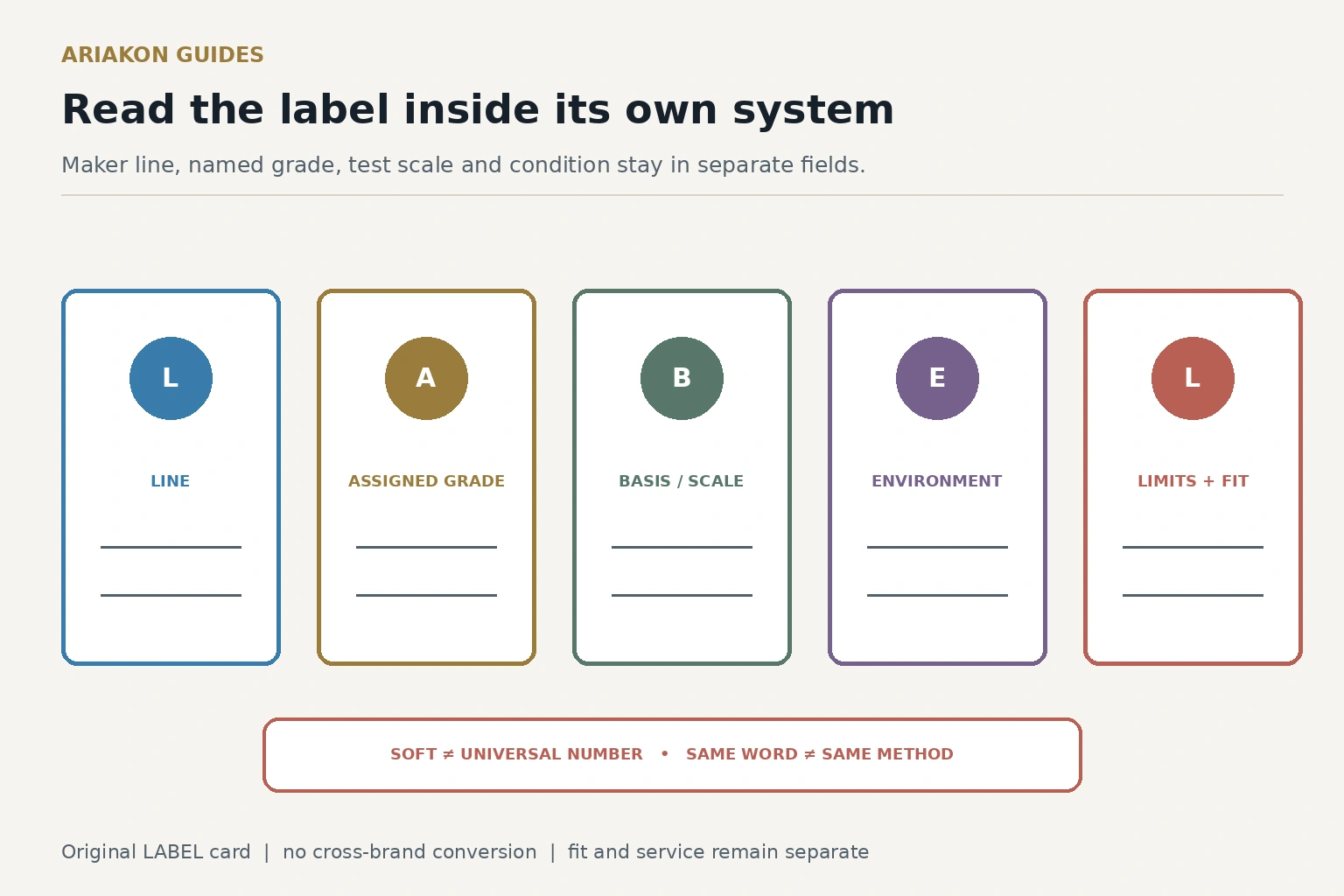
Create one five-field LABEL card for each candidate
If only the assigned grade is documented, record grade only. Do not fill the basis cell with a guessed reading. A label can help select adjacent options inside its documented family without proving that another family’s same word means the same thing. NIST indentation reviews describe the importance of calibration, protocols and analysis; they do not certify a billiards rating chart.
| Field | Required record | Do not replace it with |
|---|---|---|
| L — Line | Exact product family, material description and dated documentation | A general maker reputation |
| A — Assigned grade | Actual grade wording and intended role | Your preferred universal meaning of medium |
| B — Basis/scale | Reported scale, method, instrument and any actual number | A bare number copied from a chart |
| E — Environment | Specimen condition, preparation and documented test conditions | A new/played comparison left unstated |
| L — Limits/fit | Size, support, installation and care permission | A hardness-based fit assumption |
Pass six comparability questions before comparing numbers
Six verified fields qualify a proposed numerical comparison for review; six entries do not make it a laboratory result. One UNKNOWN means the missing basis stays explicit. A table trial cannot repair missing test-method disclosure. Do not press a handheld instrument into an installed tip to manufacture a value without a suitable documented procedure.
| Question | Evidence needed |
|---|---|
| Same property? | Both values actually report hardness, not density or a grade |
| Same scale/method? | Exact disclosed procedure and scale for both |
| Suitable geometry? | Specimen thickness, curvature, support and measurement location documented |
| Same preparation? | New/played state and treatment comparable |
| Conditions disclosed? | Conditioning and measurement timing recorded |
| Measurement quality known? | Calibration, repetition and uncertainty information adequate for the proposed difference |
Work three anonymous records without relabeling a specification
P and Q are placeholders for different disclosed methods in this hypothetical example, not actual test standards or brand specifications. Subtracting 74−68=6 is valid arithmetic but not an established hardness difference across methods. Even when two actual reports use one method, a small difference needs their uncertainty and sampling context before a ranking is justified.
| Record | Available evidence | Bounded conclusion |
|---|---|---|
| Candidate 1 | Grade Medium; no numerical method supplied | A grade choice within that documented line only |
| Candidate 2 | Reported reading 68 under method P; geometry and condition documented | Preserve 68 with its own method record |
| Candidate 3 | Reported reading 74 under method Q; condition missing | Do not compare 74 with 68; both method and condition differ |
Keep density, construction and playing response in other columns
Density is mass divided by volume; hardness is a method-dependent material response. Layer count is construction information, and a player’s feel is an observation on a complete cue. None supplies a missing hardness method. Keep these four categories separate when reviewing a listing or a forum chart.
Write one reader question per conclusion: “Which grade in this line should I trial?” is different from “Which specimen produced a larger comparable indentation result?” Neither establishes more spin or guaranteed longer life. Ask for source details when a chart blurs the categories.
Separate density and hardness for units and a worked mass/volume example.
Review hardness and spin claims before treating a rating as a shot-performance prediction.
Compare leather construction when bond structure, not grade, is the actual question.
Send a complete purchase and service question
The request has four parts: your exact shaft/support system and intended use; the candidate’s exact label; the missing comparability field; and the installation/care confirmation you need. Keep the dated response with the LABEL card. A vendor’s recommendation is documentary advice, not independent measurement evidence.
If the missing information remains unavailable, choose only from established fit, intended use, documented care and a safely evaluated personal preference. Do not invent a numerical equivalent to make the purchase appear scientific. Installation and bond concerns go to a qualified technician.
Use the general tip buying guide for the broader fit, care and ownership decision.
Sources and further reading
References support the specific factual information above. The practical checklists are Ariakon editorial guidance.