
Equipment guides · 3 min read
Cue Tip Density and Hardness: Understand the Difference
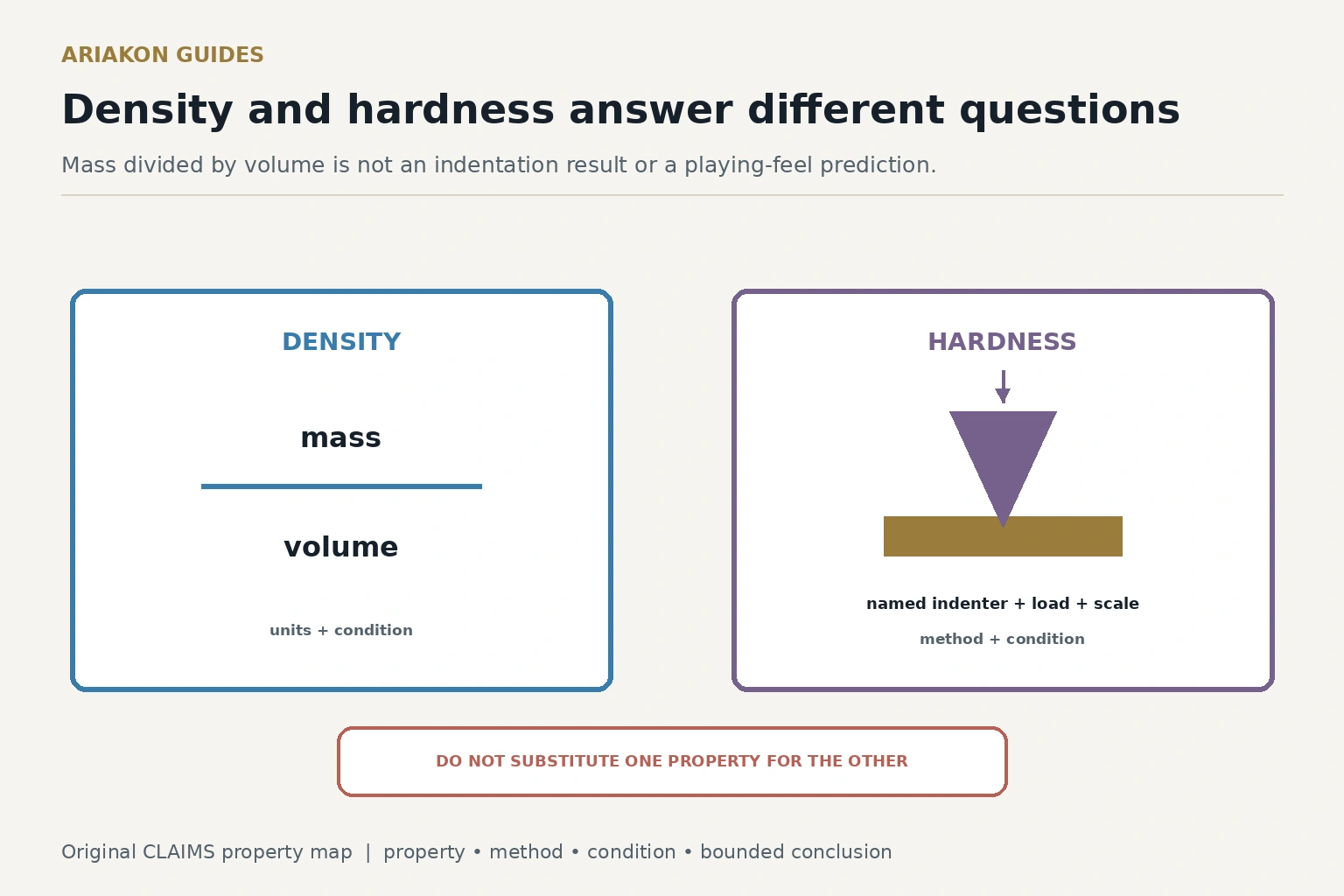
Density asks how much mass occupies a stated volume. Hardness asks how a material responds to a stated test. Confusing the words can turn a precise-looking chart into a false buying conclusion. This property worksheet checks what was actually measured and what remains untested; it does not prescribe damaging an installed tip to obtain a number.
Sort the claim into one of four categories
NIST’s SI tables give mass density in kilograms per cubic meter. Its indentation literature concerns mechanical response and the limits of a specified method. These institutional references support the distinction, not a density-to-hardness conversion for cue leather.
| Category | Required evidence | Cannot substitute for |
|---|---|---|
| Mass density | Mass, volume, units, specimen definition and condition | Hardness test or spin prediction |
| Indentation hardness | Named method, indenter/load or depth procedure, scale and condition | Mass per volume or service-life proof |
| Assigned grade | Exact documented family and wording | Universal cross-family measurement |
| Playing feel | Safe personal trial on a recorded complete configuration | Material certification |
Keep volume definition and units visible
Use densityρ=m/V only when mass and volume describe the same specimen and condition. One cubic centimeter is 1000 cubic millimeters; one gram per cubic centimeter equals 1000 kilograms per cubic meter. Do not divide grams by a diameter and call the result density.
For an ideal flat-ended cylinder, V=π(d/2)²h. An actual domed, tapered, porous, bonded or partly installed tip is not automatically that ideal shape. A bounding cylinder includes space the tip may not occupy, and a whole-cue mass cannot isolate tip mass. Do not cut, sand, soak or submerge a usable tip to make it match the formula. Request a suitable professional or documented method if an actual material result is needed.
Calculate an explicitly hypothetical sample
The useful rounded density is about 1.60 g/cm³, not a long string of justified measured digits. These assumed inputs demonstrate the calculation only. No durometer value, spin advantage or durability result follows. A second sample with the same density can have different indentation behavior; an actual relationship would need matched measurements.
| Input or result | Value | Interpretation |
|---|---|---|
| Diameter d | 14.0 mm =1.40 cm | Radius 0.700 cm |
| Height h | 3.00 mm =0.300 cm | Flat-ended ideal geometry |
| Mass m | 0.740 g | Assumed specimen mass |
| Volume V | π×0.700²×0.300 ≈0.461814 cm³ | About 461.814 mm³ |
| Densityρ | 0.740/0.461814 ≈1.60238 g/cm³ | About 1602.38 kg/m³ |
Show how input limits change the possible answer
Suppose the same hypothetical inputs are bounded by mass 0.735–0.745 g, radius 0.695–0.705 cm and height 0.290–0.310 cm. A conservative minimum uses the smallest mass and largest volume:0.735/[π×0.705²×0.310]≈1.51844 g/cm³. The maximum uses largest mass and smallest volume:0.745/[π×0.695²×0.290]≈1.69293 g/cm³.
Rounded outward, that assumed range is 1.51–1.70 g/cm³. It is an extreme-input bound under an ideal-cylinder model, not a statistical confidence interval or a lab uncertainty report. If the shape model is wrong, these calculations cannot rescue it. A displayed 0.01 g resolution alone does not establish the mass bounds.
Complete six CLAIMS fields before using the result
A complete six-field audit can conclude that density is undetermined or hardness data are absent. Do not transform a maker grade into density, or a mass/volume result into hardness. For buying, keep exact fit, construction, intended use and qualified installation separate from the property claim.
| Field | Question |
|---|---|
| C — Claim | Which property is actually named? |
| L — Lot/specimen | Which exact object and state does the record describe? |
| A — Apparatus | What suitable measurement method and calibration exist? |
| I — Inputs | What raw values, units and volume definition are available? |
| M — Meaning | Does the conclusion stay within that property? |
| S — Scope | What remains untested and who needs to verify it? |
Compare hardness-label evidence when two ratings lack a common documented method.
Choose construction and care when the practical decision does not require a lab property ranking.
Sources and further reading
References support the specific factual information above. The practical checklists are Ariakon editorial guidance.