
Pool ball buying · 4 min read
Compare Pool-Ball Set Features Without Confusing Packages and Performance
Once the table and game requirements are known, the useful question is which exact package supplies a feature you will use. A different color scheme, cue-ball marking or accessory bundle is not automatically a better ball formulation. Compare two candidates field by field, attach a dated source to each statement and leave performance claims unproved until their method is available.
Name one feature that would change your decision
Write the job before opening listings: recognizing numbers on a room camera, observing cue-ball rotation, obtaining a matching spare, or supplying a complete plain set. A useful feature answers that job. Words such as advanced, professional and premium do not identify a measurable improvement.
This is a second-stage package comparison. The general buying guide determines game, ball count and table compatibility first. The consistency guide separately records measurements of a physical set; this worksheet does not certify tolerances or authenticity.
Establish the table and set requirements before comparing packages.
Measure a received set consistently after the purchase decision, with the appropriate tools.
Separate four kinds of difference
The WPA competition equipment reference describes one white cue ball and fifteen numbered object balls at a nominal 2¼-inch diameter. It is a competition reference, not proof that every home or return table accepts the same set. Keep your table requirement separate from that reference.
Preserve units as published. Exactly 2.25 inches converts to 57.15 millimeters. A listing rounded to 57.2 millimeters differs by 0.05 millimeter numerically; that alone does not show a manufactured mismatch, an allowed tolerance or interchangeability. Ask what nominal size and tolerance the actual table and package specify.
| Difference | Useful question | Evidence boundary |
|---|---|---|
| Color and numbering | Can the intended user distinguish the balls in the actual room or camera view? | A visibility trial, not improved rebound |
| Cue-ball markings | Would visible rotation help the intended practice task? | Markings reveal orientation; they are not a spin-rate instrument |
| Package contents | Are the cleaner, spare or training item explicitly included and usable? | An extra item does not change the other balls |
| Material or durability statement | What exact dated record and comparative method support it? | A stated formulation is not an independently verified lifetime |
Fill eight rows for each exact candidate
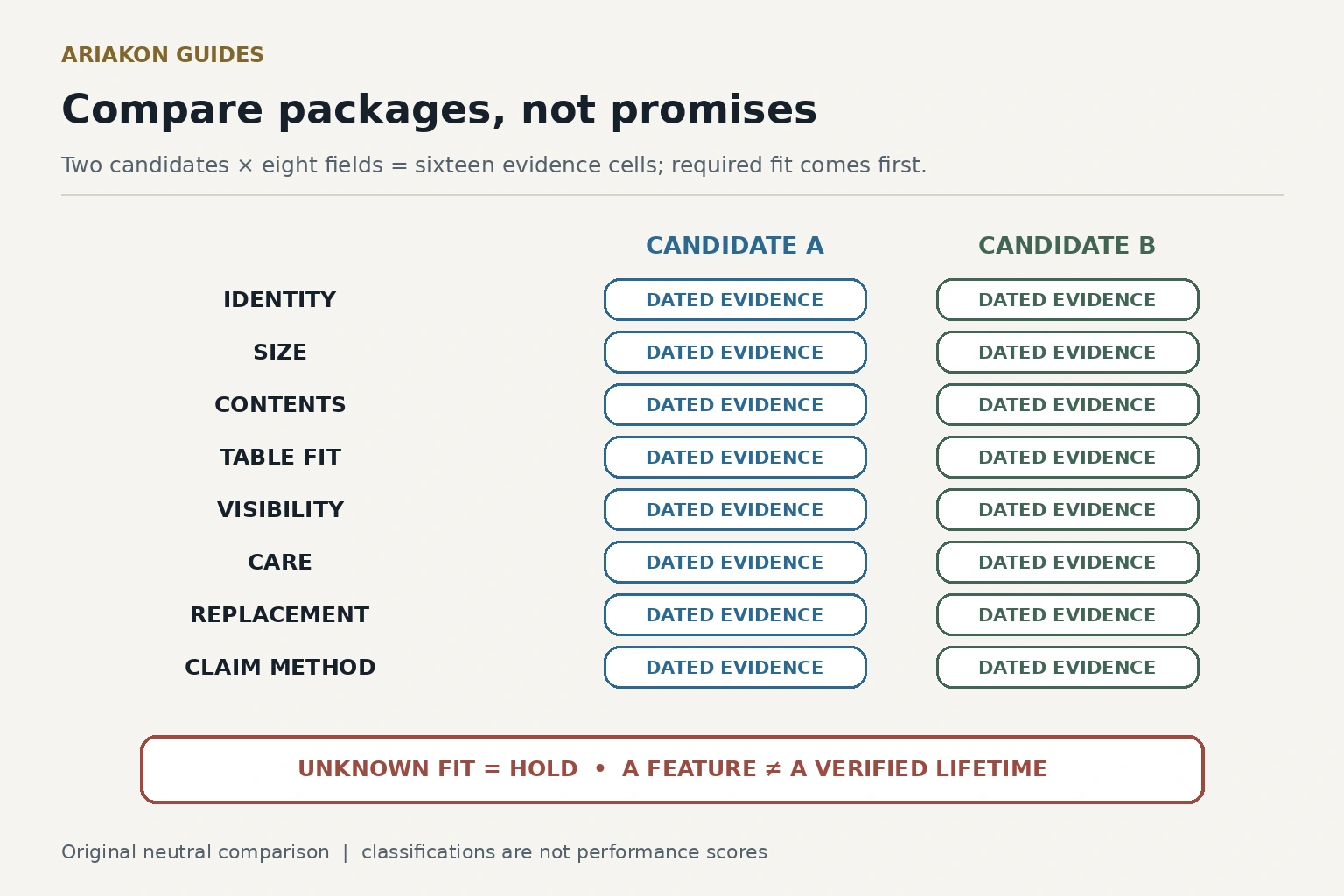
Mark each of the sixteen cells DOCUMENTED, OBSERVED, CLAIM ONLY or UNKNOWN. Attach a document date or observation date. These categories describe evidence, not a numerical quality score. A candidate with more completed cells still fails if its required size, contents or return behavior is unresolved.
Do not move a lifespan percentage into DOCUMENTED merely because it appears on a current page. The wording can be documented while the comparative outcome remains CLAIM ONLY. Keep the claimed property and the verification method as separate statements.
| Field | Candidate A / dated evidence | Candidate B / dated evidence |
|---|---|---|
| Identity | Exact set, variant, package date ___ | Exact set, variant, package date ___ |
| Size | Published units, nominal size, stated tolerance ___ | Published units, nominal size, stated tolerance ___ |
| Contents | Ball count, numbering, cue-ball type ___ | Ball count, numbering, cue-ball type ___ |
| Table fit | Operator or model requirement; return check ___ | Operator or model requirement; return check ___ |
| Visibility | Room/camera observation or not yet tried ___ | Room/camera observation or not yet tried ___ |
| Care | Material-specific instructions and compatible supplies ___ | Material-specific instructions and compatible supplies ___ |
| Replacement | Documented matching spare identity or unknown ___ | Documented matching spare identity or unknown ___ |
| Claim method | Test conditions, comparator and result; otherwise claim only ___ | Test conditions, comparator and result; otherwise claim only ___ |
Work a camera-practice comparison
Hypothetical example: a drop-pocket room already has a documented conventional set requirement. Candidate A has a plain cue ball and standard numbering. Candidate B has the same documented nominal requirement but a marked cue ball and a different color presentation. Both have complete written contents; no independent durability method is supplied.
The buyer marks five fields DOCUMENTED, one visibility field OBSERVED, one replacement field UNKNOWN and one performance field CLAIM ONLY for each candidate: 5+1+1+1=8 per candidate, sixteen cells total. A sample camera view distinguishes the numbers in both sets. Rotation feedback is the only remaining useful difference, so the marked cue ball is a preference, not a durability winner.
If the return mechanism were unknown, the table-fit gate would fail before that preference mattered. If only the white ball needs replacing, use the narrower replacement guide instead of purchasing an entire package.
Check a replacement cue ball separately when the task concerns only the white ball.
Close the comparison without inventing a test
A price comparison belongs to the live seller at purchase time. This guide supplies no price, availability, inventory or Ariakon stocking claim. It also supplies no cleaning recipe: the actual material and current care instructions govern.
- Save the exact package description and stated seller terms at decision time.
- Resolve required compatibility and contents; do not average an unknown away.
- Record one useful differentiating feature and the evidence that supports it.
- Keep unsupported performance statements labeled as claims.
- On receipt, compare all sixteen balls with the order, preserve the packaging and quarantine visible damage.
Inspect balls before the next session for a separate short damage check.
Sources and further reading
References support the specific factual information above. The practical checklists are Ariakon editorial guidance.