
Pool ball care · 3 min read
Inspect Pool Balls for Damage Before Practice
A quick pre-session inspection protects the cloth, cushions, other balls and the practice record. The task is triage, not restoration: identify the set, examine each surface, clean only by documented directions, screen the roll, then classify each ball as READY, CLEAN + RECHECK, QUARANTINE or UNKNOWN. Never polish away evidence or declare a ball defective from one slow roll on one table lane.
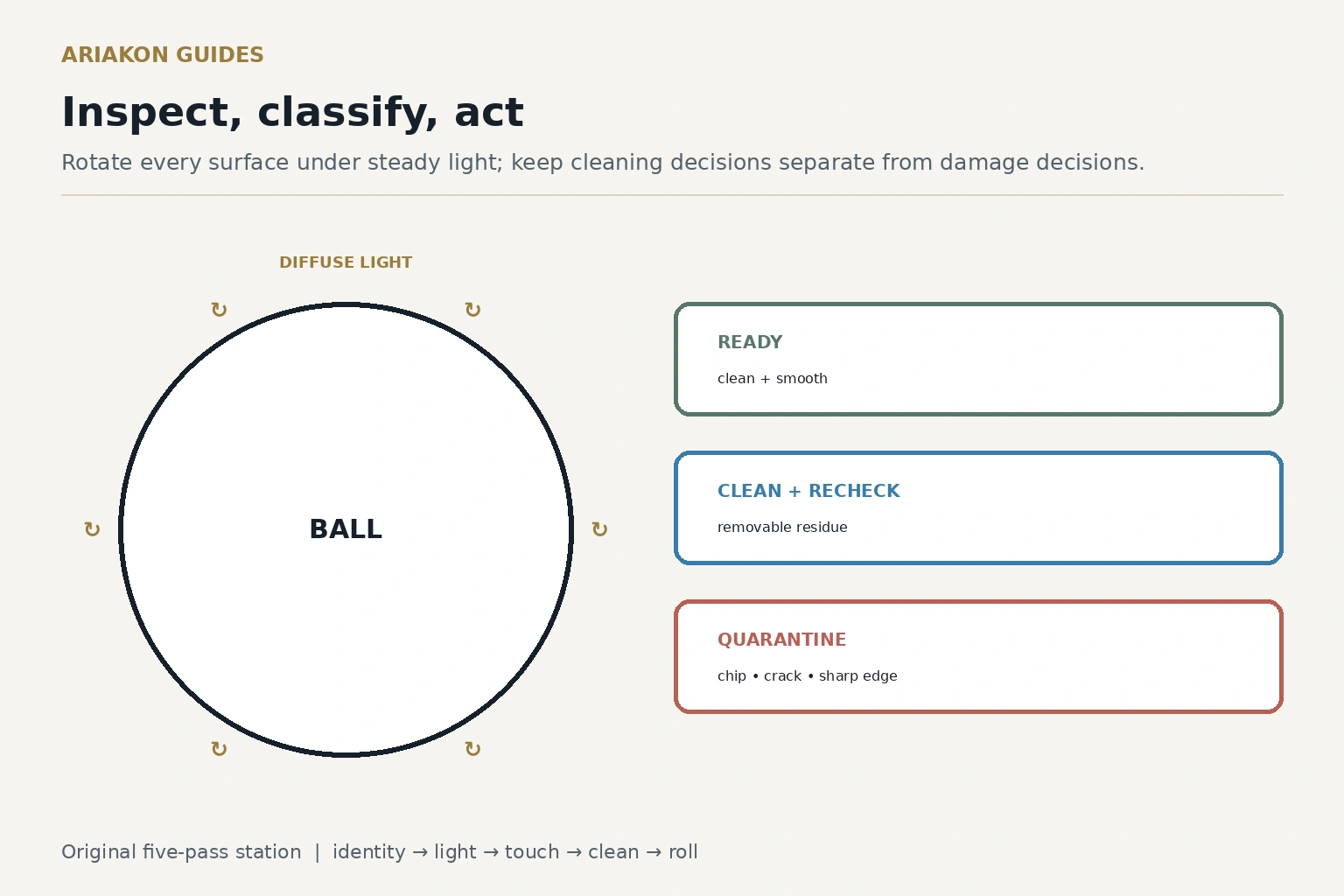
Set up a controlled inspection station
- Use a padded clean mat, diffuse light, a lint-free cloth and the set's storage tray.
- Keep a separate padded quarantine cup or box so a suspect ball cannot return by accident.
- Record set identity, ball number, date and the exact maker-approved cleaning method if known.
- Wash and dry hands; remove rings, watches and hard objects from the work area.
- Do not use abrasives, solvents, household polish or heat without exact material instructions.
Run five passes on every ball
Do not drag a bare fingernail over a defect. Rotate the ball in your hand over the padded mat. Photograph a concern with the ball number and a removable location marker beside—not on—the surface.
| Pass | Action | Record | Stop |
|---|---|---|---|
| Identity | match number and set | present / duplicate / missing / unknown | mixed or unidentified replacement |
| Light | rotate 360° on two axes | residue, haze, cut, chip or crack location | sharp edge or open crack |
| Touch | use a cloth-covered fingertip | smooth / ridge / depression / unknown | skin-catching edge |
| Clean | use exact documented method only | removed / persists / method unknown | material reaction or undocumented chemistry |
| Roll | slow paired routes after cleaning | stable / repeated hop / lane-dependent drift | repeatable hop or impact sound |
Use paired roll routes without overdiagnosing
Choose two clean, level-looking lanes away from slate seams and pocket approaches. Mark centers A1=(2, 1), A2=(6, 1), B1=(2, 3) and B2=(6, 3) in table-diamond coordinates. Gently hand-roll the suspect ball A1→A2 and A2→A1, then B1→B2 and B2→B1. Repeat with one confirmed clean comparison ball.
A concern becomes repeatable when the suspect ball shows the same hop or abrupt change after its starting orientation is rotated, while the comparison ball does not. If both balls drift on the same lane, inspect table level, cloth, contamination or a seam. This screen does not measure roundness or certify tolerances.
Use the table-care inspection routine when more than one clean ball reacts on the same path.
Give every ball one disposition
| Disposition | Observable evidence | Next action |
|---|---|---|
| Ready | clean, smooth; no persistent alarming roll | return to padded set tray |
| Clean + recheck | removable residue or approved-product haze | clean by exact directions; repeat all five passes |
| Quarantine | crack, chip, sharp edge, deep damage or unexplained repeatable hop | remove from play; document compatible replacement or qualified guidance |
| Unknown | identity, material or evidence unresolved | do not experiment; preserve photos and ask for exact guidance |
Work a sixteen-ball example
Initial sheet: 12 READY, 3 CLEAN + RECHECK and 1 QUARANTINE. After the documented cleaning method, two residue-only balls pass every route and return to READY. The third cleaned ball and a comparison ball both drift on Lane B, so that ball also returns to READY and the table lane is flagged for inspection. The chipped ball still has a cloth-catching edge and remains quarantined.
Final sheet: 15 READY, 1 QUARANTINE, 1 table lane to inspect. Practice may continue only with tasks that do not require the quarantined ball. The record does not call the set poor, invent a replacement tolerance or conceal the defect with cosmetic treatment.
Know when to repeat the full check
Run all five passes when a set is new to you, after transport or impact, after an unknown cleaner, or when a persistent surface or roll concern appears. Between ordinary sessions, a quick light-and-touch pass is sufficient unless something changed.
The current international rules describe restoration and ball-set handling for covered play, but they are not a material-specific home cleaning manual. Exact cleaning chemistry and replacement compatibility must come from reliable documentation for the actual set.
Clean and restore pool balls conservatively after the inspection classifies removable residue.
Sources and further reading
References support the specific factual information above. The practical checklists are Ariakon editorial guidance.