
Practice · 3 min read
Choose the Next Pool Skill by the Racks It Costs You
The next skill to practice is not automatically the shot you missed most recently. Record where ten racks actually turned, group those lost opportunities by controllable skill and verify the leading category on a repeatable setup. The general improvement-plan guide organizes a session; this ledger decides what deserves the first focused block.
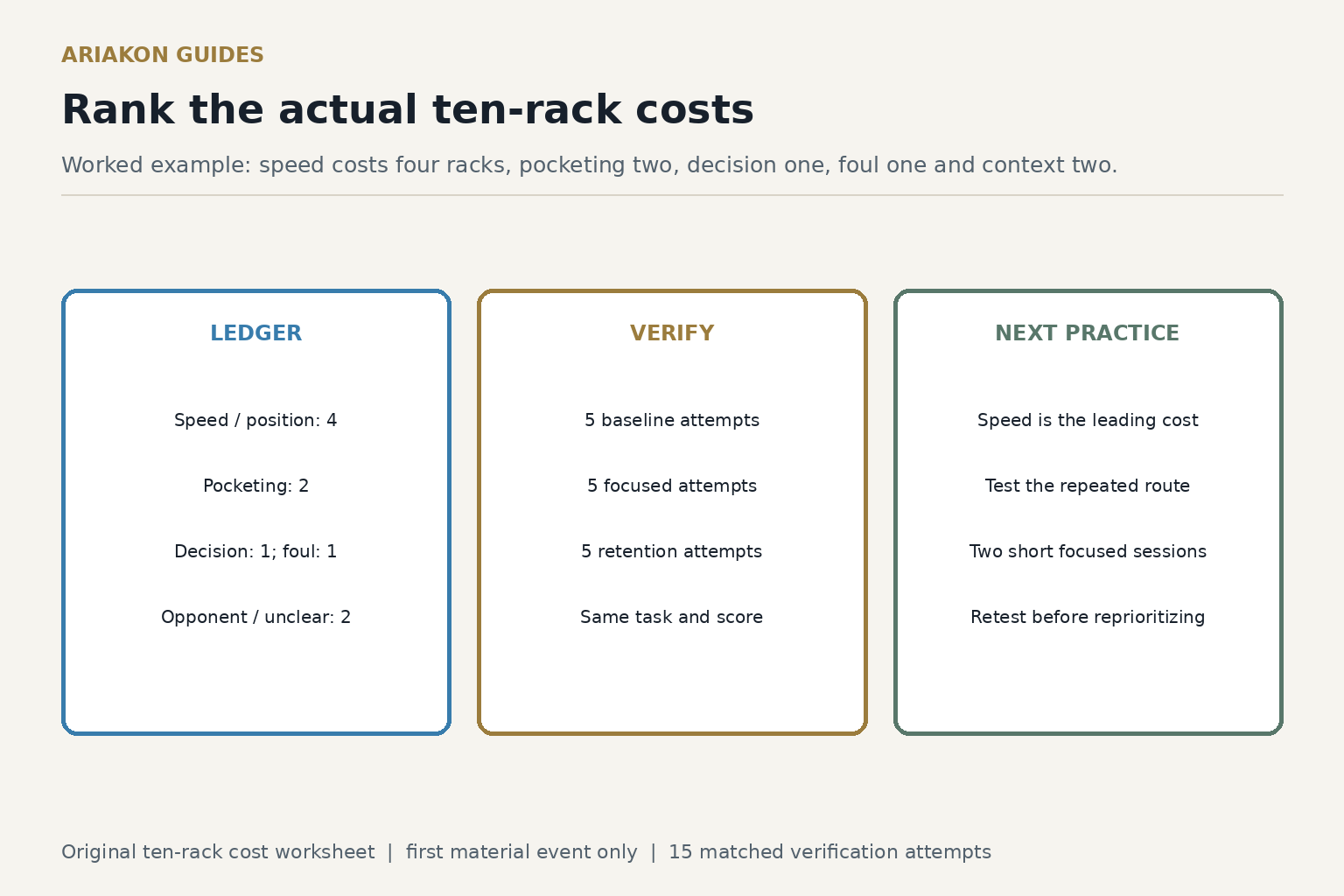
Log the first costly turn in ten racks
Record only the first event that materially handed over the rack or removed a realistic runout. Later misses may matter, but counting every error from one rack can make a single bad sequence dominate the ledger.
Use neutral language. ‘Position finished two diamonds long’ can be tested. ‘No talent’ cannot. Opponent runouts and difficult rolls belong in the context column, not as invented technique diagnoses.
| Code | Costly event | Record |
|---|---|---|
| P | Pocketing | Shot, distance, cut and miss side |
| S | Speed or position | Chosen zone and actual finish |
| D | Decision | Safer or higher-percentage option noticed later |
| B | Break | Cue-ball control, legal contact and next shot |
| F | Foul or routine | Specific foul or skipped routine step |
| O | Opponent or ordinary outcome | No controllable practice claim |
Build a complete practice-improvement plan after the priority is chosen.
Use diagnostic drills to isolate the cause when one label still contains several skills.
Convert the ledger into a ranked cost
Rank first by frequency among controllable events. Break a tie by choosing the category with the simplest reproducible test. Separate pocketing, speed, decisions, break control and fouls before training, so one broad total does not hide the actual task.
| Field | Entry | Why it matters |
|---|---|---|
| Frequency | Racks containing the category | Repeated cost outranks one vivid miss |
| Opportunity | Could the player reasonably practice it now? | Separates useful work from advanced exceptions |
| Control | High, medium or low | Keeps opponent outcomes out of the score |
| Test | One fixed setup | Requires evidence before committing a month |
| Transfer | One rack situation | Connects drill work back to play |
Verify the leader with fifteen attempts
Build one representative setup and mark every ball. Shoot five baseline attempts with no technical change, five focused attempts using one cue or decision rule, then five retention attempts after a two-minute unrelated task. Score the same observable outcome in every phase.
For speed control, award one point for the pot and one for the target zone. For pocketing, record make and miss side. For decisions, use five printed layouts, repeat the same five in each phase and score whether the option is named before lowering. A practice priority survives only if the fixed test reproduces the rack problem.
Worked ten-rack decision
A hypothetical ledger contains four position-speed costs, two pocketing costs, one decision cost, one foul, one opponent runout and one rack with no clear turning point. Speed is the leading controllable category. The player recreates the most common route and scores 3/5, 4/5 and 3/5 target-zone hits across baseline, focus and retention.
The evidence confirms a practice need but not a solved technique. The next two sessions begin with twelve attempts at the same zone. Pocketing remains a secondary note instead of competing for equal time.
Retest before changing the priority
| Evidence | Next action |
|---|---|
| Rack cost and fixed test both improve | Transfer to random racks |
| Fixed test improves but rack cost remains | Test recognition or decision timing |
| Rack cost disappears but test is flat | Keep watching; do not force extra volume |
| Neither measure improves | Narrow the category or seek qualified instruction |
| Pain or unsafe movement appears | Stop and address health or fit before training |