
Pattern play · 4 min read
Choose the Best Contact Point for a Pool Cluster Breakout
The best cluster contact point is not automatically the center of the tied balls or the hardest available hit. It is the point the cue ball can reach after pocketing the current ball while separating the problem balls, avoiding a scratch or hook and preserving a playable next shot. This exercise compares three entry points from one fixed layout instead of judging the breakout only by how far the balls move.
Name five jobs before choosing contact
| Job | Question | Evidence |
|---|---|---|
| Can the entry ball be made first? | Called pocket and contact | |
| Path | Which tangent or rolling line reaches the cluster? | Marked cue-ball corridor |
| Separation | Which tied balls must move? | One-ball-width escape gates |
| Survival | Where can the cue ball scratch or become trapped? | Hazard and safe zones |
| Insurance | Which ball remains playable after contact? | Called next-shot window |
Plan the full cluster before disturbing it when choosing entry balls and insurance balls.
Build one two-ball cluster with entry and insurance balls
First make an original setup card with every ball center, actual legal first ball and pocket, three separately feasible cue arrival routes, insurance-ball pocket and selected finish boundary. Use four object balls overall: one entry ball, two problem balls forming the cluster and one insurance ball.
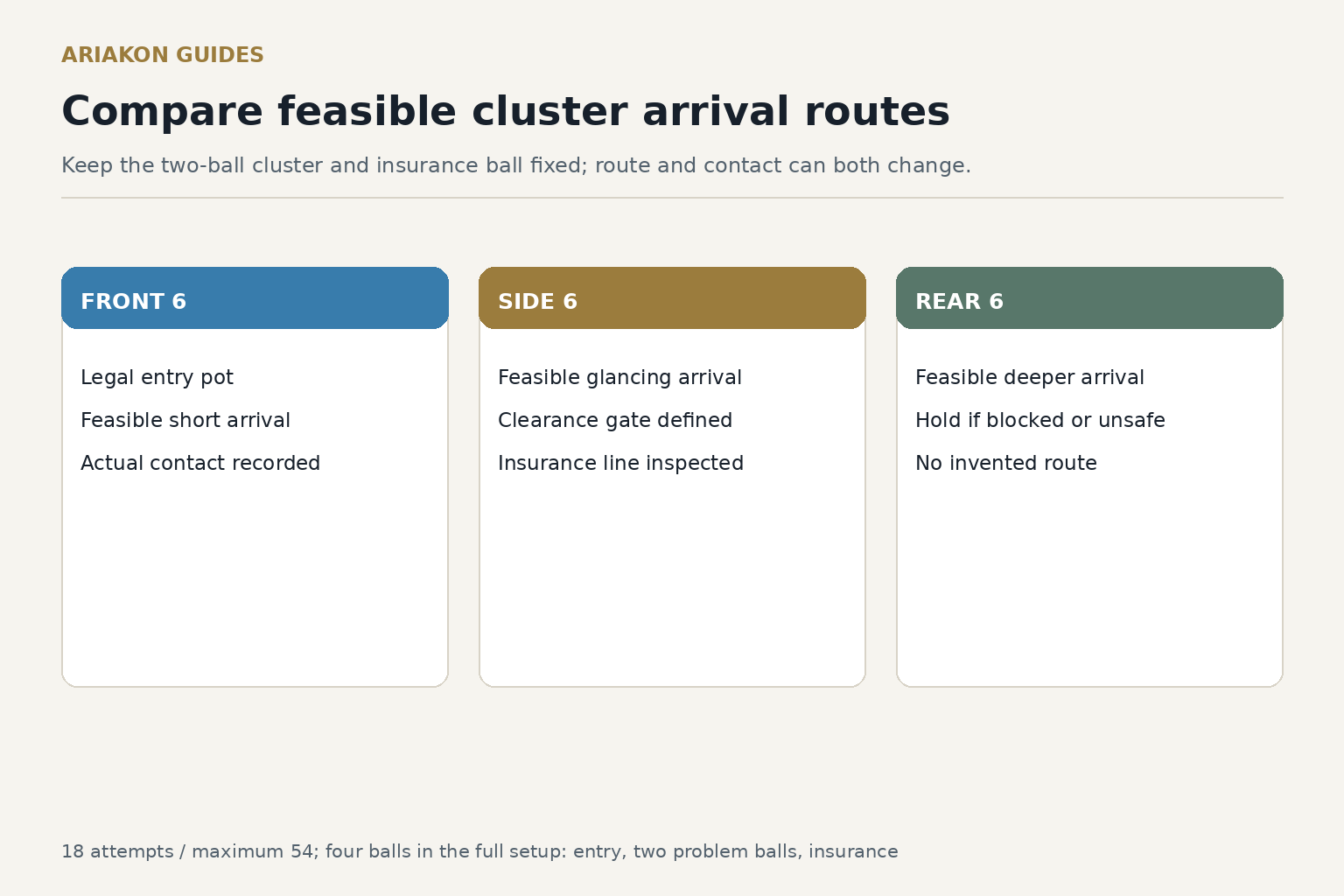
Have a qualified partner verify that all three arrival routes can make the same entry ball legally without requiring a prop, unintended jump or uncontrolled force. Front, side and rear are local labels on that specific cluster. If one is blocked or inaccessible, record not feasible rather than claiming matched trials. No universal position or three routes is promised by the illustration.
The three six-attempt groups compare route/contact choices with the same object centers, not contact point alone: the arrival direction may necessarily differ. Retain each route version, pace and intended contact. This is distinct from the broader cluster-planning guide, which chooses whether and when a breakout belongs in a pattern.
Run eighteen matched breakouts
| Contact | Route intention | Attempts | Main risk |
|---|---|---|---|
| Front | Shortest tangent or rolling path | 6 | Cue ball rebounds into traffic |
| Side | Glancing outside-half contact | 6 | Insufficient separation |
| Rear | Deeper or cushion-assisted arrival | 6 | Scratch or hook before/after contact |
Score the useful result, not maximum motion
| Points | Result | Record |
|---|---|---|
| 0 | Known foul, entry miss or wrong required first contact | End attempt |
| 1 | Legal entry pot; cluster not contacted or separation fails | Record actual arrival or missed cluster |
| 2 | Legal entry pot, intended cluster contact and stated clearance gate succeeds; no usable insurance shot | Record target gate and finish |
| 3 | Score 2 plus actual insurance shot is clear and comfortably reachable | Inspect actual leave |
| Unscored | Required contact, gate or legality hidden | Keep independent known fields |
Choose the best repeatable contact
Eighteen attempts have a maximum of 54 points. A contact point qualifies only if at least five of six entry balls are pocketed, four correct cluster contacts occur and no more than one cue-ball scratch or trap occurs. Among qualifying contacts, choose the highest score; if scores are within two points, prefer the one with the larger miss-safe cue-ball area.
Check the entire postcontact route, including traffic and scratch exposure. A dramatic spread without a next shot is not automatically superior to smaller controlled separation.
Diagnose the first failed event
| Failure | Inspect first | One change | Hold fixed |
|---|---|---|---|
| Entry ball misses | Pocketing line | Reduce cue-ball route demand | Cluster coordinates |
| Cue ball misses cluster | Tangent or rolling path | Change contact route, not force | Entry-ball aim |
| Cluster moves but remains tied | Actual arrival point | Test adjacent side point | Speed band |
| Separation works; cue ball trapped | Exit lane | Choose glancing contact or insurance ball | Do not add power |
Transfer the selected point into a three-ball pattern
Use the selected arrival in a pattern with the entry ball, insurance ball and one freed problem ball. Start five separate innings and continue from each actual leave. Award 0 for a known foul or missed entry pot; 1 for a legal entry pot when the cluster gate or subsequent insurance pot fails; 2 for a legal entry pot, completed cluster gate and insurance pot when the freed-ball pot fails; 3 only for all three legal pots through the required cluster gate. End at the first failed requirement, with at most 15 actual strikes overall and a ceiling of 15 run points. Keep an unresolved required event unscored and retain known observations.
If the breakout only succeeds when the insurance ball is unavailable, the pattern plan is incomplete. Return to the decision checklist and compare delaying the breakout, selecting a different entry ball or playing safe.
Sources and further reading
References support the specific factual information above. The practical checklists are Ariakon editorial guidance.