
Equipment fit · 4 min read
Choose Pool Equipment for Smaller Hands and Shorter Reach
Smaller hands and shorter reach do not identify one special cue. They identify fit questions: can you form a stable bridge, hold the cue without stretching, keep the grip hand on a usable section and carry the case comfortably? Measure those tasks directly and choose equipment around the player rather than a label.
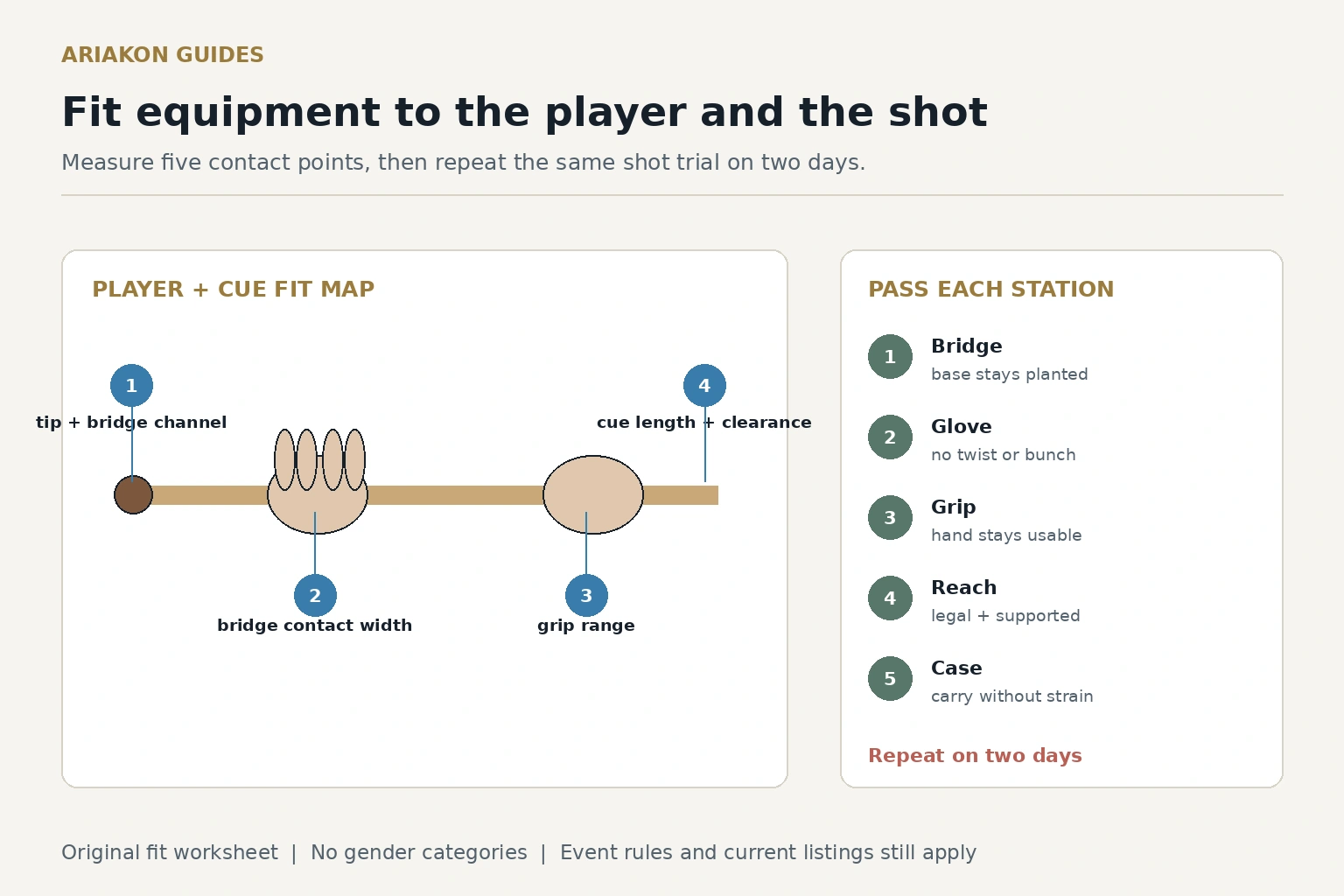
Start with the shots that create the problem
Write down three real situations: a normal center-table shot, a cue ball near the rail and the longest comfortable reach you face. Note whether the limitation is hand stability, cue length, grip position, table reach, case handling or more than one. A shorter cue cannot solve a glove that twists, and a smaller grip cannot solve a table-reach problem.
Use the same shoes and ordinary stance for every comparison. The goal is a repeatable delivery with relaxed joints, not the smallest or lightest equipment available.
Choose a cue for your complete stroke before changing one dimension in isolation.
Measure hand contact without forcing a number
Trace the bridge hand in its normal open bridge and measure the stable contact width from the outside support finger to the heel contact. Then form a comfortable closed bridge and note whether the loop guides the shaft without squeezing. For a glove, check each finger length, palm width, seam position and whether the material shifts during five slow practice strokes.
At the grip hand, record the contact location at address and check whether it slips unintentionally during the backswing or finish. The ordinary grip should stay on usable handle material without a forced reach or compensating body movement. Record surface, diameter and actual grip location instead of assuming one size fits every hand.
Fit a billiard glove to the bridge hand when fabric movement or finger length is the limiting factor.
Test cue length in the normal stance
Shoot five comfortable stop shots with the regular cue. Have a helper record, without marking an unfamiliar finish, the grip location at address, any unintended slip and body or cue clearance through the finish. Pass when the hand stays on usable handle material, the shoulder and elbow remain comfortable and the cue clears the room. Repeat a safe rail setup and a modest bridge-length change separately.
The WPA equipment specification sets a 40-inch minimum cue length for its competition, but that is a competition boundary, not a fit recommendation. Confirm the rules of the event where the cue will be used. Use a mechanical bridge or a permitted extension for occasional reach before choosing a permanently longer cue that disrupts ordinary shots.
Run the full cue-length fit test when the grip hand or room clearance changes across shots.
Use a mechanical bridge with control when reach is occasional rather than a cue-length problem.
Complete the fit worksheet
| Fit station | What to measure or film | Pass condition | If it fails |
|---|---|---|---|
| Open bridge | Contact width and shaft channel | Base stays planted for five strokes | Change hand shape or bridge aid |
| Closed bridge | Loop clearance and finger strain | Shaft moves freely without squeezing | Use open bridge or larger loop |
| Glove | Finger length, palm width and seam movement | No twisting or bunching in ten shots | Try a different documented size or cut |
| Cue grip | Address, backswing and finish locations | Hand stays on a comfortable handle area | Compare length, balance and grip surface |
| Table reach | Farthest stable shot without climbing | Feet and supported bridge remain legal and stable | Use a mechanical bridge or permitted extension |
| Case handling | Loaded weight, handle reach and opening motion | Carry and remove sections without strain | Reduce capacity or change carry style |
Use a worked comparison
Suppose a player can pot five stable stop shots but the comfortable address position puts the grip near the usable handle end. Compare a documented different complete configuration while keeping bridge length fixed. A shorter cue can move the handle end closer and worsen the fit; the useful choice is the one that actually preserves a comfortable grip location, free delivery and clearance. The hand need not slide along the cue during a normal stroke. Reaching across the table remains a separate task for a safe mechanical bridge or permitted extension.
If a smaller glove removes palm bunching but the shaft begins to bind, the size change solved one issue and created another. Keep the hand fit, then compare the finger cut or material instead of accepting the new friction.
Make a purchase decision from repeated passes
Repeat the worksheet on two days with at least ten ordinary shots per candidate. Keep only changes that pass the same station twice without causing a failure elsewhere. Save the measurements, candidate specifications and current seller terms with the receipt.
Equipment should reduce a documented fit problem while preserving the rest of the stroke. It should not be assigned by gender, height alone or marketing category.
Use the ten-check cue buying worksheet after the fit requirements are documented.
Sources and further reading
References support the specific factual information above. The practical checklists are Ariakon editorial guidance.