
Break shot · 4 min read
Choose a Controlled Break Speed With a Contact Accuracy Test
The useful break is the one you can deliver repeatedly while satisfying the adopted rules. Personal effort labels are not measured ball speed. This ladder selects the highest tested band that meets explicit accuracy gates, with a stopping rule before force becomes the goal.
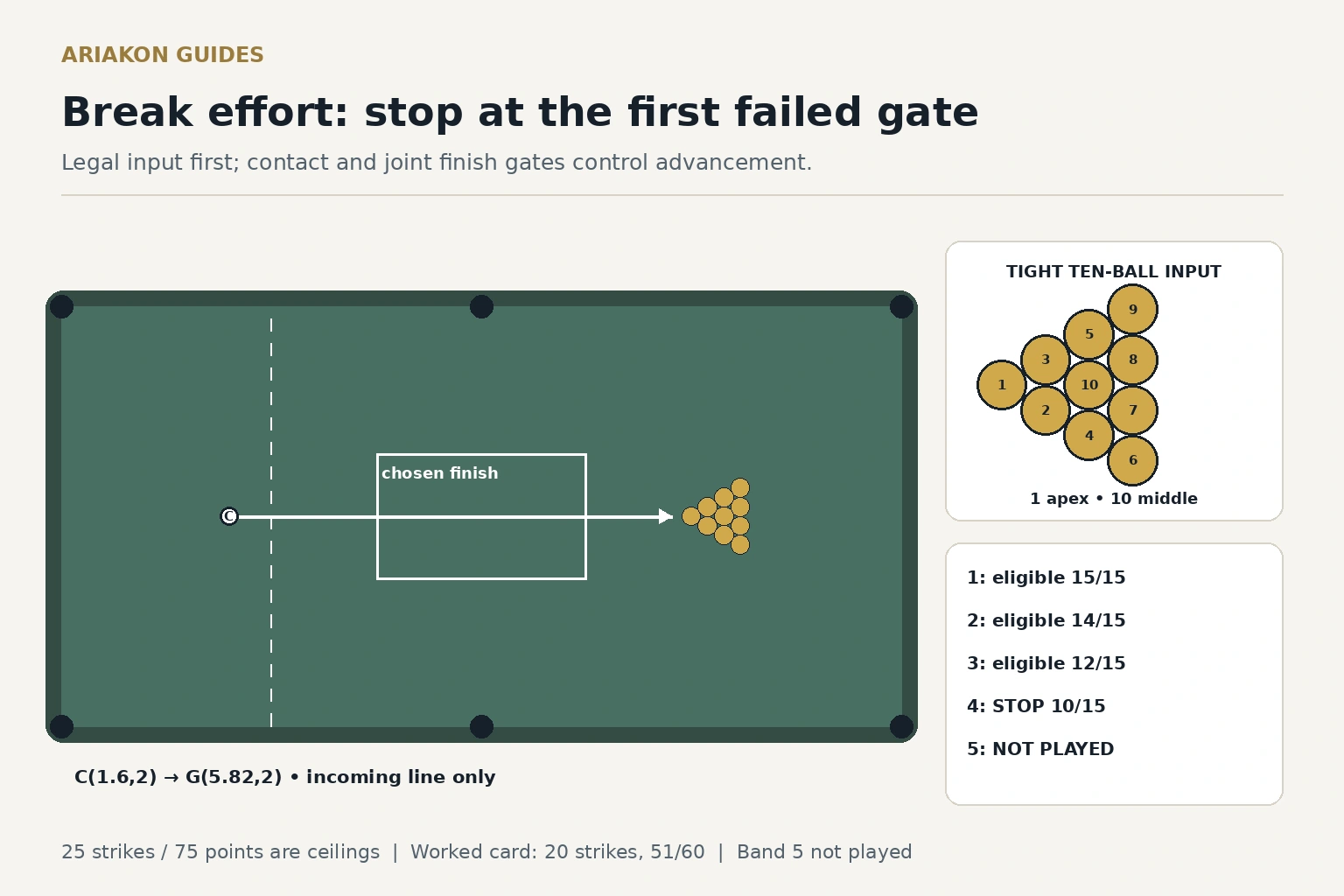
Freeze a rule-compliant ten-ball setup
Use ball-center coordinates on an illustrative 100×50-inch bed: x=0..8 along the length, y=0..4 across it, origin at the lower-left cushion-nose corner. Equal 2.25-inch balls have radius 0.09 and diameter 0.18 units. Intact-cushion center limits are 0.09..7.91 and 0.09..3.91. Six real pockets interrupt the boundary at the four corners and (4,0),(4,4). Measure the actual bed, balls and mouths before scaling; remove measuring aids before shooting and never mark a competition table.
Use WPA ten-ball: 1 at foot-spot apex (6,2), 10 at the middle of row 2, ten touching equal balls in rows of one, two, three and four. Row r=0..3 has centers x=6+r√3×0.09, y=2+(2j−r)×0.09 for j=0..r. Other numbers have no deliberate pattern; the inset shows just one possible permutation.
Cue center C(1.6,2) is behind the head string x=2; intended full first-contact center is G(5.82,2). Call a ±0.09-unit y window at first contact and a separate final cue-center rectangle x=3..5,y=1.4..2.6. Check rack tightness before every strike. Rejected input is reset work, not a recorded break.
Accept and record the rack first so delivery is compared against equivalent inputs.
Diagnose the five break outcomes separately if you need to locate a cause rather than select an effort band.
Advance only while the nested gates remain satisfied
Name five personally repeatable effort requests from controlled to firmer, without mph claims or percent-of-maximum precision. Test five struck breaks at the first band. Move to the next only if the current block has 5/5 known legal breaks, at least 4/5 in the first-contact window, and at least 3/5 that combine that contact with the called finish. Unknown contact or legality does not pass the gate.
Stop the ladder at the first failed gate, discomfort, loss of stable control or unsafe conditions. Do not force the remaining higher bands to fill a worksheet. Five bands × five breaks is a ceiling of twenty-five attempts, with a maximum of 75 points only if every attempt was actually made and scored. A softer effort still must satisfy legal-break requirements.
Make the score and the gates agree
A legal ten-ball break requires correct first object and no foul, plus a pocketed object or at least four object balls driven to rails. Pocket count is context, not the contact gate. If result visibility is insufficient, mark unknown outside the numeric subtotal, reduce its maximum by three, and do not advance.
For a five-break all-legal block let k be contact-window successes and j the subset that also finishes inside the box. Score=5+k+j, with 0≤j≤k≤5. This nesting prevents a finish outside the intended contact from masquerading as accurate power.
| Points | Established result |
|---|---|
| 0 | Known illegal break or other foul |
| 1 | Legal break, outside called contact window |
| 2 | Legal break within contact window, outside finish box |
| 3 | Legal break within contact window plus cue resting in finish box |
Read the worked early-stop card
Bands 1..4 score 15+14+12+10=51 out of 60 for twenty actual breaks. Band 3 is the highest tested eligible band; band 4 has a useful score but fails the 4/5 contact requirement. There are no invented band-5 results. This does not establish the objectively fastest ball speed or a permanent optimum.
| Band | Legal / contact / joint finish | Score / 15 | Decision |
|---|---|---|---|
| 1 | 5 / 5 / 5 | 15 / 15 | eligible; next band permitted |
| 2 | 5 / 5 / 4 | 14 / 15 | eligible; next band permitted |
| 3 | 5 / 4 / 3 | 12 / 15 | eligible; next band permitted |
| 4 | 5 / 3 / 2 | 10 / 15 | stop; contact gate failed |
| 5 | not played | not scored | higher effort not authorized by this card |
Retest before using the choice in play
At a fresh block take five breaks at the selected band with the same gates. If it fails, step down and investigate; do not declare it confirmed. When it passes, log five separate game-break opportunities as transfer. In the worked example 20+5+5=30 strikes; if all five baseline bands had passed, the ceiling with those two later blocks would instead be 35. Actual completed counts belong in the record.
A failed gate may reflect rack, contact or observation quality rather than strength. The cause-isolation guide addresses that question. A buying guide or a cue-weight comparison cannot replace a controlled delivery test.
Isolate rack, contact and pace inputs when the ladder fails for an uncertain reason.
Compare break-cue weight independently only when configuration is the next supported question.
Sources and further reading
References support the specific factual information above. The practical checklists are Ariakon editorial guidance.