
Cue-ball control · 3 min read
Calibrate a Three-Diamond Draw Route on Your Own Table
A cue ball that returns several diamonds after contact can be a useful draw-control benchmark, but the distance is an outcome to calibrate—not a law. Cloth speed, ball condition, spin-to-speed ratio, cushion response and stroke delivery all change the route.
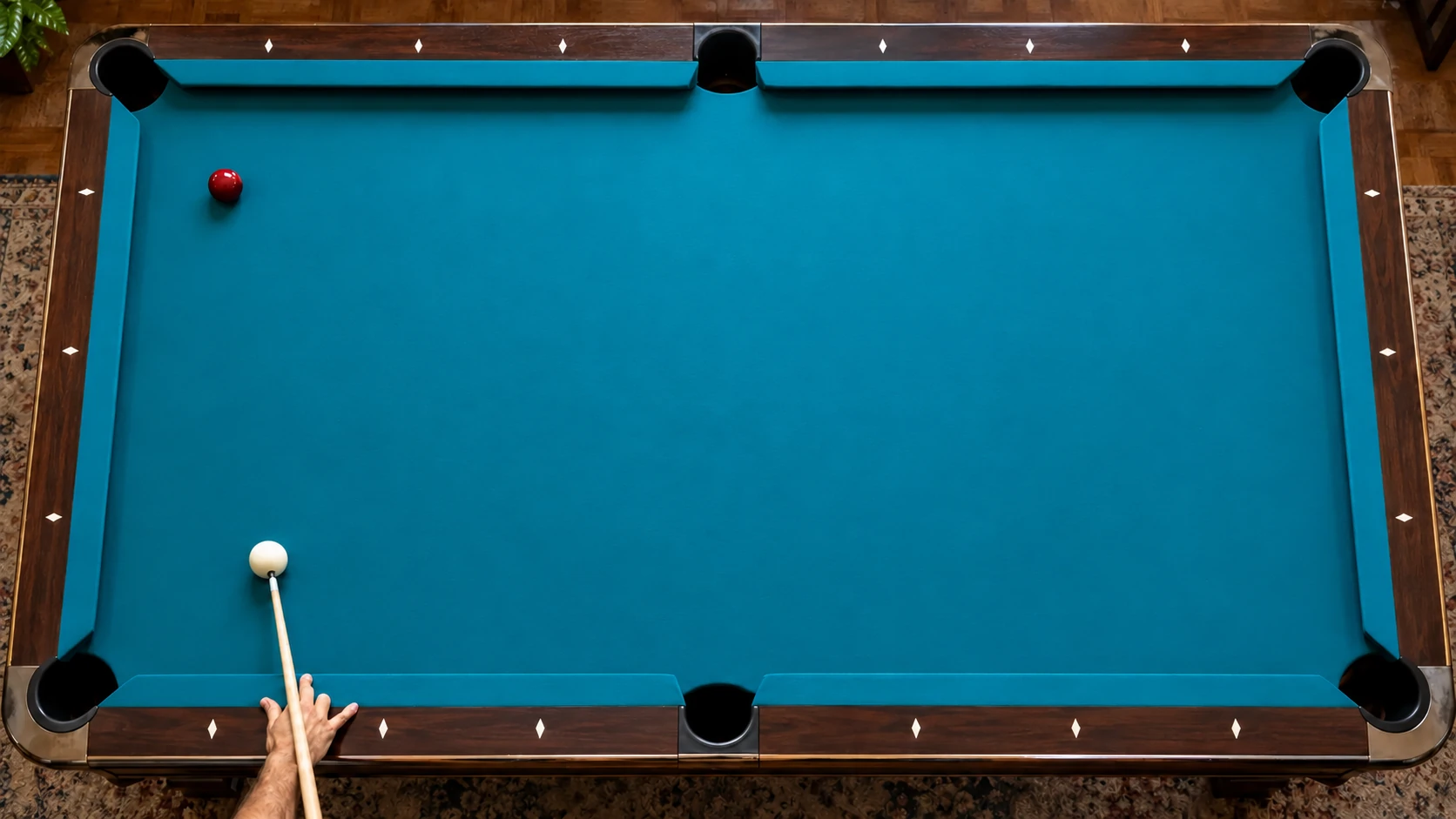
Build a neutral baseline
For this example use a 100 × 50-inch playing surface and 2.25-inch balls. Coordinates are ball centers in 12.5-inch units, x=0–8 along the length and y=0–4 across it. Use real corner pocket P=(8,0), object ball O=(4,2) and cue ball C=(2.2111,2.8944). The three are collinear on direction u=(0.894427,-0.447214). The cue-ball contact center is G=O−0.18u=(3.8390,2.0805).
Measure the main target three diamond units back from G along the shot line: T=G−3u=(1.1557,3.4221). Use a circle of radius 0.25 unit around T and return directly to it without touching any cushion. Its entire boundary and the 0.09-unit ball radius fit on the bed. Photograph the registered centers and remove anything that could obstruct a ball. No side-pocket facing or cushion rebound belongs in this station.
Establish clean draw first
Use a level cue, stable bridge and contact below center while staying within your reliable tip-offset range. Chalk normally and accelerate through the cue ball without forcing a steep downward hit.
Start at a speed that pockets the object ball reliably and produces visible backspin after contact. If the cue ball hops, miscuing risk rises or accuracy collapses, reduce the demand.
Change only one input
Hold the setup and aim constant while changing either speed or tip height in small steps. Record where the cue ball stops relative to the direct return zone; this station has no target rail.
Do not add sidespin until the center-axis version is repeatable. Sidespin introduces squirt, swerve, throw and cushion effects that can hide whether draw control improved.
Read the table, not the slogan
Clean polished balls, worn cloth, humidity and cushion response can all alter travel. A route that reaches three diamonds on one table may finish short or long elsewhere with the same visual stroke.
Use the first few practice attempts to map the current table. The calibrated result is local evidence for that equipment and condition.
Score a useful zone
After a comfortable warm-up, shoot two five-attempt blocks with a rest between them. Award one pot point for the called object ball without a foul. Award one target point only when that pot is made and the cue-ball center rests inside or on the three-diamond circle without touching a cushion. Ten attempts provide 20 component points, with pot and target counts kept separately.
Record the first failed event, contact region, observed return direction and finish distance. A stop, short return, cushion contact or miscue does not earn a target point. If the target requires force you cannot control, shorten the draw target to one or two units on the same line and label that changed task; never force repeated miscues to complete the three-unit score.
Keep the drill safe
- Use only approved removable markers and never mark the cloth permanently.
- Stay inside a reliable low-hit range; repeated miscues are a stop signal.
- Keep the cue near level and avoid striking down into the cloth.
- Reset every ball from the same references.
- Change speed or tip height, not both at once.
- Record table and ball condition with the result.
Sources and further reading
References support the specific factual information above. The practical checklists are Ariakon editorial guidance.