
Practice · 3 min read
Build Weekly Habits That Support Consistent Pool Practice
Consistency improves when starting is defined before motivation is tested. Choose three stable weekly anchors, assign a minimum and standard dose, and finish each session with a reset that lowers friction next time. This is not another training curriculum: the practical-training guide decides what to practice, while this worksheet makes the planned work more likely to happen.
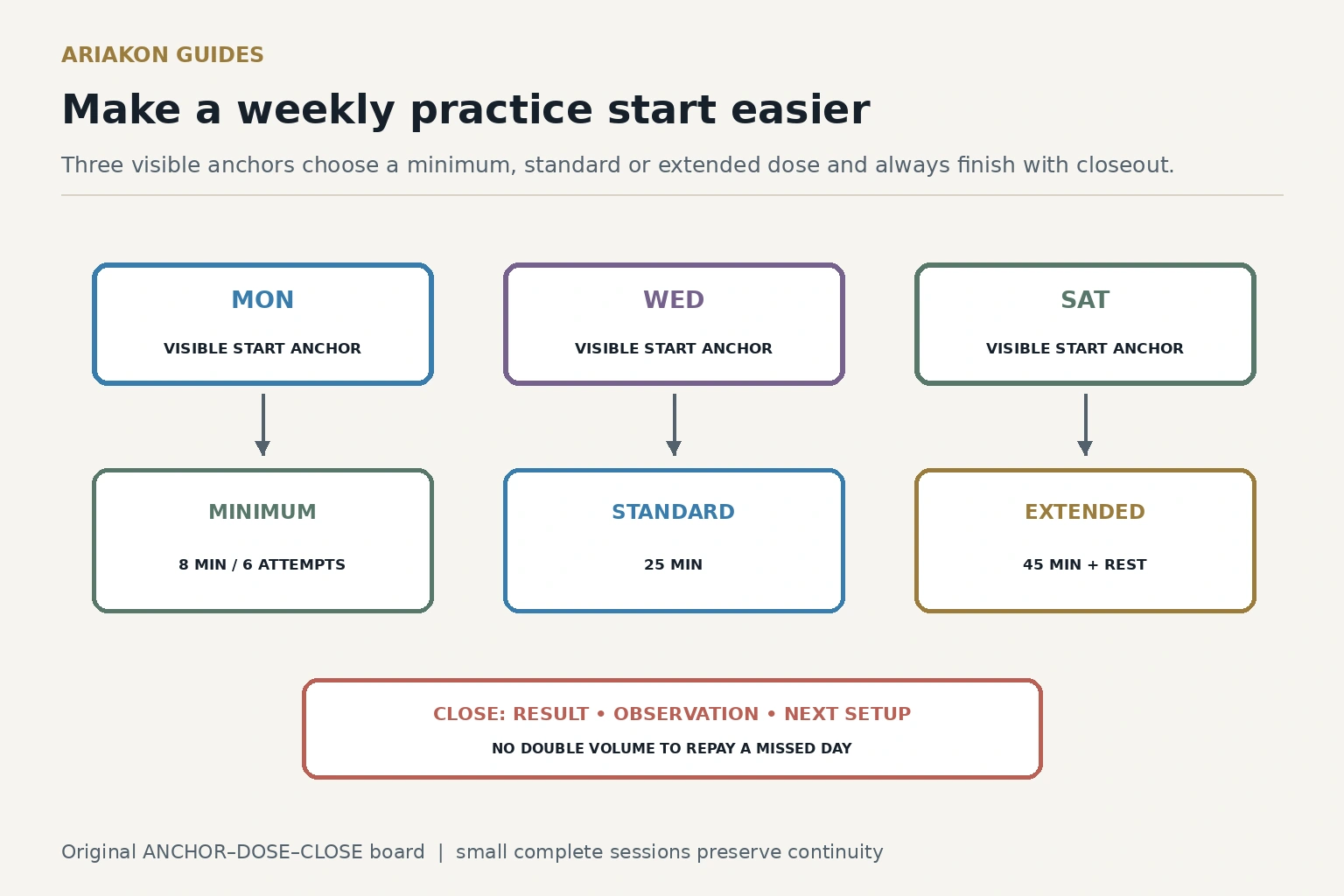
Choose three anchors you can observe
An anchor is a visible event, not ‘when I have time.’ Record venue hours, travel, table access and any physical limits. A backup window prevents one disruption from becoming a vague promise, but it does not authorize late-night fatigue, unsafe travel or doubling the next session.
| Anchor | Start signal | Backup window |
|---|---|---|
| Session 1 | After a named recurring event | One named later window |
| Session 2 | Arrival at a specific room or table | Minimum dose at home if safe |
| Session 3 | Calendar alert plus prepared case | Next available day; no double volume |
Build a practical pool training week to choose the technical content inside each practice dose.
Run a monthly fundamentals checkup to review whether the habit is supporting the right work.
Define minimum, standard and extended doses
The example times are planning options, not universal prescriptions. Adapt them to access, ability and health. A minimum session is complete work, not a punishment or a debt. Stop for pain, unsafe fatigue, equipment damage or loss of safe table access.
| Dose | Example boundary | Must include |
|---|---|---|
| Minimum | Eight minutes or six registered attempts | One setup, one score, closeout |
| Standard | Twenty-five minutes | Warm-up, named drill, score, closeout |
| Extended | Forty-five minutes only when planned | Rest break and second task if useful |
Close every session so the next one has a runway
Do not leave balls, tape, chalk, tripods or cords where they obstruct a shared room. Closeout ends when the space is safe and the next action is written.
| Closeout step | Record |
|---|---|
| Result | Attempts and component score |
| Observation | One visible pattern, not a diagnosis |
| Next setup | Ball marks, drill and first block |
| Equipment | Clean, dry and safely case cue and tools |
| Schedule | Confirm the next anchor or backup |
Worked week: preserve the chain without chasing volume
A hypothetical player plans Monday, Wednesday and Saturday standard sessions, with Thursday and Sunday as the written backup windows. Monday delivers twenty-five minutes and a 14/24 speed-control score. Wednesday access is lost, so Thursday's backup becomes six registered stop shots and a closeout note. Saturday delivers forty minutes with a planned rest. The week records three completed anchors, not ‘one missed workout.’
The following week starts with the Thursday setup because the closeout named it. No session is doubled to repay Wednesday. After four weeks, the player reviews completed anchors, average start delay and the technical scores separately.
Diagnose the habit, not your character
| Observed failure | Small repair |
|---|---|
| Anchor occurs but practice does not start | Prepare cue, marks and first task earlier |
| Minimum repeatedly expands and gets skipped | Return to the written minimum boundary |
| Sessions happen but nothing is scored | Put the score sheet with the cue case |
| Backup is always needed | Choose a more stable primary anchor |
| Pain or exhaustion ends sessions | Stop and adjust with appropriate qualified guidance |