
Advanced practice · 3 min read
Build an Advanced Pool Training Curriculum From Individual Skills
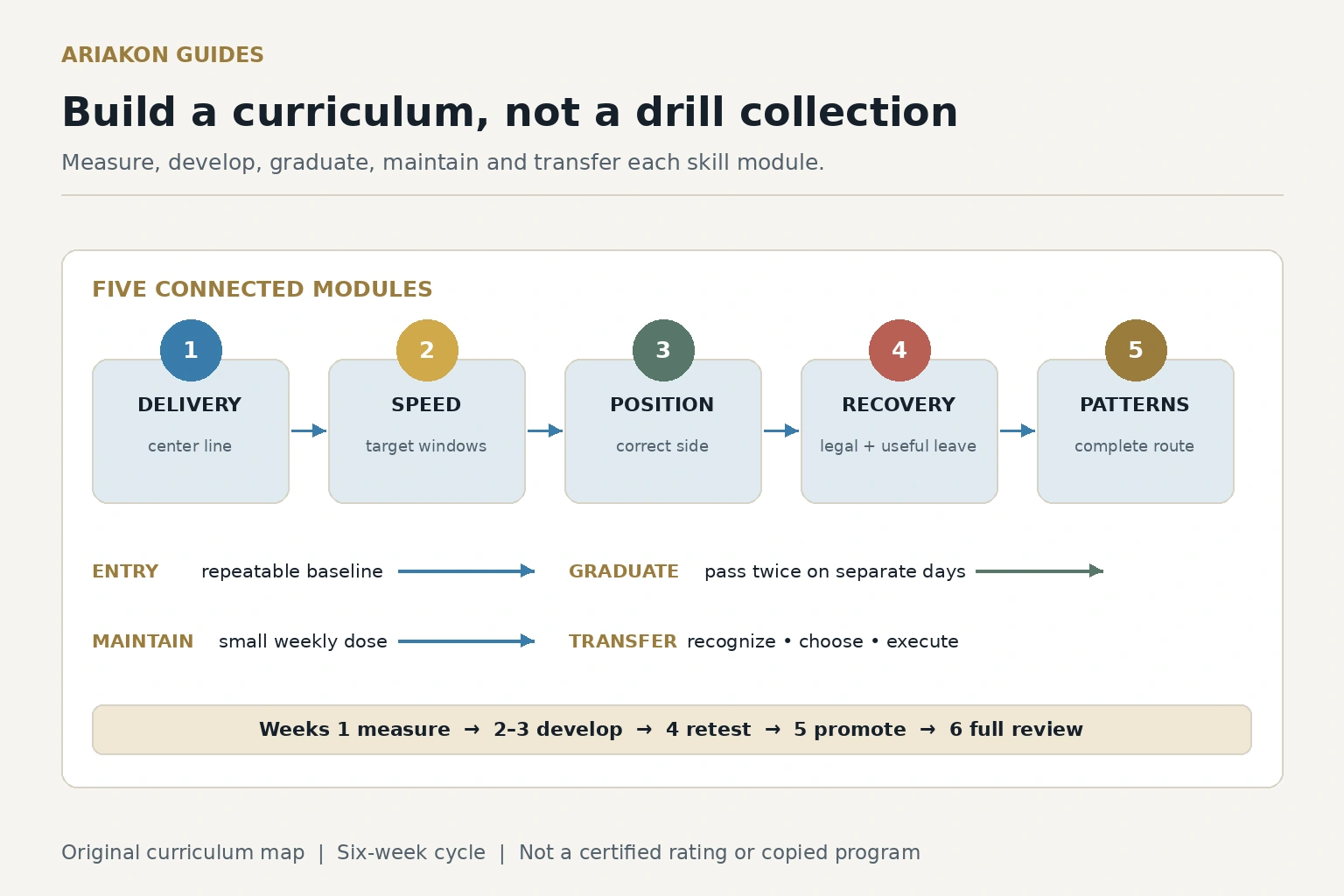
A collection of advanced drills is not yet a curriculum. A curriculum decides what comes first, what evidence allows progression, how old skills are maintained and how isolated execution returns to real racks. This six-week map turns individual skills into a connected training cycle.
Begin with evidence, not the most impressive drill
Take one repeatable baseline for cue delivery, speed control, position, recovery and pattern decisions. Use the same table, recorded setups and scoring boundaries. Keep any separately administered assessment under its own published procedures; do not combine its result with this curriculum.
For an Ariakon working baseline, use the five-test progress dashboard and write one observable error for each category. The two lowest stable categories become development modules; the others receive shorter maintenance blocks.
Build a five-test progress dashboard for a compact diagnostic baseline.
Review ten essential pool skills when selecting the modules that matter to your game.
Build five modules with entry and graduation rules
| Module | Entry evidence | Development block | Graduate when | Maintenance dose |
|---|---|---|---|---|
| Delivery | Straight-shot drift or one-sided miss | Three 10-shot center-line sets | 8 of 10 pass twice on separate days | One 10-shot set weekly |
| Speed | Long or short bias in target windows | Three distances, 10 attempts each | 7 of 10 in window at all three distances twice | Ten mixed distances weekly |
| Position | Repeated missed side of next-shot zone | Stop, follow and draw to called zones | 8 of 10 correct side and zone twice | One mixed 12-shot block |
| Recovery | Low kick, safety or escape score | Four replies from one failed route | Legal contact plus useful leave on 7 of 10 | Six recovery choices weekly |
| Patterns | First failed transition in three-ball runs | Plan, play and review five layouts | 4 of 5 routes completed twice | Three new layouts weekly |
Use a six-week loading plan
Week one measures all five modules. Weeks two and three devote two 25-minute blocks to the lowest category and one 15-minute block to the second-lowest, followed by fifteen minutes of rack transfer. Week four retests the two development categories. Week five promotes a passed category to maintenance and moves the next stable weakness into development. Week six retests all five and plays two race-length match simulations.
Keep total repetitions high enough to reveal a pattern but stop a block when fatigue changes the movement you are trying to train. Do not graduate from one lucky score. Require the same threshold on two separate days.
Connect modules instead of stacking them randomly
Delivery supports every other module, but it does not need to dominate every session after it passes maintenance. Speed control connects to position. Position connects to pattern completion. A failed pattern creates a recovery decision. Draw arrows between the actual failure sequence in your log and order the next session along that path.
For example, a player may miss three-ball patterns because the first position shot finishes on the wrong side. The next block is position-zone control, not more pattern memorization. Once the zone score passes, replay the pattern to test transfer.
Score transfer separately
At the end of each session, play three short racks or five three-ball layouts with no drill resets. Award one transfer point for recognizing the trained situation, one for choosing the correct response and one for executing within the defined boundary. Maximum is three per situation.
A drill score can rise while match decisions remain unchanged. Keep a separate transfer column so the curriculum does not mistake isolated repetition for usable game skill.
Review and rebuild the next cycle
At six weeks, compare baseline and final scores under the same conditions. Retain one passed module for maintenance, carry forward any module that has not passed twice and select only one new development emphasis. Archive the old plan rather than rewriting its targets after seeing the results.
If every test improves but match transfer does not, shorten the technical blocks and add decision-rich layouts. If results vary wildly, stabilize the test conditions before adding harder drills.
Set measurable practice goals when defining the next six-week outcome.
Build a structured two-hour session when placing the modules into one day.