
Practice planning · 4 min read
Build a Monthly Pool Skills Rotation That Prevents Neglect
Priority practice should not silently erase the rest of the game. This monthly planner names one priority, five maintenance domains and exact dates, then checks the gap since actual completed work. It is a coverage ledger, not a universal training prescription or a ranking of popular articles.
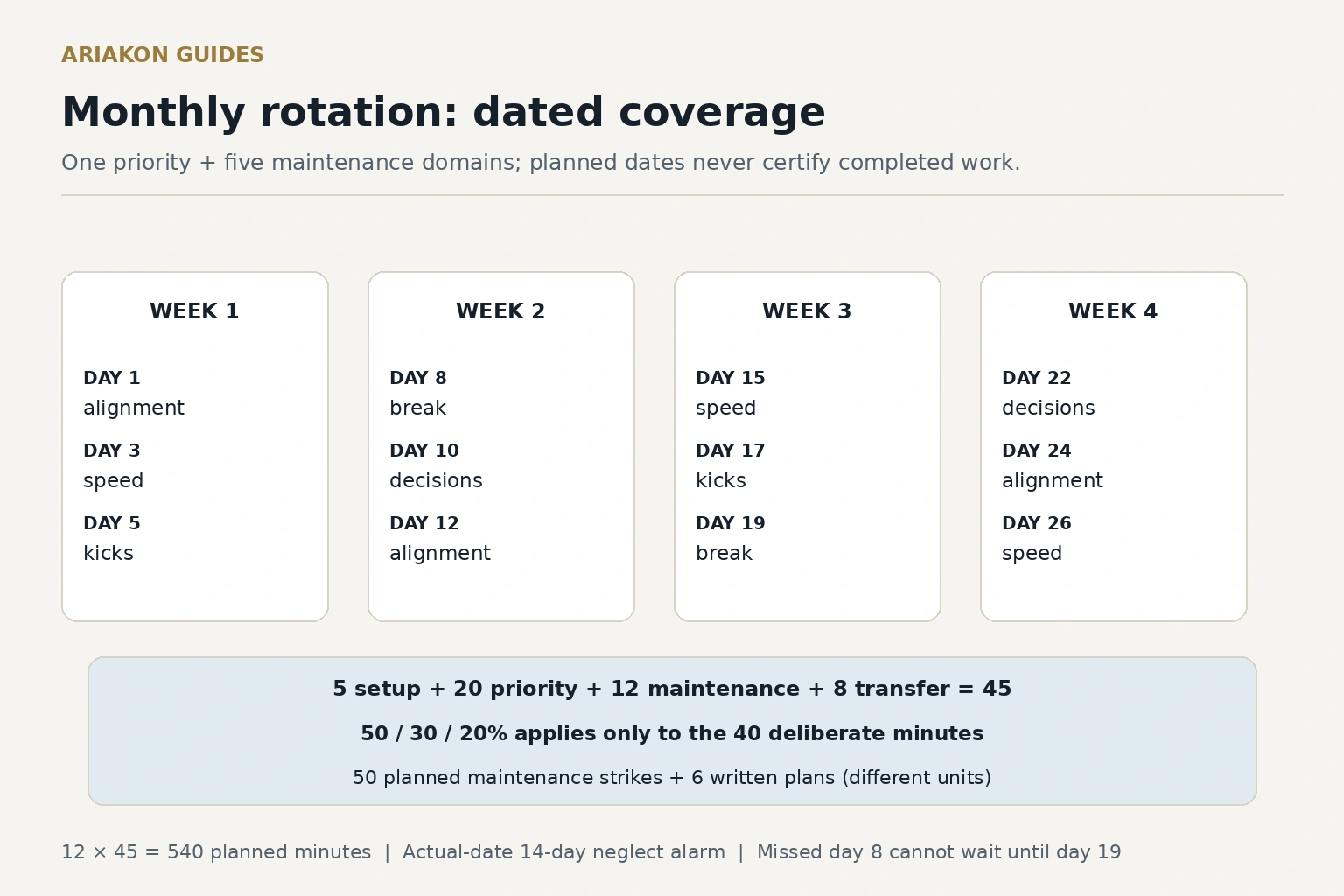
Name six domains without counting the priority twice
For this example cue-ball routes is the priority. The five maintenance domains are alignment, speed, kicks, break and decisions. That is six domains total, not six maintenance domains plus a hidden seventh priority. Keep your chosen protocol version and actual last-completed date for each.
Assume a recorded baseline touch of each maintenance domain on day 0 before this illustrative 28-day month. If that baseline did not occur, use the true dates and inspect neglect immediately. A planned date never resets the clock. The twelve-week plan develops one goal; this page protects recurring coverage of several.
Use the twelve-week plan for goal progression rather than asking this calendar to certify a new skill.
Place twelve real slots and inspect the gaps
Alignment occurs on days 1,12,24; speed 3,15,26; kicks 5,17; break 8,19; decisions 10,22. With the stated day-0 baseline, no planned completed-touch gap through day 28 exceeds twelve days. Each maintenance domain has at least two scheduled touches, but completion still needs a dated record.
Use a fourteen-day neglect alarm on actual dates. If the day-8 break session is missed, waiting for day 19 would create a nineteen-day gap from day 0. At day 14 the alarm should already prompt a short safe catch-up or a revised realistic schedule. Never backfill a missed date as completed to turn the alarm off.
| Week | Session day | Maintenance |
|---|---|---|
| 1 | 1 | alignment |
| 1 | 3 | speed |
| 1 | 5 | kicks |
| 2 | 8 | break |
| 2 | 10 | decisions |
| 2 | 12 | alignment |
| 3 | 15 | speed |
| 3 | 17 | kicks |
| 3 | 19 | break |
| 4 | 22 | decisions |
| 4 | 24 | alignment |
| 4 | 26 | speed |
Make the percentage denominator explicit
The deliberate-work part is 40 minutes: 20/40=50% priority, 12/40=30% maintenance, 8/40=20% transfer/notes. Those percentages do not describe all 45 minutes. Setup remains five minutes, and reset/rest time stays inside the block. Use actual elapsed times rather than certifying the planned 540 as completed.
| Block | Per session | Across twelve |
|---|---|---|
| Setup/readiness | 5 minutes | 60 |
| Priority cue-ball routes | 20 minutes | 240 |
| Maintenance | 12 minutes | 144 |
| Transfer and notes | 8 minutes | 96 |
| Total | 45 minutes | 540 |
Give each maintenance touch a bounded protocol
Use ball-center coordinates on an illustrative 100×50-inch bed: x=0..8 along the length, y=0..4 across it, origin at the lower-left cushion-nose corner. Equal 2.25-inch balls have radius 0.09 and diameter 0.18 units. Intact-cushion center limits are 0.09..7.91 and 0.09..3.91. Real pockets interrupt the boundary at four corners and (4,0),(4,4). Measure your actual bed, balls and pocket mouths before scaling. Remove measuring aids before shooting and never mark a competition table.
Alignment uses O(6,3), P(8,4), G(5.839003, 2.919502), C(4.944576, 2.472288), stop disk radius 0.18 at G. Speed uses cue only C(2,1), finish disk radius 0.25 at (5,1), no object or required rail. Both direct lines avoid pocket openings. The linked kick and break cards supply their own exact centers and rules; do not replace them with a vague photo.
Across the complete schedule alignment 3×6=18, speed 3×6=18, kicks 2×4=8 and break 2×3=6 give 50 planned maintenance ball strikes. Decisions has 2×3=6 written plans, not six additional drill strikes. Priority and transfer attempts are separately recorded; fifty is not a fabricated total for the month.
| Domain | One touch | Separate evidence |
|---|---|---|
| Alignment | Six attempts at the exact stop baseline below | Joint legal pot/stop, pots and actual attempts |
| Speed | Six cue-only disk attempts below | Disk finishes / actual strikes |
| Kicks | Four attempts: A,B,C,D once each from linked near-pocket setup | Target-first and complete legality |
| Break | Three accepted-rack controlled breaks from linked diagnosis card | Five fields, unknowns and actual strikes |
| Decisions | Three written pre-shot plans during ordinary permitted play | Called task, intended next region, actual result; not three drill strikes |
Use the four exact near-pocket kick stations for the kick maintenance dose.
Use the rule-compliant break diagnosis inputs for the three-break maintenance dose.
Review actual coverage before choosing next month
At day 28, if every slot was completed, latest maintenance ages are alignment 4 days, speed 2, kicks 11, break 9 and decisions 6. Recompute from actual dates if anything changed. A completed touch needs its task, actual dose and evidence, not just an entry on a calendar.
Keep each score with its own units: stop successes, speed disks, legal kicks, break observations and written plans cannot become one meaningful ability percentage. If a domain weakens, temporarily adjust next month’s allocation before it starts. If a session ends early, record unused slots and protect the alarm rather than inventing practice.
Select the next priority from supported errors after checking which tasks were actually maintained.
Shrink the session budget explicitly when the calendar exceeds realistic access.
Sources and further reading
References support the specific factual information above. The practical checklists are Ariakon editorial guidance.