
Practice planning · 4 min read
Turn Pool Resolutions Into a Twelve Week Practice Plan
A resolution becomes usable when the next session has a reconstructible task and a decision rule. This twelve-week example keeps one baseline unchanged, introduces demands only after a stated gate, and records game transfer separately. Calendar time alone does not prove progress.
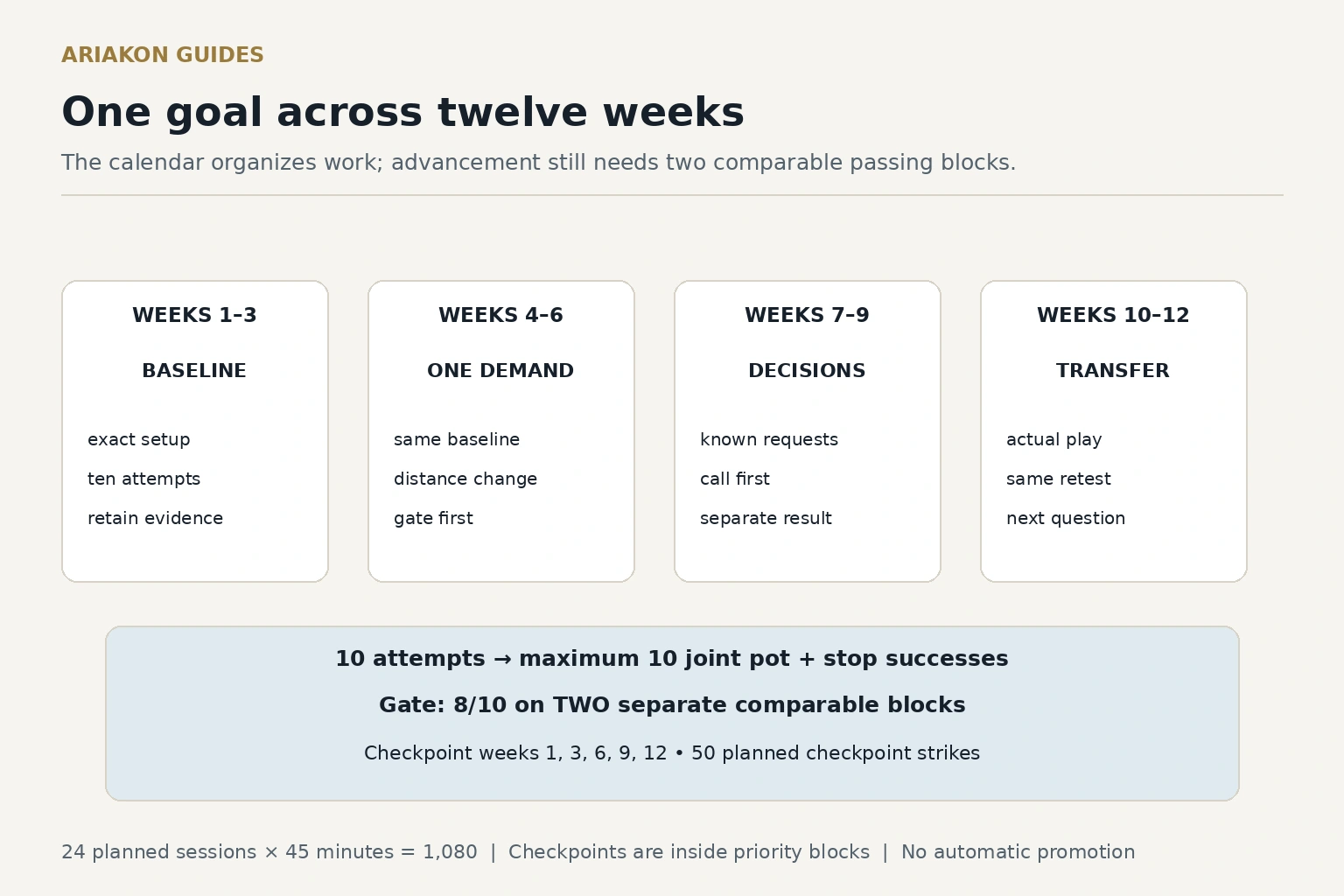
Choose one task and a realistic dose
Use two 45-minute sessions each week for twelve weeks: 24 planned sessions and 1,080 planned minutes. This is an original example, not a required training volume or promise of improvement. Stop for discomfort, unsafe reach or lost control. Record missed sessions as missed, not zero skill or completed work.
This page plans one goal across a quarter. The monthly rotation maintains several domains, the single-session budget manages one visit, and the assessment worksheet selects a task. Preserve those independent questions.
Choose a task from supported game evidence before scheduling it for twelve weeks.
Adapt the single-session budget if your actual access differs.
Keep the exact baseline unchanged throughout the cycle
Use ball-center coordinates on an illustrative 100×50-inch bed: x=0..8 along the length, y=0..4 across it, origin at the lower-left cushion-nose corner. Equal 2.25-inch balls have radius 0.09 and diameter 0.18 units. Intact-cushion center limits are 0.09..7.91 and 0.09..3.91. Real pockets interrupt the boundary at four corners and (4,0),(4,4). Measure your actual bed, balls and pocket mouths before scaling. Remove measuring aids before shooting and never mark a competition table.
The worked goal is a legal called pot plus cue-center stop within radius 0.18 of G. Use O(6,3), P(8,4), G(5.839003, 2.919502), C(4.944576, 2.472288) and a comfortable stop request. Ten struck attempts produce maximum 10 binary successes, not thirty hidden points. Count a success only when both the pot and stop boundary are met without foul.
Retest this same task in weeks 1,3,6,9,12. Five complete checkpoints contain 50 planned strikes, allocated inside the priority time. They are not the total shots of the cycle, and missed checkpoints remain unplayed. Save actual attempts, pots and joint successes so 6/10 stops cannot conceal eight pocket outcomes or unclear footage.
Assign four three-week phases without forcing promotion
For this example set the gate at 8/10 joint successes on two separate comparable blocks. A short favorable sample only authorizes trying one demand; it is not proof of permanent skill. If the gate fails, stay with the current task even when the calendar moves to the next phase. No score threshold is an official player rating.
A longer-distance progression uses C(4.40792, 2.20396), 1.6 units behind the same G, while O,P and the success disk remain fixed. Later decision practice can ask for stop versus follow only after both are familiar and their targets are stated. Never combine a changed setup with the baseline and call the later fraction improvement.
| Weeks | Work if prerequisites hold | Decision at review |
|---|---|---|
| 1–3 | Baseline setup and repeatable comfortable delivery | Resolve setup/observation uncertainty |
| 4–6 | One demand, such as longer cue distance | Advance only after two comparable passing blocks |
| 7–9 | Choose between already learned requests | Keep decision evidence separate from pot result |
| 10–12 | Ordinary game transfer plus unchanged baseline retest | Retain gains and choose the next goal |
Budget every session minute once
If a reset or rest takes longer, reduce shooting within the remaining budget. A timer is a block boundary, not a reason to hurry the stroke. Record elapsed minutes separately from the 1,080-minute plan; do not invent a total attempt count from time. Maintenance results use their own protocol and denominator.
| Block | Minutes | Record |
|---|---|---|
| Readiness and setup | 5 | Condition, comfort and layout version |
| Priority | 20 | Actual attempts, including any scheduled ten-shot checkpoint |
| Familiar maintenance | 10 | One separate calibrated task |
| Transfer and closeout | 10 | Actual game opportunities plus next action |
| Total | 45 | Elapsed time and any overrun |
Work the end-of-cycle decision honestly
Hypothetical baseline week 1 is 6/10 and week 12 is 7/10 joint successes; a separate transfer record rises from 2/5 to 4/5 useful opportunities. The baseline has not reached the selected 8/10 gate despite better transfer. Keep the exact task for another review or investigate the recurring miss. Do not round seven into a pass or add transfer successes to the baseline.
At the closeout save the first and latest setup version, actual completed sessions, missed allocations, unchanged baseline scores and one supported next action. A changed table or equipment makes a separate condition record. If evidence stalls or remains uncertain, seek qualified feedback instead of indefinitely increasing volume.
Maintain other domains with a separate monthly rotation while this one goal receives priority.
Sources and further reading
References support the specific factual information above. The practical checklists are Ariakon editorial guidance.