
Bank shots · 3 min read
Are Any Banks Guaranteed? Test Pocket Width and Cushion Response
No bank is guaranteed independently of execution and table conditions. Cushion response, object-ball speed, cut angle, spin transfer and the pocket approach all affect whether a geometric line is accepted. The bank-basics guide builds the first reference; this protocol measures how wide that reference remains usable on the table in front of you.
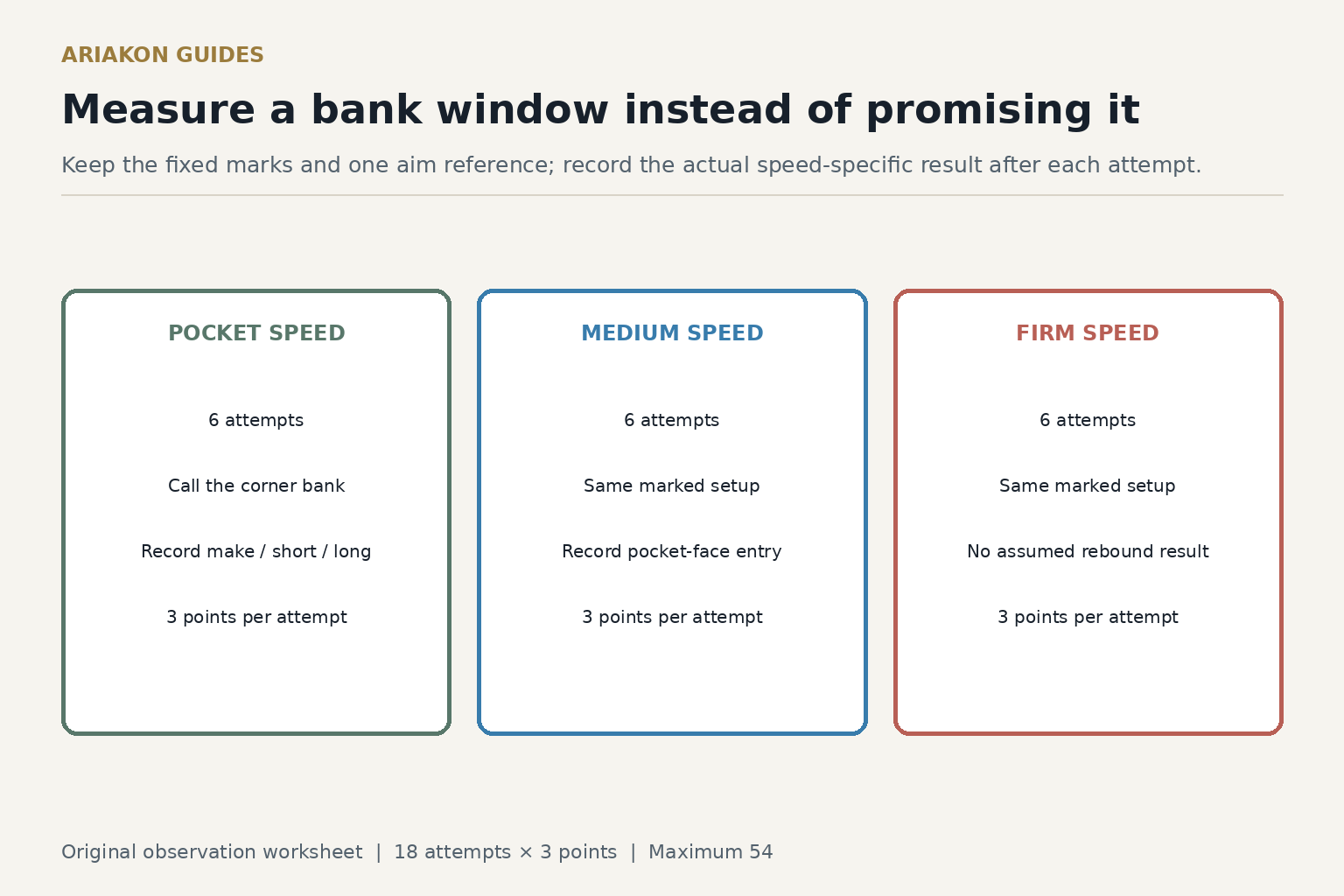
Mark one reference bank and two gates
Use a normalized 100-by-50 table map measured between cushion noses, with corner pockets at (0,0), (100,0), (0,50) and (100,50). Place the cue-ball center at (22,39) and the object-ball center at (36,31). Call the lower-right corner. The reference object-ball route reaches the top cushion at (61,0), then crosses the called pocket face near (100,50). Use center-ball cue contact and a level cue for the first set.
At the target pocket, record a center entry, the short jaw or the long jaw. Do not place loose objects in or near the pocket during a live shot. Small removable starting marks are used only where the room permits them.
Build the simple bank-shot baseline before measuring a pocket window.
Test whether a diamond-system assumption transfers when a numbered reference is involved.
Shoot eighteen banks at three named speeds
Use the same aim and cue contact for all eighteen. A short result reaches the near jaw before the pocket center; a long result reaches the far jaw or adjacent short rail. These labels turn cushion response into a directional observation instead of a vague feeling.
Institutional bank-and-kick resources document that speed, spin, cut and cushion conditions can change rebound. This drill does not calculate a universal correction; it creates one current-table reference.
| Speed | Attempts | Record after every shot |
|---|---|---|
| 6 | Make, long/short miss and entry half | |
| Medium | 6 | Make, long/short miss and entry half |
| Firm | 6 | Make, long/short miss and entry half |
Score pocket acceptance, not only makes
The maximum is fifty-four points. Keep long and short misses beside the total. Two speeds can tie on makes while one repeatedly reaches the pocket face and the other misses the window entirely.
| Point | Evidence |
|---|---|
| Legal start | Cue ball contacts the intended object ball, which then reaches the named cushion |
| Entry window | Object ball crosses the face of the called pocket |
| Object ball falls without a foul |
Widen the setup only after a pattern appears
| Stage | Change | Advance when |
|---|---|---|
| Reference | Fixed marks, three speeds | One speed reaches the pocket face at least 4 of 6 |
| Pocket window | Move object ball half a ball toward the rail | Miss side remains predictable |
| Cushion check | Repeat reference after table conditions change | New result is recorded, not assumed |
| Game transfer | Choose bank or safety in six layouts | Decision names pocket window and sell-out risk |
Worked result and reject rule
A hypothetical block scores pocket speed 13/18, medium 11/18 and firm 7/18. Pocket speed reaches the pocket face five times, while firm speed produces four long misses. The next action is a second pocket-speed block with the same marks—not an aim correction copied to every bank.
In game transfer, reject the bank when the object ball starts outside the tested window, the cue-ball path risks a scratch or a miss sells out an easy reply. A correct rejection earns the decision point. That is more useful than calling a familiar-looking bank automatic.