
Bank shots · 4 min read
Aim a Basic Bank With a Mirror Line Before Adding Corrections
A mirror line gives a bank shot a clean geometric starting point. It does not cancel cushion compression, ball condition, speed, cut-induced spin or transferred spin. Build the line on one marked shot, hold delivery variables steady and keep a correction only when a group—not one result—shows the same miss.
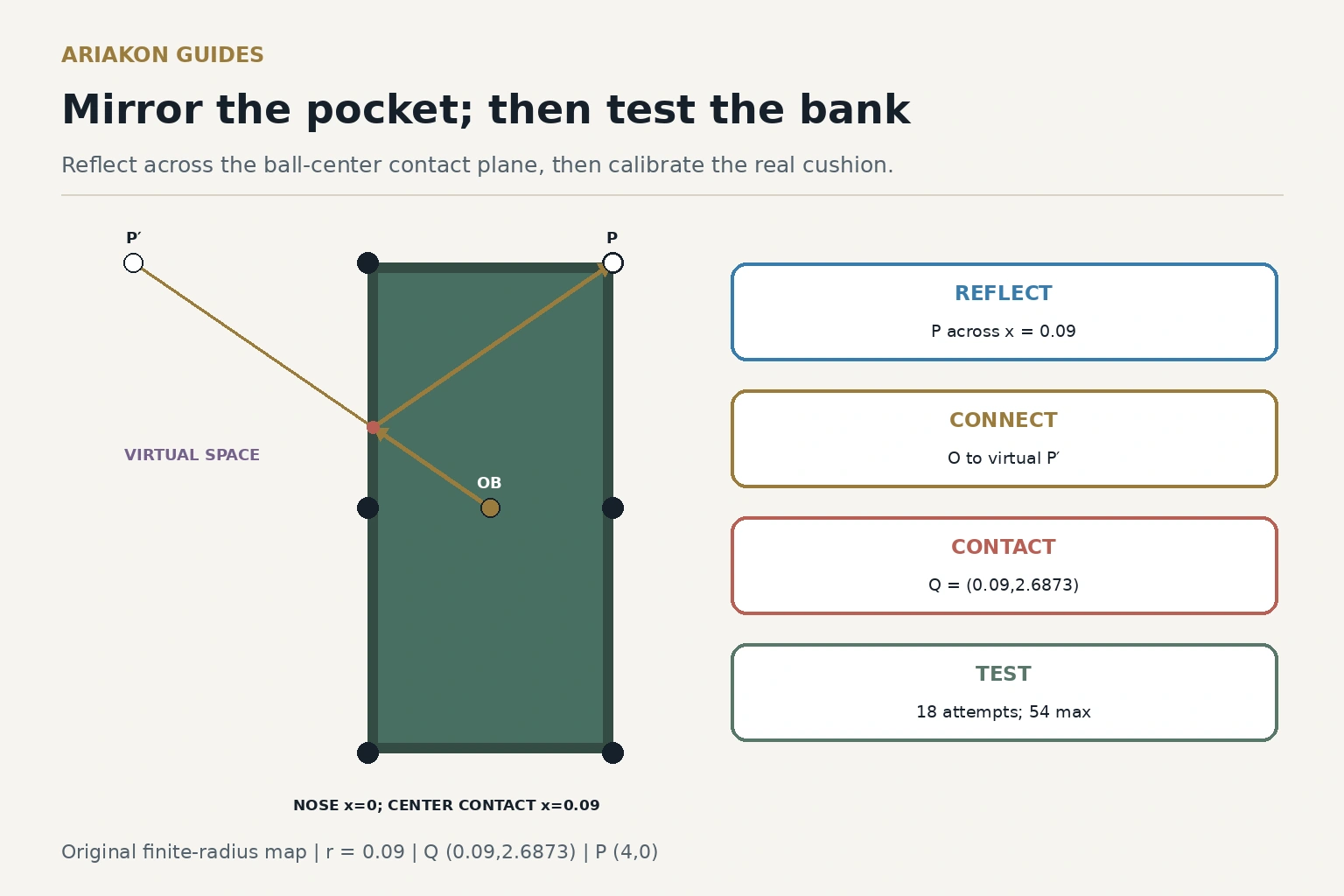
Reflect the pocket across the cushion nose
Use a normalized table map measured between cushion noses, four units across the short rail and eight along the long rail. Set the foot-left corner as (0,0). Place the object-ball center at (2,4), call the foot-right corner at (4,0), and place the cue ball near (2.5,6). Mark centers only where the room permits, then remove anything that can interfere.
Reflect the called pocket across the left long-cushion line x=0. For a measured 100 × 50-inch surface with 2.25-inch balls, one map unit is 12.5 inches and radius r=0.09 unit. A ball center touches the left cushion at x=r, not x=0. Reflect P=(4,0) across x=0.09 to P′=(-3.82,0). The line from O=(2,4) to P′ crosses the center-contact plane at Q=(0.09,2.6873). Its physical cushion-nose reference is (0,2.6873). The two ideal center-path segments are O→Q and Q→P. Aim the cue ball through the ghost center one diameter behind O along O→Q; the initial cue-ball center near (2.5,6) allows that cut. This is the geometric baseline, not a promise that a real cushion returns the ball perfectly.
Build the broader bank-shot baseline before using a construction method.
Adjust bank speed and sidespin only after a baseline when the mirror group is repeatable.
Register six center-ball baseline attempts
These first six attempts are the Geometry block below, not an extra set. Shoot them without moving the target. A contact error is an object-ball path that misses the selected rail crossing by more than half a ball. Mark it separately; do not call it a table correction.
If the results scatter to both sides, repair delivery and object-ball contact. Aiming away from a scattered group merely moves the noise.
| Hold constant | Record |
|---|---|
| Ball centers | Reset all three marks |
| Cue-ball tip contact | Vertical axis; no intentional sidespin |
| Delivery | One comfortable medium-firm speed |
| Rail target | Same cushion-nose crossing |
| Result | Made, long, short or contact error |
Run eighteen scored attempts in three blocks
Each attempt earns one point for crossing the rail within half a ball of the target, one for entering the called pocket or contacting its jaws, and one for no scratch; maximum fifty-four. The half-ball target is an original practice rule, not a universal tolerance.
Rebuild the mirror for the moved layout instead of carrying the old rail point. This tests whether the construction transfers rather than whether one spot was memorized.
| Block | Attempts | Change |
|---|---|---|
| Geometry | 6 | None; establish the group |
| Confirm | 6 | Repeat after a short reset |
| Transfer | 6 | Move both balls one diamond up-table; rebuild the mirror |
Correct only a stable miss group
Bank systems are reference points because speed, spin, cut and table conditions can alter rebound. Make one small target change—no more than half a ball for this worksheet—then shoot another six before keeping it.
The direction of a correction depends on the chosen rail and view. Label the actual miss as long or short relative to the pocket; do not rely on left or right shorthand.
| Evidence | Action |
|---|---|
| Rail crossing varies | Repair object-ball contact |
| Tight group consistently long | Test a small rail-target shift predicted to reduce the observed long miss |
| Tight group consistently short | Test a small rail-target shift predicted to reduce the observed short miss |
| Speed changed with miss side | Re-establish fixed delivery |
| One outlier | Record it; do not adjust the group |
Worked example and rack transfer
A hypothetical player scores ten rail-target points and two pocket-or-jaw points in the first twelve shots, with twelve opportunities for each component. Ten object balls pass the pocket long in a tight group. The next action is one half-ball rail-target change while speed and center-axis contact remain fixed. Four of the next six reach the pocket opening, so the player records that table-specific correction.
For transfer, choose one bank in three practice racks. Before shooting, identify the pocket mirror and rail crossing while standing, then decide whether the table correction still applies at that speed. Do not force a bank when a cut or safety has the larger margin.