
Bank and kick shots · 4 min read
Adjust Bank Shots for Speed and Sidespin After a Baseline Test
A mirror line gives a bank starting point, not the final answer. Object-ball speed, cut-induced spin, transferred sidespin, cushion response and cloth condition can move the rebound. Register one bank, establish a center-ball baseline and then change speed and cue-ball sidespin in separate blocks. The goal is a dated correction for this table and shot—not a universal spin recipe.
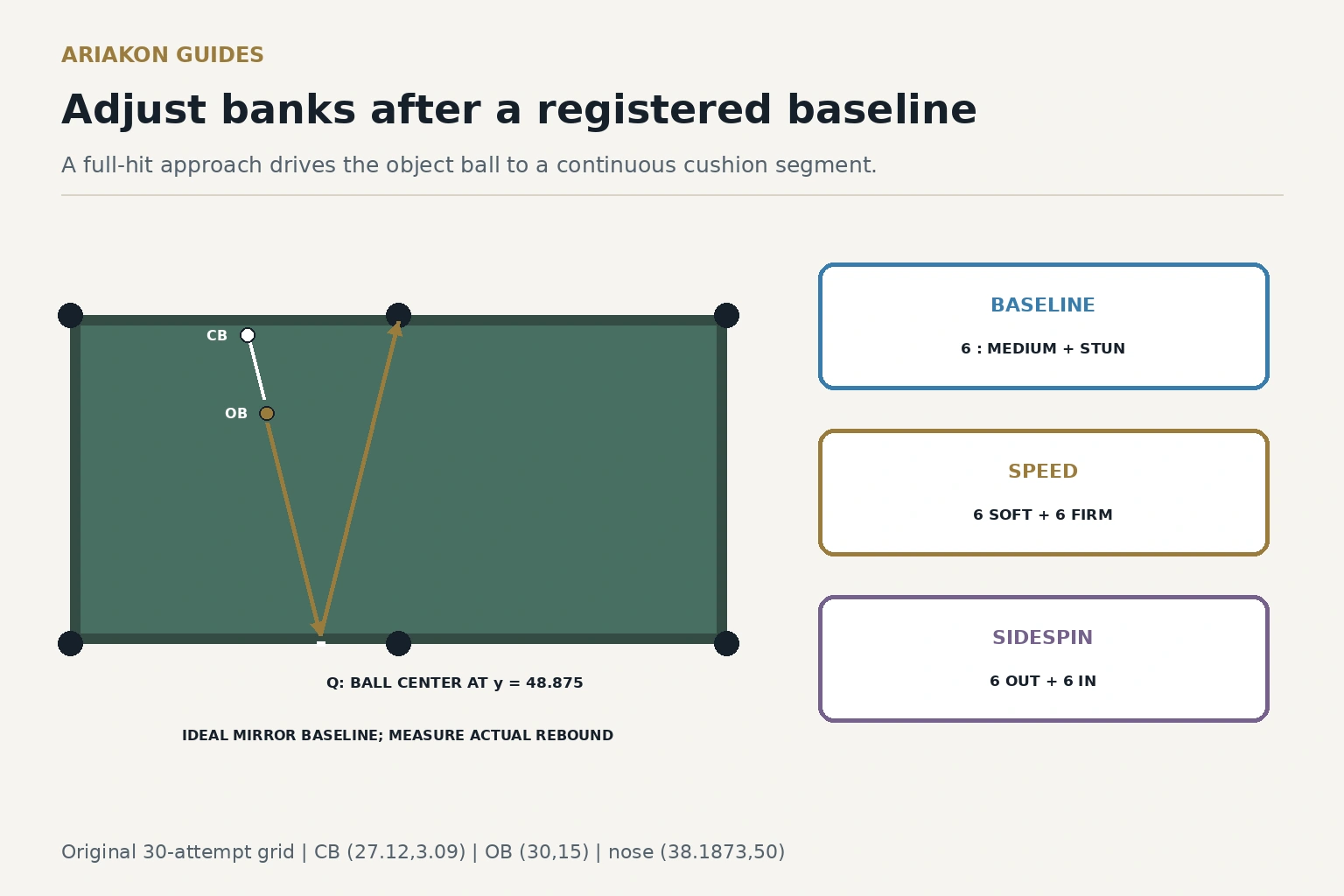
Register the baseline before correcting it
Use a 100 × 50-inch cushion-nose map and 2.25-inch balls, so ball radius r=1.125 inches. Call upper side pocket P=(50,0), set object-ball center O=(30,15), and use the lower cushion’s center-contact plane y=50−r=48.875. Reflect P across that plane to P′=(50,97.75). The O–P′ line meets the plane at Q=(38.1873,48.875); the corresponding physical cushion-nose point is (38.1873,50). The initial object-ball direction is u≈(0.23494,0.97201). Place cue ball C≈(27.121,3.093), behind contact center G=O−2.25u≈(29.471,12.813), and deliver a controlled full contact. The cue ball must stop near G; register a reliable vertical-axis stun contact in warm-up. The returning object-ball line from Q to P passes clear of that stop region.
Use the registered vertical-axis stun contact and one medium speed. Shoot six attempts without moving the aim line. Record pocket, long jaw, short jaw or outside, plus the actual lower-cushion contact. A tight directional group supports an adjustment; scattered results call for a delivery or contact test first.
Build the simple bank baseline before adding controlled corrections.
Test cushion response around the table when the same bank differs by location.
Run the speed block with spin held neutral
In general, firmer banks tend to rebound shorter and can group more consistently, while softer rolling banks can lengthen. The effect is not perfectly uniform because cushion efficiency, friction and ball state interact. Measure the actual table instead of forcing the general tendency onto every result.
| Block | Attempts | Hold fixed | Record |
|---|---|---|---|
| Softer than baseline | 6 | Aim and vertical-axis contact | Rail point, long/short direction, pocket result |
| Firmer than baseline | 6 | Aim and vertical-axis contact | Rail point, long/short direction, pocket result |
Run sidespin blocks without changing speed
Return to the baseline speed. Shoot six attempts with a small repeatable outside cue-ball offset relative to the cut, then six with the matching inside offset. Keep the tip offset conservative and within your reliable range. Cue-ball sidespin can change throw before object-ball contact and can transfer opposite spin to the object ball, so both the initial bank line and cushion rebound may change.
Label the two directions instead of assuming one must lengthen or shorten this bank. If tip placement or cue-ball curve changes the object-ball contact, the block is testing more than cushion spin. That is valid evidence, but it is not a clean rebound-only correction.
| Measure | Why it matters |
|---|---|
| Cue-ball tip offset | Makes the input repeatable |
| Object-ball cushion contact | Separates changed initial line from rebound |
| Long/short pocket side | Shows correction direction |
| Cue-ball finish | Exposes a position or scratch tradeoff |
Score the thirty-shot calibration
Award one point for the intended cushion-contact window and one for pocketing through the intended pocket half. The baseline maximum is 12; each two-direction speed or spin comparison has 24 available points. Also retain long/short counts because equal totals can hide opposite patterns.
Keep a correction only when one block improves at least four points over its matched comparison and does not create a worse cue-ball finish. This is a practice rule for deciding what to retest, not a statistical proof or a claim about every table.
Worked example and transfer
A hypothetical baseline scores 7/12 with four long-side misses. The softer block remains long and scores 6/12; the firmer block scores 10/12 with a tighter short-to-center group. The player therefore favors the firmer speed on this shot and moves the aim only after verifying the group. The two sidespin blocks are scattered, so no spin correction is adopted.
Transfer uses six nearby cross-side banks with one attempt each. The player begins from the verified firmer band, then reads the new cut and cushion contact rather than copying an exact aim offset. Record table, ball and cloth conditions with the date; recalibrate when they change.