
Learning · 3 min read
Use a Mentor Between Formal Pool Coaching Sessions
A practice mentor can help count attempts, replace marked balls and record an agreed observation between lessons. The role becomes harmful when it quietly turns into a second, conflicting coaching system. Use this charter to define ownership, language, consent and stop points. It is distinct from choosing a qualified coach because it governs what happens after formal instruction.
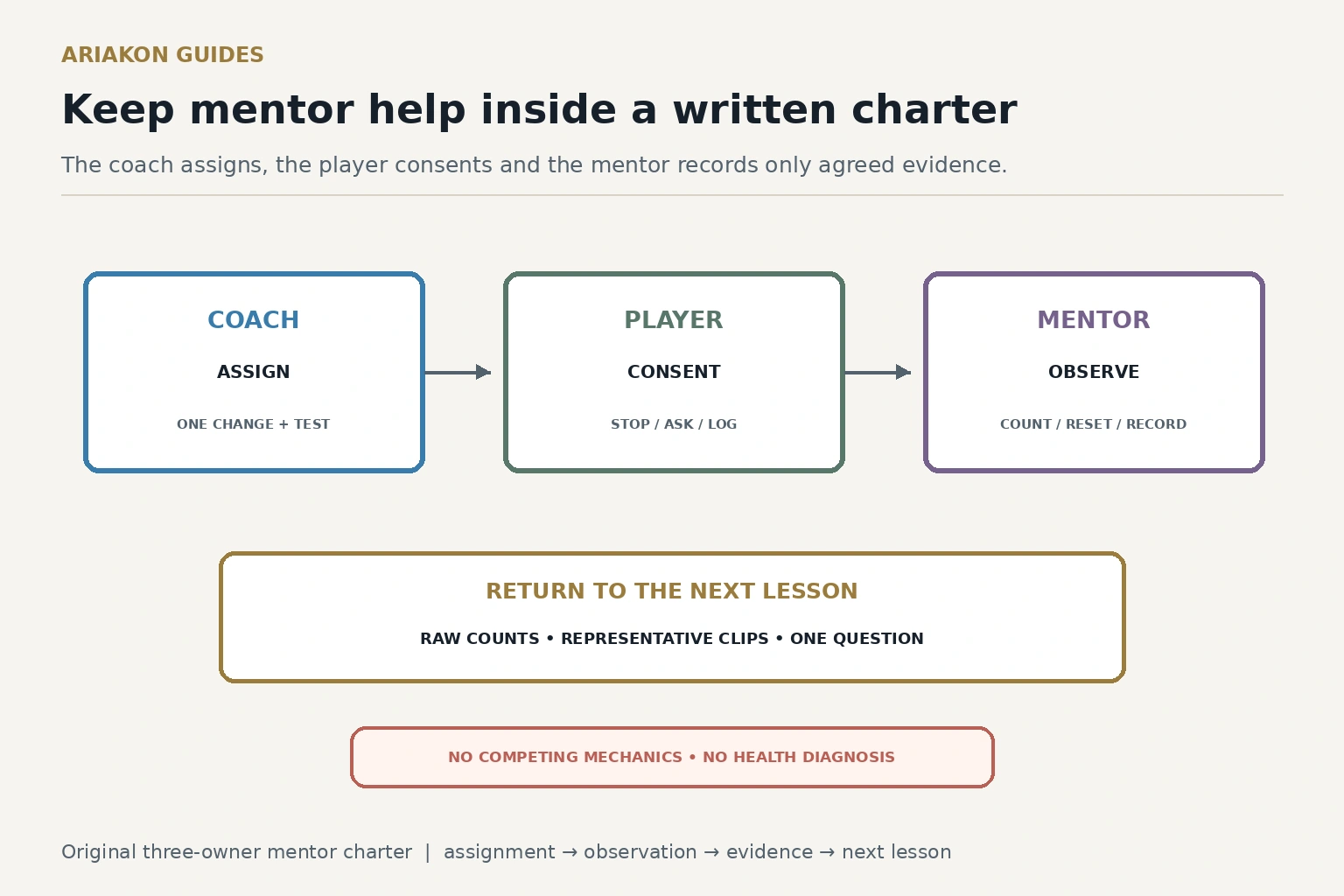
Write the assignment before naming the mentor
| Field | Write exactly |
|---|---|
| Coach assignment | One drill and one change or external cue |
| Setup | Ball marks, distance, speed and attempts |
| Evidence | The result fields the coach wants returned |
| Feedback timing | After attempt, after block or not during session |
| Stop point | Pain, distress, unsafe setup or assignment uncertainty |
| Next lesson | Date or review condition |
Choose a qualified pool coach before assigning formal diagnostic authority.
Ask a diagnosable instructor question when the evidence needs to return as one testable question.
Use a three-owner mentor charter
A mentor can also provide company, scheduling support and encouragement. Those are valuable without requiring technical authority. Credentials, safeguarding needs and venue policies still matter when selecting anyone who works with a minor or vulnerable player.
| Owner | May do | Must not do |
|---|---|---|
| Coach/instructor | Assign diagnosis, change and test | Assume unseen practice followed the plan |
| Player | Consent, stop, ask and keep the log | Practice through pain or unwanted recording |
| Mentor | Count, reset, record agreed fields and neutral video | Add mechanics, diagnose health or overrule coach |
Use neutral language during the block
If the assignment is unclear, pause and write the question for the coach. Guessing is not continuity. Delete or retain recordings according to the player's consent and applicable venue policy; no upload is required.
| Allowed observation | Competing instruction to avoid |
|---|---|
| The cue ball finished right on four attempts | Move your elbow inward |
| The assigned finish hold was visible on seven of twelve | Your grip is wrong |
| The ball mark moved after attempt six | That drill no longer matters |
| You asked to stop recording | One more clip will fix it |
Worked example: protect one finish-line assignment
A formal instructor assigns twelve straight stop shots with the cue finishing through a visible shaft-width gate. The mentor replaces the balls, marks pocket/stop/gate and gives no feedback until the block ends. Results are 9 pockets, 7 stop-window finishes and 8 gate matches. On three misses the gate still matches, so the mentor does not announce that the stroke caused every miss.
The mentor returns the sheet and two consented representative clips. The player's next question is: ‘The gate held on eight shots but the stop window held on seven; should the next block keep the gate and test contact height?’ The coach owns that decision.
End or revise the arrangement when boundaries drift
| Signal | Action |
|---|---|
| Mentor adds a second mechanical cue | Stop; return to the written assignment |
| Player feels watched or pressured | Remove observation or end the session |
| Evidence field cannot be seen reliably | Mark unknown and ask the coach |
| Assignment holds across two blocks | Return evidence; do not increase difficulty automatically |
| Pain, injury concern or safeguarding issue | Stop and use appropriate qualified channels |