
Artistic pool · 8 min read
Three Simple Pool Trick Shots for a Controlled Demonstration
A clear demonstration gives viewers one observable job and lets the performer repeat it without escalating risk. These three cards use ordinary strokes, explicit ball centers and separate rehearsal gates. A successful edited clip cannot replace the record of what happened on each attempt.
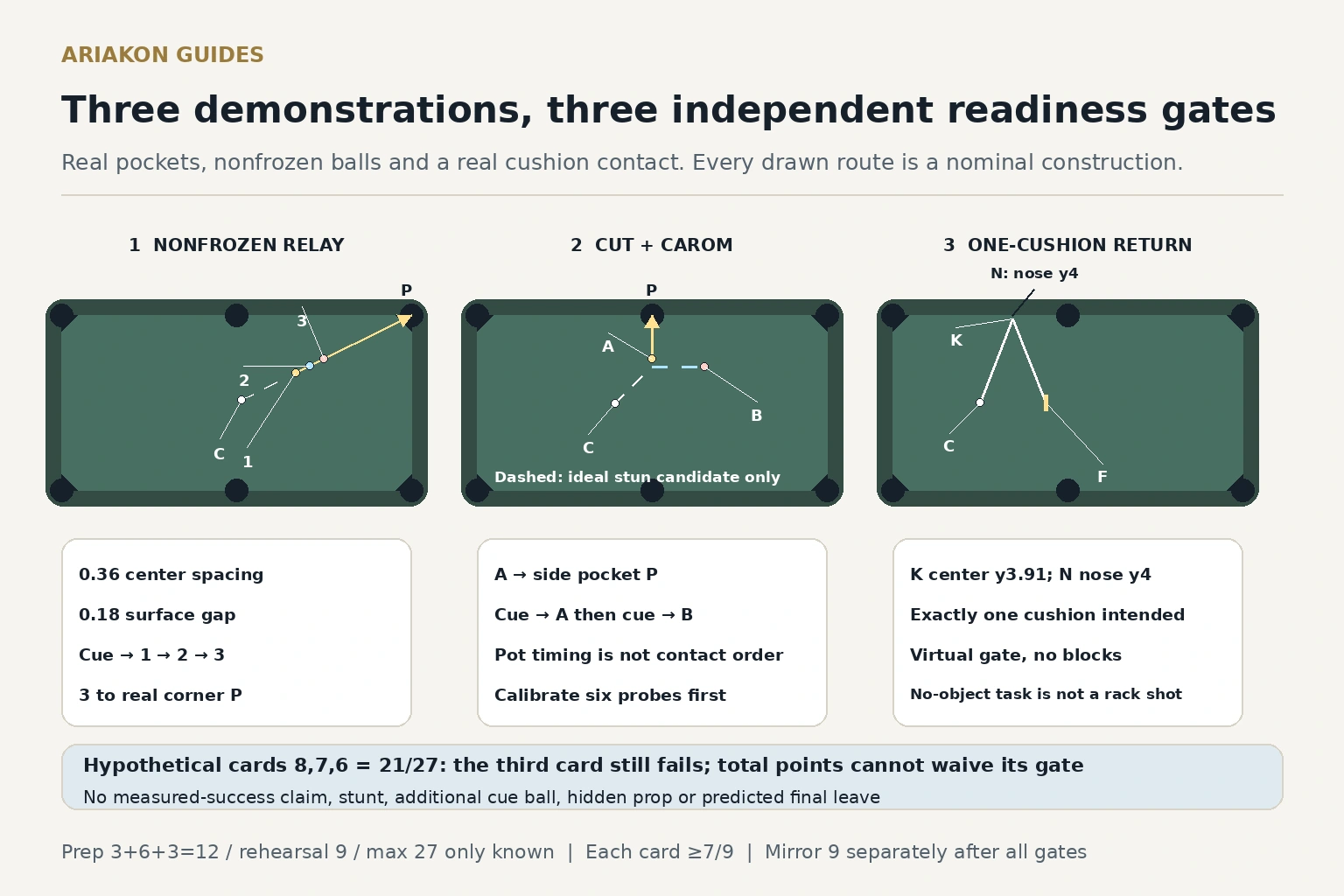
Keep the demonstration ordinary and transparent
Use only permitted practice on a clear table. No jump, scoop, steep cue elevation, prop, fire, glass, person or camera belongs in a ball or cue path. Keep spectators back, use a stable familiar bridge and stop on hop, miscue, uncontrolled rebound, cloth contact or an unsafe reach. No stunt is necessary for these examples.
These are independently constructed rehearsal cards, not official Artistic Pool program shots or a recreation of a performer’s clip. PBIA teaching guidance recommends prepared, visually clear demonstrations; it does not supply these layouts or the 0..3 readiness score. Remove any layout aids before shooting and show the misses as well as the make.
Apply the complete artistic-practice safety boundary before a presentation.
Use the five ordinary shot-skill families when choosing which underlying task to practice.
Card 1: build a nonfrozen three-object relay
Use ball-center coordinates on an illustrative 100×50-inch bed: x=0..8 along the length and y=0..4 across it, origin at the lower-left cushion-nose corner. One unit is 12.5 inches; equal 2.25-inch balls have radius 0.09 and diameter 0.18 units. Intact-cushion center limits are 0.09..7.91 and 0.09..3.91. The four corners and (4,0),(4,4) are real pockets. Measure the actual bed, balls, mouths and jaws before scaling. Remove measuring aids before striking; do not mark a competition table.
Use real upper-right P(8, 4) and u=(2,1)/√5. Final object 3 starts at (6, 3); put object 2 at (5.678006, 2.839003) and object 1 at (5.356012, 2.678006). Consecutive centers are 0.36 units apart, so the surface gap is 0.18 units or 2.25 inches here. They are not frozen. Intended first-contact cue center is G1(5.195016, 2.597508); cue starts at (4.121703, 2.060851). All centers are collinear toward the pocket.
Call cue→1→2→3, with 3 entering P. Use no intentional sidespin and modest ordinary pace. A contact chain may have later additional collisions; the required first sequence is what the observer must establish. The finish bonus requires a legal shot, no unsafe event and the cue resting behind object 2’s starting plane: dot(F−O2,u) ≤ −0.09. This is a chosen control check, not a guaranteed leave. Inspect actual jaws before treating the center line as pocket-accessible.
| Label | Center / reference | Job |
|---|---|---|
| Cue | (4.121703, 2.060851) | First object must be 1 |
| 1 | (5.356012, 2.678006) | Transfer to 2 |
| 2 | (5.678006, 2.839003) | Transfer to 3 |
| 3 | (6, 3) | Enter real P(8,4) |
| G1 | (5.195016, 2.597508) | Cue center one diameter behind 1 |
Card 2: establish the cut before placing the carom target
Use A(4, 3) to real upper side pocket P(4, 4). Its intended first-contact cue center is G(4, 2.82). Start cue C(3.151472, 1.971472) on the approach v=(1,1)/√2. With a calibrated stun arrival, the ideal initial cue direction is +x, perpendicular to A’s +y object line. Rolling arrival is not the same tangent candidate; do not claim one fixed tip position guarantees stun.
Begin with B absent. Take six ordinary, no-sidespin probes at one comfortable input, recording the A pot and the cue’s first center crossing at x=5.02. Require at least four known legal A pots, all six crossings observable, and all crossings within ±0.18 of their median. If the gate fails, hold the full carom and use the tangent prerequisite. Select no completed-only subset.
For the nominal median y=2.82, place B(5.2, 2.82). The intended cue contact at B is GB(5.02, 2.82), one diameter to B’s left. If the measured median differs, place B at (5.2,median y) and preserve that new version in the card. Require B and its approach to remain within bed bounds and clear of A’s pocket line; the provided nominal coordinates are not a promise of where your ball travels.
Call cue→A then cue→B, and A in the side pocket. A’s pot can occur before or after cue→B; do not assert an unmeasured time order between those separate branches. The finish bonus is a known safe cue rest inside x=4.5..5.6,y=2.4..3.2, without scratch or off-table event. If that is not controllable at the calibrated input, choose a simpler demonstration instead of applying more force.
Calibrate the tangent/stun arrival first before using the carom candidate.
Keep contact order separate from the finished effect when observation leaves a required event unresolved.
Card 3: return from one intact cushion without sidespin
Place only cue C(2, 2) and use no intentional sidespin. Aim along the center line toward K(2.75, 3.91) on the upper ball-center envelope y=3.91. At K the ball’s top edge touches physical cushion nose N(2.75, 4). This is an intact cushion away from upper side pocket (4,4), not a turn inside the bed.
The ideal equal-angle reflection passes outbound-to-return target F(3.5, 2). It follows by mirroring F over y=3.91 to (3.5, 5.82). Local cushion response, pace and delivery can move the actual return, so observe rather than promising the reflected line. Use a virtual return gate at the first post-cushion x=3.5 crossing, accepting cue-center y=2±0.18. No physical gate objects remain on the cloth.
Call ordinary strike→upper cushion→return window. This cue-only path task is not a legal ordinary rack shot because it has no object-ball first contact. The finish bonus requires exactly one cushion contact and safe rest inside x=3.5..4.1,y=0.6..2.0. Choose a comfortable pace that stops before another cushion; a second rebound, pocket or unresolved finish earns no bonus. Do not add running sidespin to hide an inaccurate initial direction.
Prepare components before the nine scored rehearsals
The preparation ceiling is 3+6+3=12 strikes. Work card by card; a failed component does not license its complete demonstration. You may continue a different safe card, but leave any withheld card’s rehearsal slots unused. Record actual preparations and retests separately.
After a card’s component passes, reset the complete card for three rehearsal attempts. Nine actual rehearsals and a maximum of 27 points occur only if all three cards are reached and all applicable outcomes are known. Do not report unused or obscured attempts as physical misses.
| Card | Actual component strikes if completed | Component gate |
|---|---|---|
| Relay | 3; object 3 alone, same pocket, cue one unit behind its contact center | At least 2 known legal pots, no safety stop |
| Cut/carom | 6; A only, B absent | Six crossings known; ≥4 pots; crossing spread as above |
| Rail return | 3; complete cue-only return | At least 2 known windows and safe finishes, no second cushion |
Score the observable prefix, effect and controlled finish
A known foul or unsafe event scores 0 even if other fields are hidden. Otherwise an unresolved required prefix or finish makes the nested score unscored; remove its three possible points from the known denominator and retain any visible events independently. A known successful effect with unknown finish cannot be called 2 merely because 3 was not proven.
Each card is ready only when all three rehearsals are completed and known, it scores at least 7 of 9, at least two main effects succeed, and there is no foul or safety stop. A high combined total cannot waive another card’s gate. Hypothetical card totals 8,7,6 give 21 of 27 known points: the third card still fails, so the complete presentation is not ready. Unknown outcomes first need better observation, not harder delivery.
| Points | Relay | Cut/carom | Rail return |
|---|---|---|---|
| 0 | Known foul, wrong first contact or unsafe event | Known foul, wrong first contact or unsafe event | Unsafe event or failure to reach required upper cushion |
| 1 | Required ball order known; 3 misses P | Cue→A then B known; A misses P | Upper cushion known; return window known missed/not reached |
| 2 | Order and legal 3 pot; known finish bonus fails | Order and legal A pot; known finish bonus fails | Required cushion/window known; known finish bonus fails |
| 3 | Effect plus known finish bonus | Effect plus known finish bonus | Window plus known one-cushion safe finish |
| Unscored | A required prefix or bonus remains unknown | Keep known pot separately; do not invent B contact | An obscured crossing/finish is unknown, not zero |
Present the method and transfer one ordinary skill
Only after every card passes, rehearse the mirrored versions three times per card on a new page: x becomes 8−x for every center, direction and pocket. The top side pocket stays (4,4), the relay uses (0,4), and the rail K becomes (5.25,3.91) with return F(4.5,2). Recalibrate the carom’s six-probe input separately if the mirror does not preserve the demonstrated path; those extra probes are not in the nine mirrored rehearsal strikes.
The initial ceiling is 12 preparation +9 rehearsal=21 strikes. Adding nine mirrored rehearsals gives 30 only when all original gates and mirrored attempts finish; any new preparation/retest is extra. The original and mirror scores each have their own maximum 27, never a general ability grade.
For match transfer, select the relay as an ordinary combination only when object 1 is the legal first target and 3 may legally be pocketed under the chosen game. In ordinary nine-ball the first hit must be the lowest remaining ball; pocketing 3 does not win the rack. The carom trains controlled secondary contact, while the cue-only return remains a route calibration rather than a match shot.
| Moment | What to show | Keep honest |
|---|---|---|
| Before | One named effect and required contacts | No claim of impossible physics |
| Setup | Centers, nonfrozen spacing or actual cushion | No hidden prop or unapproved marker |
| Attempt | One quiet ordinary stroke | Spectators outside the travel area |
| After | Known effect, first failed event or unknown | Keep the unsuccessful take in the record |
Separate rail calibration from legal escape outcomes when transferring the cushion task.
Review the recording’s evidence limits before claiming unseen contact or exact timing.
Sources and further reading
References support the specific factual information above. The practical checklists are Ariakon editorial guidance.