
Artistic pool · 5 min read
Analyze an Artistic Pool Sequence One Contact at a Time
A finished combination can hide the first missing or unobservable event. This resource separates the contact ledger from the result score, then tests a simple ordinary chain at three bounded stages. It is not a reproduction of a performer’s sequence, a named training program or an official Artistic Pool scoring system.
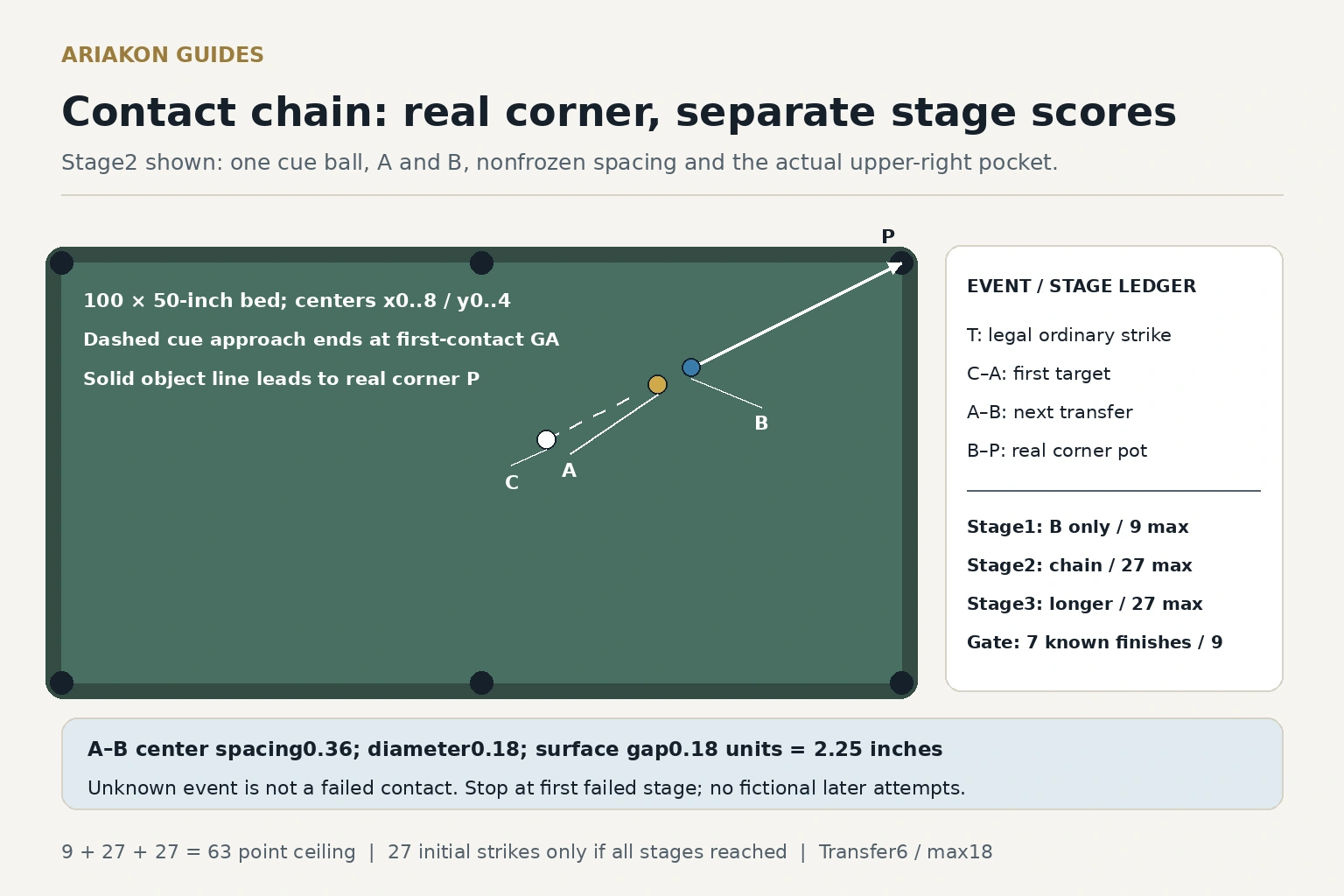
Define events without inventing what the camera missed
Write failed only when evidence shows that a required event did not occur. An obscured or off-frame event is unknown, not a failed physical transfer. Do not infer exact timing, impulse or continuous contact from successive frames. Ordinary in-person scoring can establish a legal shot without a phone resolving the microscopic tip interval; keep those kinds of evidence distinct.
The WPA Artistic Pool Division publishes program-dependent competition formats and scoring. The coordinate exercise below is an original ordinary-combination example for analysis, not one of those official shots or a disguised recreation of source video media.
| Event | Question | Allowed record |
|---|---|---|
| T | Was the ordinary cue-tip strike legal and observable? | Confirmed, failed or unknown; first motion alone is not resolved tip contact |
| C–A | Did the cue ball first contact A? | Observed first contact, wrong target or unknown |
| A–B | Did A then contact B? | Confirmed transfer, missed transfer or unknown |
| B–P | Did B enter the chosen real pocket? | Known legal pot, miss/foul or unknown |
Apply the broader video-to-safe-practice progression before reconstructing any unfamiliar specialty sequence.
Keep a bounded visible-event ledger when camera evidence is the main unresolved issue.
Place three nonfrozen centers on one line
Use ball-center coordinates on an illustrative 100×50-inch bed: x=0..8 along the length, y=0..4 across it, origin at the lower-left cushion-nose corner. One unit is 12.5 inches; equal 2.25-inch balls have radius 0.09 and diameter 0.18 units. Intact-cushion center limits are 0.09..7.91 and 0.09..3.91. Real pockets interrupt the boundary at four corners and (4,0),(4,4). Measure the actual bed, balls and pocket mouths before scaling. Remove measuring aids before shooting and never mark a competition table.
Let B(6, 3) lead toward real upper-right P(8, 4) with u=(2,1)/√5. Place A(5.678006, 2.839003) = B−0.36u. Center spacing is 0.36 units, twice the 0.18 diameter; the surface gap is 0.18 units, or 2.25 inches on this illustrative bed. One ball-width of center separation would be frozen, not a visible gap.
For cue-to-A first contact use GA(5.517009, 2.758505) = A−0.18u. All starts below are collinear with A,B,P; use modest ordinary delivery with no intentional sidespin. A required first contact can be followed by additional contacts later: the ledger checks the stated first required order, not an unsupported claim that no other collision ever occurs.
| Stage | Objects | Cue start | Required finish |
|---|---|---|---|
| 1 | B only; remove A | (4.944576, 2.472288); G=(5.839003, 2.919502) | Legal B pot |
| 2 | A and B | (4.622582, 2.311291); GA=(5.517009, 2.758505) | Cue→A→B→P |
| 3 | Same A and B | (3.728155, 1.864077); same GA | Same chain, twice the Stage 2 approach distance |
Use a different score when the chain has fewer events
Stage 1 has nine allocated strikes:0 for a known miss/foul,1 for a known legal B pot, maximum 9. It has no A–B event to reward. Stages 2 and 3 each have nine allocations and use the nested 0..3 scale below, maximum 27 per stage only if all applicable scores are known.
Record unknown events and known outcomes independently. A visible B pot cannot certify an unseen A–B contact. If a required prefix is unknown, leave the nested score unscored, reduce its maximum by 3, and retain the known pot as a separate outcome. A known foul scores 0 even if some contacts are unobservable.
| Points | Established result |
|---|---|
| 0 | Known foul or known failure of cue→A first contact |
| 1 | Known legal strike and cue→A, but A→B fails |
| 2 | Required ball contacts in order, but B does not legally enter P |
| 3 | Required order and known legal B pot |
Advance by known finishes and stop at the first failed stage
At each stage require at least 7 known final successes among its 9 actual strikes, no safety stop, and the same setup throughout the last 3 attempts. An unknown is not one of the 7 successes. If fewer than 9 strikes can be completed safely, do not invent the remainder or declare the gate passed.
A failed Stage 1 stops the initial progression at 9 strikes; a failed Stage 2 after a passed Stage 1 stops at 18. Reaching the end of Stage 3 uses 27 strikes. Complete known score ceilings are 9+27+27=63, not 81, because Stage 1 has only one outcome point. Gate passes are separate from that total.
Retest a failed stage with one modest change as a new nine-strike record, not a replacement of the earlier score. Do not add the retest points to 63 and still call it the same progression. No automatic six-shot transfer or full 27-strike claim follows from an earlier failed gate.
Let the first established failure choose the next check
A miss label is not proof of its hidden cause. Inspect before changing; keep one named variable fixed for the retest. Stop if the task needs a prop, scoop, aerial ball, uncontrolled force or unfamiliar elevated delivery.
| Record | Next check | Keep fixed |
|---|---|---|
| T unknown | Improve the permitted observation; do not claim contact duration | Ball centers and ordinary delivery |
| Cue misses A | Recheck cue start and chosen approach | A,B and pocket |
| A misses B | Recheck nonfrozen spacing and intended first contact | Pocket and comfortable pace |
| B misses P after contacts | Recheck B line and actual mouth/jaws | Do not introduce elevated cueing |
| Same chain fails only at Stage 3 | Inspect longer approach/setup and ordinary delivery | Do not add another object or prop |
Transfer to an ordinary legal combination separately
Only after the full stage gate passes, take six mirrored Stage 2 attempts: B(2, 3), A(2.321994, 2.839003), P(0, 4), GA(2.482991, 2.758505), cue C(3.377418, 2.311291). Use A as 1 and B as 2 under ordinary nine-ball contact rules. First contact must be 1; a legal pot of 2 is an ordinary combination outcome, not a win and not a required first hit on 2.
Use the same 0..3 prefix score: maximum 18 for six known attempts, separate from the initial 63. Twenty-seven initial plus six transfer strikes makes 33 only when every initial stage and the transfer finish. The video-safety resource handles unfamiliar reconstruction; this guide supplies exact nonfrozen geometry and honest event/score bookkeeping.
Choose practical ordinary shot skills without stunts when the useful task does not require an artistic sequence.
Sources and further reading
References support the specific factual information above. The practical checklists are Ariakon editorial guidance.