
Equipment care · 4 min read
Ten Pool Tools: Essential, Optional and Best Left to a Technician
The useful tool is the least intrusive one permitted for the observed task. This ten-group map separates ordinary wiping, protection and documentation from material-changing work. It is not a claim that every player needs ten purchases, nor that a familiar tool authorizes a repair on an unfamiliar shaft.
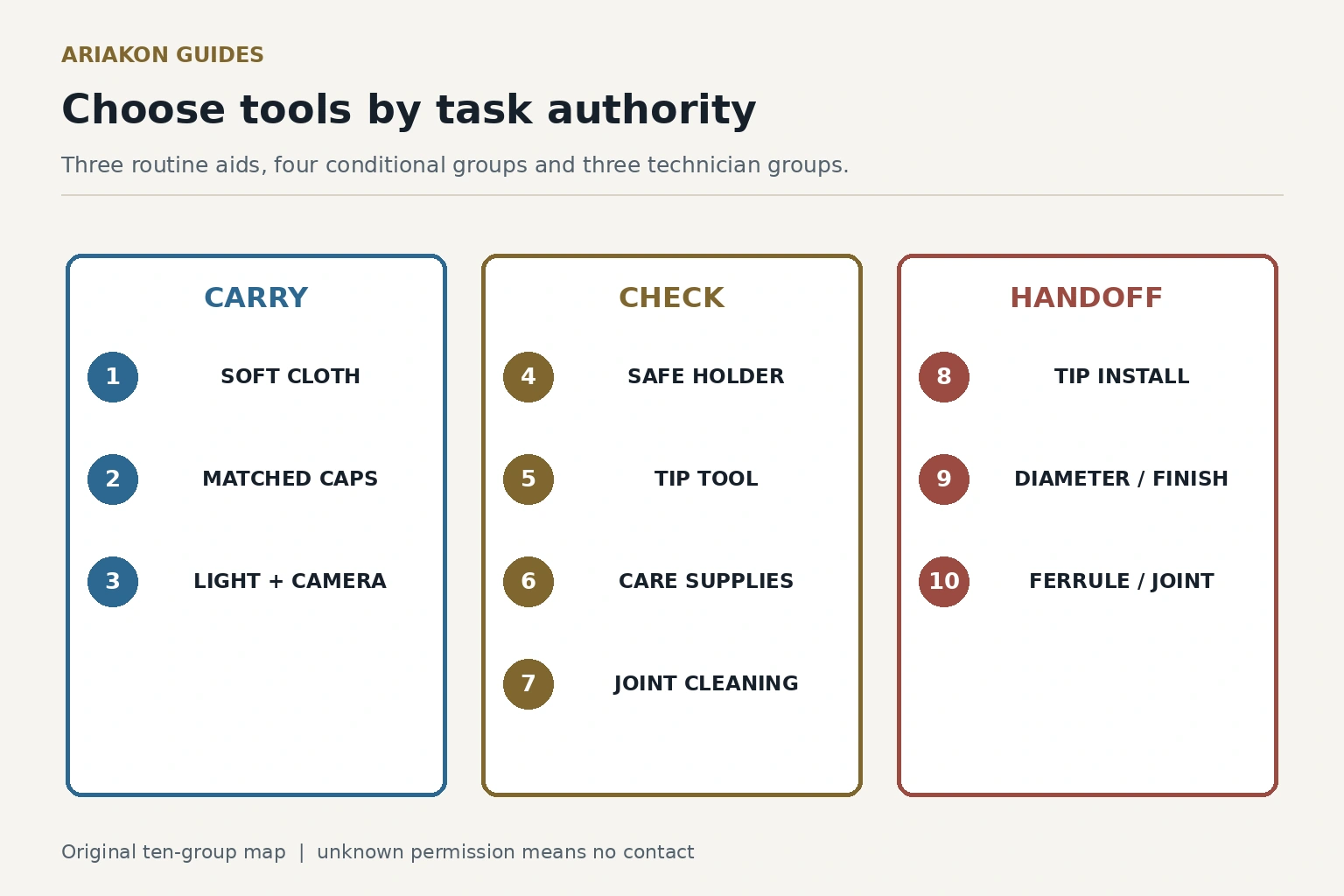
Match the ten numbers to their actual boundaries
The image numbers mean these rows, not a ranking. Carry contains three aids, Check contains four groups and Handoff contains three groups: 3+4+3=10. A current instruction can prohibit a task even for a technician; Handoff means ask, not automatically authorize.
A player may use only a cloth and documentation aid at a session. Do not count separately packed heads on a combination tool as permission for extra functions. Keep inactive abrasive or cutting faces isolated from the cue.
| # and tool group | Default zone | Condition or stop |
|---|---|---|
| 1. Clean soft cloth | Carry | Remove loose surface debris only by the permitted method |
| 2. Exact matched joint protectors | Carry | Fit must be documented; never force or use a pin as a gauge |
| 3. Light and camera | Carry | Record the surface; do not probe a crack |
| 4. Stable cue holder | Check | Placement and support must be safe; no crowded traffic route |
| 5. Leather-tip shaper or scuffer | Check | Known construction, height, bond, tool fit and one permitted function |
| 6. Exact-model shaft-care supplies | Check | Material/finish and written method known; no generic solvent recipe |
| 7. Soft accessible-joint cleaning aid | Check | Only the published method; binding or loose hardware stops work |
| 8. Tip cutting, clamping or lathe tools | Handoff | Installation requires competent model-specific work |
| 9. Shaft abrasive or diameter-changing tools | Handoff / may be prohibited | No player-level sanding or undocumented finish modification |
| 10. Ferrule, joint-facing or internal hardware tools | Handoff | Exact design and authorization required; no forced repair |
Audit the actual case load after choosing safe functions.
Buy an accessory for one observed need rather than treating this map as a shopping list.
Complete the four-field job card
There are four required fields, not four points that can compensate for an unsafe bond. Photograph the baseline before a permitted action, then recheck after the minimum instructed motion. An unknown pad, plate, finish or minimum dimension stops any proposed removal.
| Field | Required record | Unknown means |
|---|---|---|
| Part and material | Exact cue/shaft/front-end identity and finish | Inspection only |
| Task | Visible problem and one intended change | Do not select a tool yet |
| Permission | Current exact instructions and competent user | Ask maker or service |
| Stop | Inspection interval and irreversible boundary | Do not start |
Use material-specific stop rules
A cleaner intended for one finish is not a compatibility fact for another. Cleaning does not repair missing material or looseness. Likewise, a shaped crown does not repair a sidewall bulge or failed installation. Choose the separate resource that owns the observed task.
| Part | Starting boundary | Stop or handoff |
|---|---|---|
| Ariakon carbon equipment | Published FAQ: clean soft cloth, avoid abrasives, heat and modifications | Ask before unfamiliar care products; no shaft sanding |
| Other wood or composite finishes | Exact maker instructions, not a generic material label | No water, coating, chemical or abrasive experiment |
| Leather crown | Sound bond/height and documented tool use | Tear, lifted layer, off-center crown or ferrule contact |
| Ferrule, pad or front-end plate | Non-contact visual record | Crack, motion, uncertain construction or removal |
| Joint or internal weight system | Accessible observation and exact instructions | Binding, moving pin, unknown fastener or unexplained gap |
Preserve crown radius with a recorded reference when geometry is the actual issue.
Keep material-specific care kits separate rather than carrying one chemical recipe.
Work a three-job case decision
Example: ordinary carbon surface dust selects group 1 under the exact published care boundary. A suspected joint defect selects group 3 for photographs and then group 10 as a service question, not a facing operation. A glazed leather tip suggests group 5, but missing height and construction records prevent contact.
The player packs two routine aids, leaves the conditional shaper unused and adds no cutting tool. The three four-field cards contain twelve possible confirmations; if two cards have all four fields and one has only two, the record is 4+4+2=10/12. The incomplete card remains stopped, even though the total looks high. This readiness count is not repair competence or equipment quality.
Preserve the evidence when handing off
This page is a ten-group authority map. The case-load audit, accessory-buying worksheet, individual tip-tool procedures and cue-service packet remain independently useful. No blanket essential purchase or warranty eligibility is invented.
- Keep the intact relevant components, photos and exact model records together.
- Describe the symptom and any permitted care already performed.
- Ask what parts service needs; do not send an unrelated near-fitting shaft.
- Agree the work and limits before cutting, facing or internal adjustment.
- Record replacement parts and the returned condition without rewriting the original identity.
Sources and further reading
References support the specific factual information above. The practical checklists are Ariakon editorial guidance.