
Buying guide · 4 min read
Choose Pool Accessories by Function Instead of Novelty
A useful accessory removes a repeated problem without introducing an unverified fit, care or rules dependency. This buying worksheet starts with observed incidents, then qualifies candidates on the same seven facts. Appearance may matter to you, but it is not evidence of compatibility or a solved practice problem.
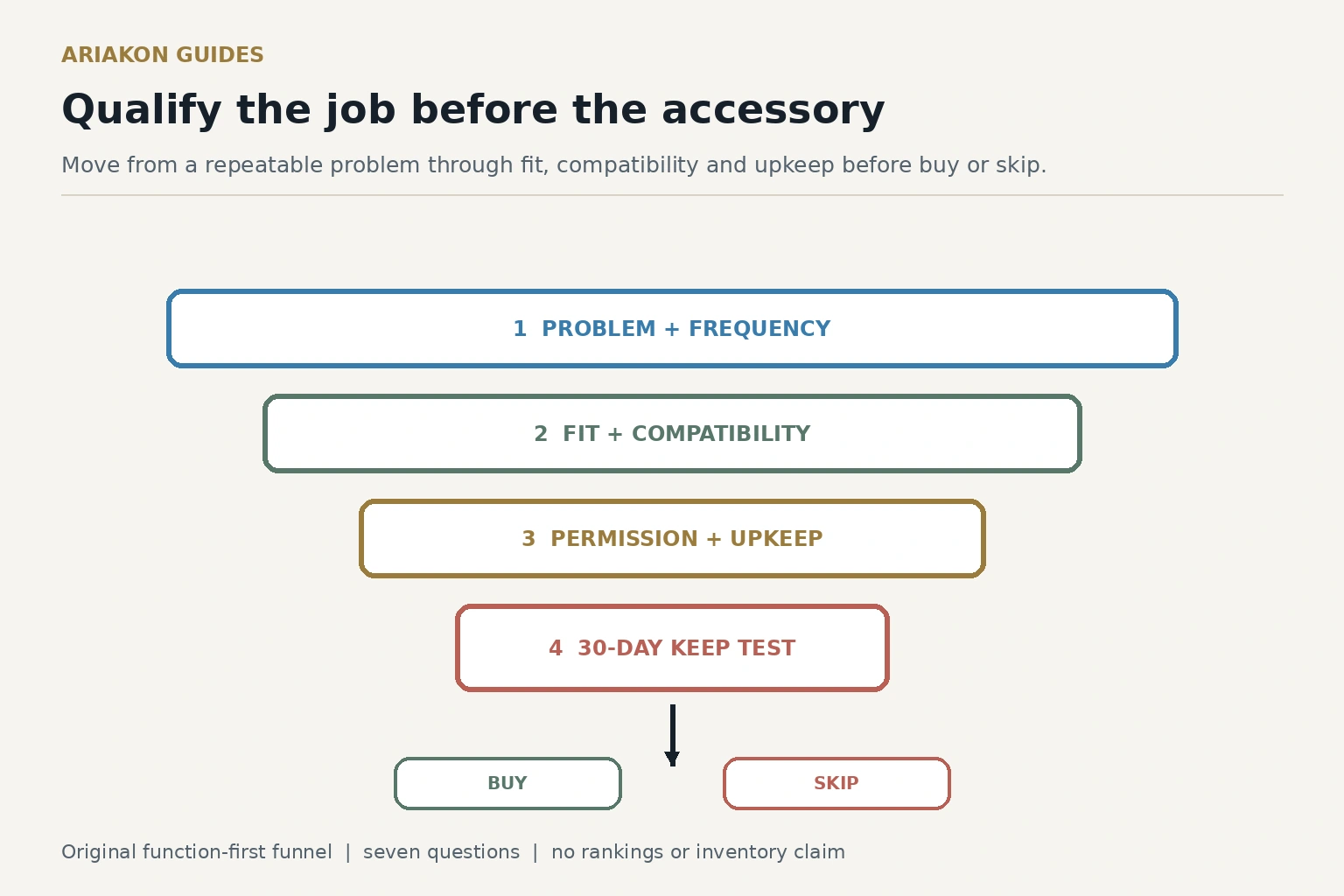
Name the job before browsing
Write one sentence: “I need to ___ when ___.” If the sentence cannot be completed, postpone the purchase. A product category is not a problem statement.
WPA rules and equipment specifications define boundaries for sanctioned play, but local rooms and events may add restrictions. Verify the actual setting before assuming an accessory is allowed.
| Job | Examples to investigate | Proof you need |
|---|---|---|
| Protect | Case, joint protectors, cue sleeve | Dimensions, joint fit and storage method |
| Reach | Mechanical bridge head or complete bridge | Shaft fit, table permission and stable use |
| Maintain | Tip tool, shaft cloth or approved cleaner | Maker instructions and material compatibility |
| Practice | Markers, score sheet or training ball | A defined task and observable feedback |
| Comfort | Glove, towel or grip aid | Personal fit, care and room or event rules |
Shop pool equipment without rushing after the function is defined.
Choose training tools by feedback when the purpose is practice rather than storage or care.
Run the seven-question gate
Mark each gate VERIFIED, UNKNOWN or FAILED and save its evidence. Seven verified fields qualify a candidate for comparison; one failed safety, compatibility or permission gate excludes it regardless of price. Do not add scores that let convenience compensate for an unsafe fit.
| Gate | Question | Stop signal |
|---|---|---|
| 1. Problem | What repeatable friction does it solve? | Only novelty or appearance is named |
| 2. Frequency | How often did the problem occur in the last month? | No observed use case |
| 3. Fit | What body, case, cue or table dimension matters? | Required dimension is unknown |
| 4. Compatibility | What material, joint or shaft limits apply? | Maker guidance conflicts or is absent |
| 5. Permission | Is it allowed in the room and event? | Rules are assumed |
| 6. Upkeep | How is it cleaned, stored or replaced? | Care burden is unacceptable |
| 7. Evidence | What result after thirty days would justify keeping it? | No observable success condition |
Compare candidates on the same facts
Use manufacturer documentation for dimensions and care. Retail copy can help identify a candidate, but it does not replace fit checks. For cue-maintenance products, the shaft, finish and tip maker’s instructions outrank a generic claim on a multi-tool package.
| Field | Candidate A | Candidate B | Candidate C |
|---|---|---|---|
| Exact job | |||
| Verified dimensions or fit | |||
| Material or joint compatibility | |||
| Carry space and setup time | |||
| Maker-required care | |||
| Failure cost | |||
| Thirty-day keep test |
Worked example: protect a cue joint in transit
A player notices exposed joint faces contacting case fabric twice in one month. The job is protection during transport. Candidate A is a matched joint-protector set; Candidate B is a padded case divider; Candidate C is doing nothing. The player records the actual joint type, protector length, case clearance and maker care instructions before comparing cost.
The matched set fits the documented joint and closes inside the case without pressure. The thirty-day test is simple: install it on every trip and record any contact or difficulty. A decorative protector with an unverified pin label fails the compatibility gate even if it looks better.
In a hypothetical thirty-day record, there are eight trips, eight installations, zero joint-to-fabric contacts, two awkward removals and four minutes of total added handling. The original two-contact problem is absent during this observed period, but this small record does not prove damage prevention. Decide whether the handling cost is acceptable; do not describe the observations as a manufacturer test.
Keep, return or retire with evidence
At thirty days, record uses, recurrence of the named problem, added setup minutes and required care. Compare with the pre-purchase incident record. Keep, modify your routine or stop using the accessory based on that evidence. If considering a return, first check the exact seller’s deadline, used-item conditions and fees; a thirty-day observation plan is not a promised return window.
Retire a damaged tool, uncertain chemical or poor-fitting accessory. A purchase is not validated by sunk cost, and a skipped purchase can be the correct outcome of the worksheet.
Sources and further reading
References support the specific factual information above. The practical checklists are Ariakon editorial guidance.