
Practice planning · 3 min read
Ten Pool Session Formats for Friends With Different Skill Levels
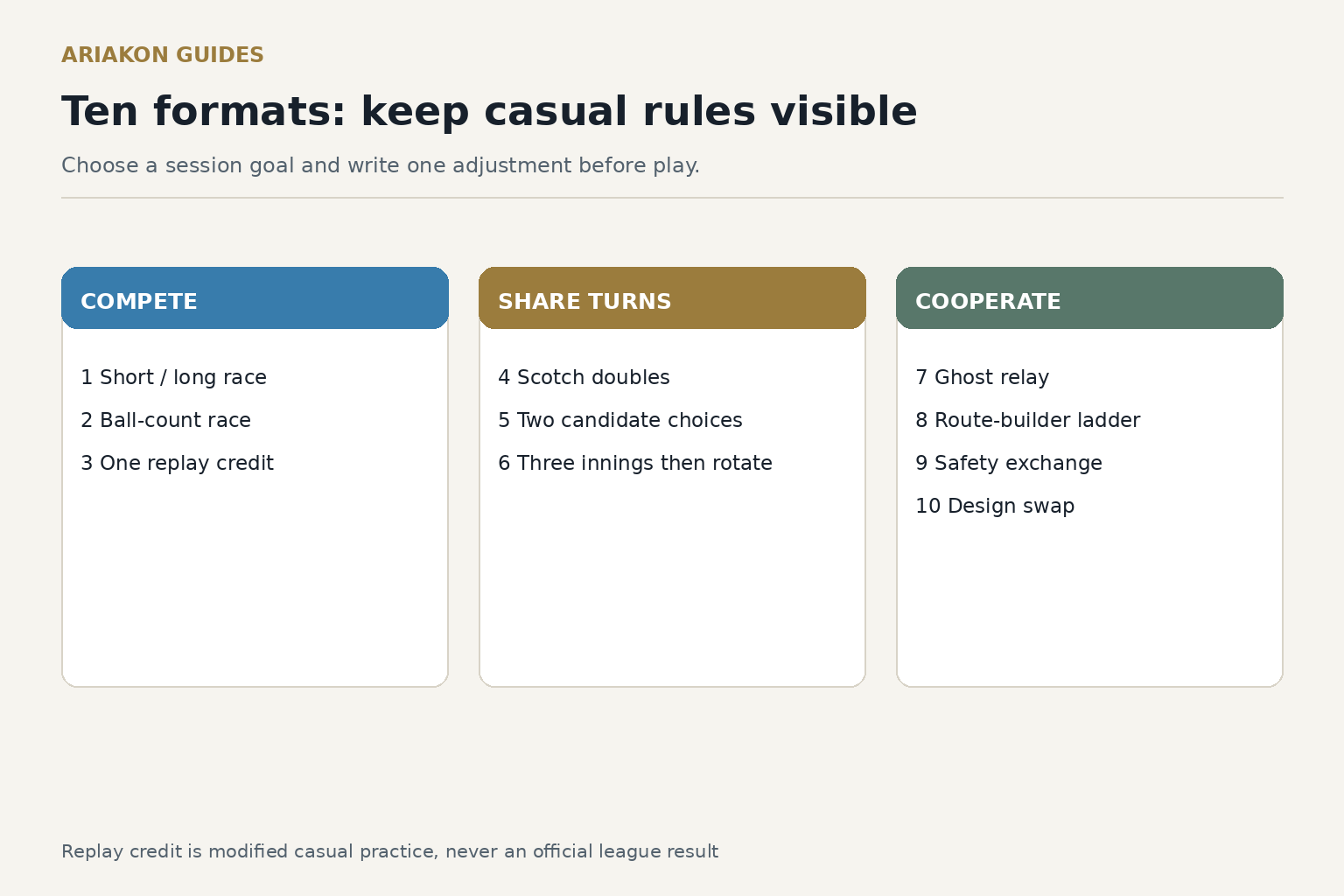
Friends with different skill levels do not need to choose between a mismatch and a lesson. A good format gives each player meaningful decisions, visible progress and enough table time. The ten options below are original casual-session structures, not official league handicaps; use formal league ratings and rules only inside the organization that owns them.
Choose the session goal before the handicap
| Question | Options | Write | Why it matters |
|---|---|---|---|
| Primary goal | Compete / cooperate / learn / socialize | One word | Prevents incompatible expectations |
| Available time | 30 / 60 / 90+ minutes | Hard stop | Controls race and rotation length |
| Skill spread | Narrow / moderate / wide | Observable evidence | Determines adjustment strength |
| Player count | 2 / 3 / 4+ | Names and order | Prevents long idle gaps |
| Preferred discipline | 8-ball / 9-ball / drills / mixed | One default | Keeps rules comprehensible |
Use structured solo and partner practice games when the main goal is skill development rather than a social match.
Formats 1–3: adjust the finish, race or points
| Format | Setup | Balancing control | Session record |
|---|---|---|---|
| 1. Short-and-long race | Same game; players have different rack targets | Set targets before play | Final racks and elapsed time |
| 2. Ball-count race | Score each legally pocketed object ball | Stronger player needs more points | Points per inning |
| 3. Replay-credit practice 8-ball | Casual practice only: developing player has one replay credit | After a nonfoul non-8 miss, restore all centers for one replay; use its result, then continue ordinary turns. No replay after foul or on 8 | Original miss, replay and modified-practice rack winner; not an official result |
Formats 4–6: share decisions and turns
| Format | Setup | Fairness rule | Learning signal |
|---|---|---|---|
| 4. Balanced scotch doubles | Pair stronger with developing; alternate shots | No coaching during stroke | Successful handoffs |
| 5. Captain's two options | Partner names two legal candidates; shooter chooses | No third hidden answer | Choice and outcome |
| 6. Three-inning rotation | Each player gets exactly three innings, then rotate | Same table state continues | Points or safeties per turn |
Formats 7–10: make progress the result
| Format | Shared task | Level control | Win condition |
|---|---|---|---|
| 7. Team ghost relay | Clear a fixed layout as a group | Developing player gets ball in hand once | Beat the group's prior innings |
| 8. Route-builder ladder | Add one ball after a successful run | Stronger player starts farther back | Highest shared rung |
| 9. Safety-and-escape exchange | One player sets safety, next attempts legal escape | Setters use matched difficulty bands | Combined legal-contact streak |
| 10. Three-ball design swap | Each person designs a solvable three-ball pattern | Designer must demonstrate or simplify | Every player completes one pattern |
Use only one main adjustment
Official handicap systems demonstrate that different races or points can help players of different abilities compete more evenly. APA's current Equalizer materials are one formal example, but the casual formats here do not reproduce an APA skill level and must not be represented as an official rating.
Choose one visible adjustment—race target, point target, ball in hand, starting distance or role. Stacking several advantages makes the result hard to interpret. Write the adjustment before the first rack and change it only at the planned review point.
Work a four-player sixty-minute example
| Minutes | Format | Players | Observable target |
|---|---|---|---|
| 0–5 | Rules and warm-up | All four | Each makes one straight stop |
| 5–30 | Balanced scotch doubles | A+D vs B+C | Race to 3; record handoff errors |
| 30–45 | Safety-and-escape exchange | Rotate setter each attempt | Team streak of 6 legal contacts |
| 45–55 | Three-ball design swap | One design each pair | Both patterns completed |
| 55–60 | Review | All four | Keep, change or retire one rule |
Adjust at the midpoint, not after every loss
At the midpoint, ask three observable questions: Is every player receiving turns? Is the score still live? Is the declared goal being met? If two answers are no, change one control for the second half. If table time is the problem, shorten innings; if competitiveness is the problem, alter only the race or points; if learning is the problem, switch to a cooperative format.
Save the format, adjustment, time, final score and one keep/change note. The next session begins with evidence rather than a label such as beginner or shark.
Design a productive two-hour practice session when the group wants a more training-focused follow-up.
Sources and further reading
References support the specific factual information above. The practical checklists are Ariakon editorial guidance.