
Nine-ball strategy · 3 min read
Prevent Unforced Nine-Ball Errors With a Decision Check
Many nine-ball mistakes are not difficult-shot failures. They begin one decision earlier: the player sees an open ball, bends down quickly and discovers the scratch, blocked next ball or illegal contact only after the cue is moving. A compact standing check catches those errors without turning every turn into a long debate.
Start with what the rules require
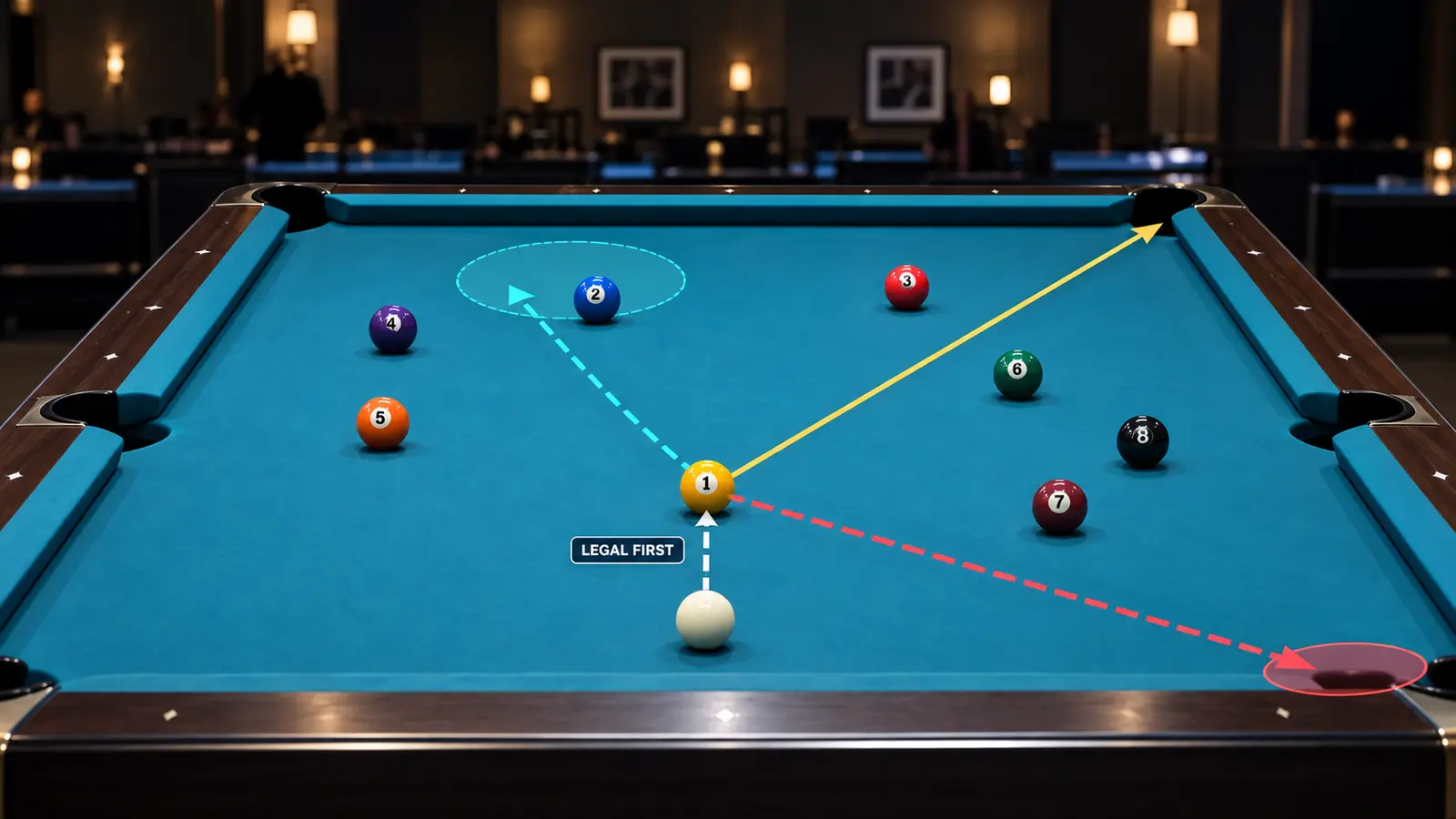
Identify the lowest-numbered ball on the table before choosing a pocket. Under the World Pool Association Rules of Play effective September 15, 2025, the cue ball must first contact that ball, even though another ball may be pocketed legally afterward.
For the illustrated station, use a normalized 100-by-50 map measured between cushion noses: cue ball (50,42), 1-ball (50,30), 2-ball (38,14), called upper-right corner (100,0) and lower-right scratch pocket (100,50). The gold line is the 1-ball route; the cyan cue-ball route finishes in a zone centered near the 2-ball. Confirm the active event rules because break, push-out and foul procedures can vary.
Look one ball beyond the hanger
An easy object ball can hide a hard cue-ball problem. From standing height, locate the next lowest ball and choose a generous side of it. A small landing zone that requires perfect speed turns a simple pot into a low-percentage sequence.
If the next ball is blocked, compare a deliberate breakout, a containing safety and a simpler position route before taking the obvious shot.
Trace the scratch side first
Follow the cue ball through contact and toward the first cushion. Check the nearest pocket, a possible kiss and any path that sends the cue ball across a corner or side-pocket mouth.
Reduce speed or spin only when that changes the route predictably. If the natural line is already safe, extra sidespin creates another variable without solving a problem.
Compare offense with the incoming table
A miss is not equally expensive in every layout. Ask what the opponent receives if the ball rattles or the cue ball stops short. An open table may justify a safety even when the shot is makeable.
A useful safety must control both balls: place the cue ball behind traffic while sending the lowest ball to distance or cover. Hiding only one without considering the other can leave a kick with an easy return.
Choose once, then execute
State one intention in plain language: pocket and stop, pocket to a broad zone, or safety to a named blocker. Enter the stance only after that choice is complete.
If the view from down changes a fact—such as a blocked edge or double kiss—stand up and restart. Do not rebuild the plan while the cue is already moving.
Use the L-P-S-R check
- Lowest ball: confirm the legal first contact.
- Position: locate a broad next-ball zone.
- Scratch: trace the cue ball past contact and cushions.
- Risk: compare the miss with a controlled safety.
- Commit to one speed and route before bending down.
- After the rack, record which part of the check caught or missed the error.
Sources and further reading
References support the specific factual information above. The practical checklists are Ariakon editorial guidance.