
Equipment records · 3 min read
Preserve an Older Cue Shaft’s Identity and Service History
An older shaft can survive longer than its product page, packaging or original owner. Preserve what the object shows today, what a dated source supports and what service has changed. An incomplete record is more useful than a polished history assembled from memory.
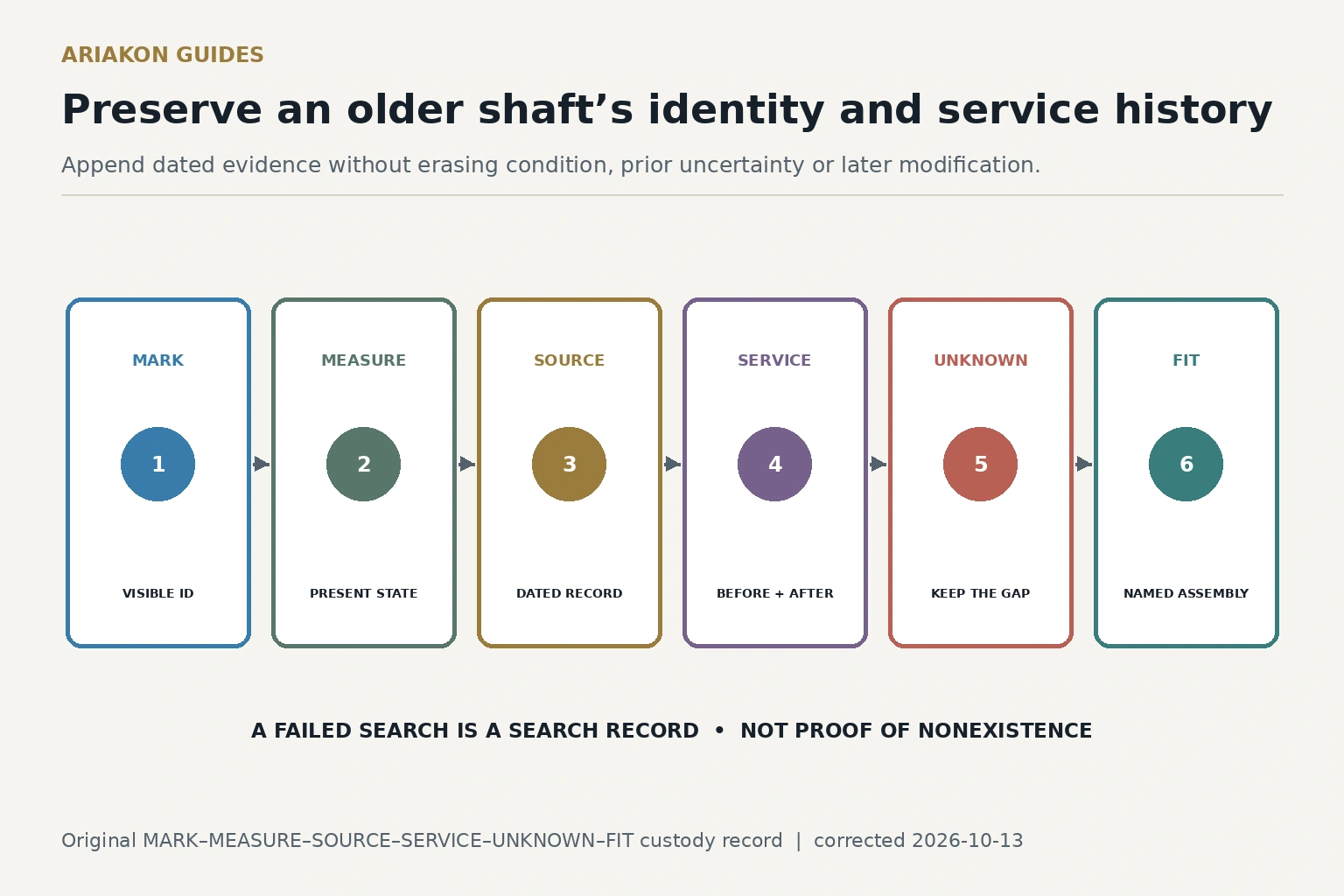
Create a six-part custody record
| Field | Record now | Do not infer |
|---|---|---|
| MARK | Every dot, logo, stamp, serial, collar pattern and service mark | Authenticity, date or hidden construction from one mark |
| MEASURE | Present length, mass, tip diameter, collar and accessible insert | Original factory dimension before wear or work |
| SOURCE | Dated catalog, receipt, archived page, maker response or invoice | Fields not printed in that exact source |
| SERVICE | Retip, ferrule, collar, insert, finish, straightening or turning event | That the present shaft remains factory-original |
| UNKNOWN | Missing years, ownership gaps and conflicting claims | A convenient continuous story |
| FIT | Current safe assembly result on a named butt | Original pairing or universal compatibility |
Audit a used shaft listing when the record begins with a seller's claims.
Inspect a segmented-wood shaft claim when visible construction is the narrower question.
Append evidence; never rewrite the past
Give each entry a date, recorder, evidence type and attachment name. If a new dated catalog resolves one field, add the source and conclusion without deleting the earlier unknown. If later service changes diameter or hardware, preserve both before and after measurements.
Use a consistent unit system and record tool resolution. Present measurement is observation of this specimen. It is not proof of the nominal dimension when new.
Separate document search from authentication
Record search terms, databases and search dates when research matters. A failed search documents where you looked; it does not prove the model never existed.
| Evidence | Useful for | Limit |
|---|---|---|
| Dated official catalog | Published model fields for that date | Does not prove the specimen is that model |
| Original receipt | Purchase date, seller and named item | May not capture later service |
| Patent record | Disclosed construction or mechanism | Does not identify an unmarked shaft |
| Service invoice | Work performed and date | May rely on an earlier owner description |
| Current photograph | Visible present condition | Cannot reveal hidden construction or complete history |
| Seller memory | Lead for further search | Keep attributed and unverified |
Package the shaft without adding damage
Photograph condition before cleaning. Use only material-compatible care already supported for the identified surface. Cover the correct joint interface with a matched protector, sleeve the shaft in a fitted compartment and keep paper or digital records outside the contact area.
Do not sand a finish, remove a dot, polish a collar or replace a part merely to make the record cleaner. Condition and service history are evidence.
Worked record: identity remains provisional
An older shaft has one colored mark, a replaced tip and no receipt. Its present diameter and insert are measured; an archived catalog shows a visually similar mark but no unique serial scheme. Record the catalog as a candidate source, not authentication.
A later service invoice confirms a ferrule replacement and names the prior owner's model description. Append the event and attribution. The final record can support current care and fit decisions while leaving original model identity unresolved.
Sources and further reading
References support the specific factual information above. The practical checklists are Ariakon editorial guidance.