
Coaching · 2 min read
Prepare for Your First Pool Coaching Lesson
Choosing a qualified coach and preparing for the first lesson are separate jobs. Once the instructor is selected, arrive with a short evidence packet instead of a long list of self-diagnoses. The first lesson should still begin with observation; your notes help the coach see the goal, constraints and baseline faster.
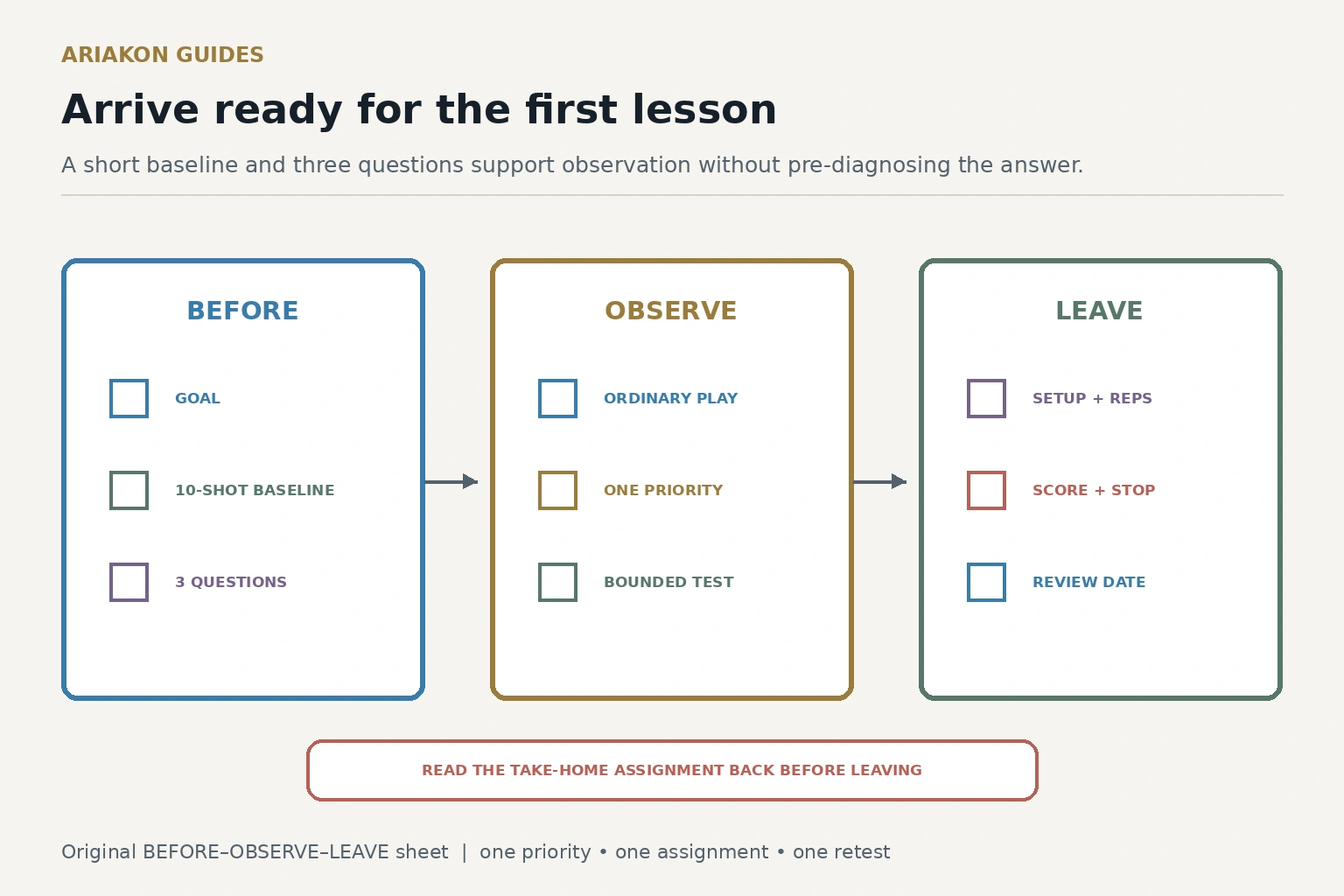
Complete the one-page lesson brief
| Field | Useful entry | Avoid |
|---|---|---|
| Goal | One observable game task | Become consistent |
| Baseline | One repeatable score and conditions | My stroke is broken |
| Pattern | Two recurring misses with dates | Every miss you remember |
| Constraints | Practice time, table access, pain or mobility boundary | Hiding a relevant limit |
| Questions | Three prioritized questions | A demand for instant confirmation |
Choose a pool coach who can diagnose and teach before booking the first lesson.
Turn coaching advice into a practice task when translating the take-home assignment.
Record a small baseline without coaching yourself
Choose one familiar straight or moderate-cut shot. Mark the balls and shoot ten attempts at a named speed. Record pocket, cue-ball finish and whether the normal routine completed. Stop there; the coach needs a reference, not a home-made mechanical verdict.
If filming is allowed at the venue, bring one short representative clip with the whole cue and body visible. Ask permission before recording another person or the lesson itself.
Confirm logistics before arrival
| Confirm | Why |
|---|---|
| Duration, price, table time and cancellation terms | Avoids using lesson time on preventable uncertainty |
| Cue and training equipment to bring | Keeps the observed system representative |
| Recording and guest policy | Protects consent and venue rules |
| Health or movement limits | Keeps demonstrations within a safe range |
| Follow-up format | Defines how the assignment will be captured |
Use the lesson to observe, prioritize and test
Let the instructor watch ordinary play before demonstrating a preferred answer. Ask what was observed, which issue has priority and what evidence would show improvement. A first lesson does not need to solve every part of the game.
When a change is proposed, repeat it in a bounded set and ask for one external success cue, one common failure and one stop or reset rule.
Worked handoff: leave with one assignment
A hypothetical player brings a 6/10 stop-shot baseline and reports that cue-ball finish varies on firm speed. The coach observes twelve attempts and assigns a six-inch finish corridor at two speeds, eight attempts each, with a stand-up reset when alignment changes. The player writes the exact marks, score and review date.
Before leaving, read the assignment back: setup, repetitions, score, expected cue, stop point and when to send evidence. Schedule additional work only after understanding what the first assignment is meant to test.