
Coaching · 3 min read
Give Useful Pool Feedback Without Distracting the Shooter
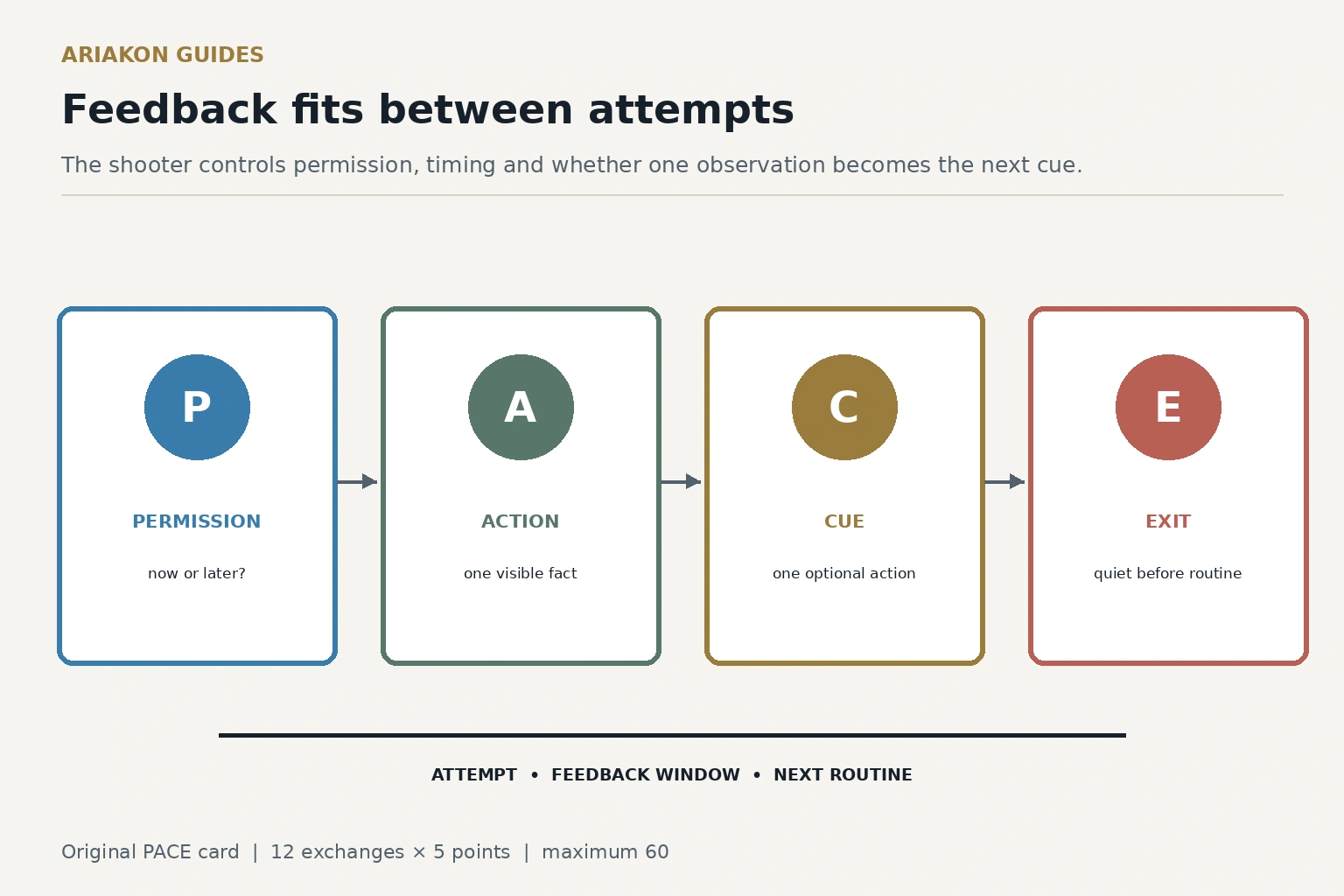
Helpful feedback is not a running commentary. During practice, the shooter needs space to decide, aim and read the result. The partner’s job is to obtain permission, report one observable fact, offer at most one next-action cue and then become quiet before the next routine begins. This is a communication worksheet, not a substitute for the broader mental-training routine.
Agree on the feedback contract first
Competition, league and room rules may restrict coaching, devices or conversation. Use this protocol in an authorized practice setting and follow the event’s actual rules during play.
Match the message to the available time and the agreed purpose. Report what the player can observe, identify what to repeat when useful and let the shooter decide whether the next block uses a cue. Keep that agreement separate from any claim about coaching credentials or a guaranteed result.
| Question | Shooter chooses | Partner follows |
|---|---|---|
| When? | After every attempt, after a block, or only when asked | No comment while the shooter is down or walking in |
| What? | Result, routine, cue delivery or decision | Observe only the selected category |
| How much? | One sentence or one question | No list of corrections |
| Recording? | Written tally, video or neither | Get permission before recording |
| Stop word? | A plain word such as “pause” | End feedback immediately without debate |
Use the simple mental-training routine when the shooter wants a self-directed cue.
Structure a productive team practice before assigning partner roles.
Use PACE after the attempt
Separate knowledge of results from an interpretation. Seven of twelve stopped in the target zone is a result. You are nervous is an inference. More detail can also distract, so preserve the agreed timing and the shooter’s choice rather than assuming more feedback is always better.
| Step | Useful language | Avoid |
|---|---|---|
| P — Permission | “Do you want the observation now or after the block?” | Assuming silence means consent |
| A — Action observed | “The cue finished left of the marked corridor on three attempts.” | “Your stroke is bad.” |
| C — Cue, if wanted | “Next block, finish through the center gate.” | Multiple mechanical changes |
| E — Exit | Confirm the task and become quiet | Explaining during the pre-shot routine |
Run twelve feedback exchanges
Score each exchange one point for permission, one for correct timing, one for an observable fact, one for honoring the shooter’s cue choice (one agreed cue or a respected decision to use none), and one for a clear exit. Twelve exchanges have a maximum of sixty. The shot result is recorded separately so a made ball cannot excuse distracting communication.
| Block | Four attempts | Partner task |
|---|---|---|
| 1 — Facts | Shooter repeats one straight shot | Report one count or visible path only |
| 2 — One cue | Shooter repeats the setup | Ask permission, then offer one action cue |
| 3 — Choice | Shooter changes to a simple position shot | Ask one question; shooter chooses the cue or none |
Worked exchange: specific and optional
The agreement says feedback comes after four attempts and covers cue delivery. The partner observes three finishes left of a visual corridor and one centered finish. After the block the partner asks, “Observation now?” The shooter agrees. The partner reports the count, then asks whether the shooter wants a cue or another uncoached block.
The shooter chooses one cue: “finish through the center gate.” The partner repeats the task once and becomes quiet. If the next block improves, the cue remains a candidate; it is not proof of a permanent technical diagnosis.
Repair feedback that lands badly
| Problem | Repair | Next boundary |
|---|---|---|
| Comment arrived during the routine | Acknowledge the timing error | Wait for the agreed window |
| Observation became a personality judgment | Restate only the visible action | Use counts or paths |
| Shooter rejects the cue | Drop it without argument | Offer facts only or stop |
| Too many changes | Return to the chosen category | One cue for one block |
| Tension persists | End partner feedback for the session | Resume only with a new agreement |
Sources and further reading
References support the specific factual information above. The practical checklists are Ariakon editorial guidance.