
Practice drills · 3 min read
Make Pool Team Practice Productive and Fun
A team practice works best when everyone has a clear job and no one spends most of the session watching. Use short stations, pair players by task rather than reputation and finish with a game that makes the practiced skill matter. The goal is not to identify one best player. It is to give every teammate useful decisions and measurable repetitions.
Choose one team objective
Begin with one outcome the team can recognize, such as improving break control, converting ball in hand or escaping one rail safeties. A narrow objective makes it easier to choose drills and compare results.
Ask each player for one recent situation that felt uncertain. Group similar answers, select the most common need and save the rest for later sessions. This keeps practice connected to real league play without trying to repair everything at once.
Run stations instead of one long line
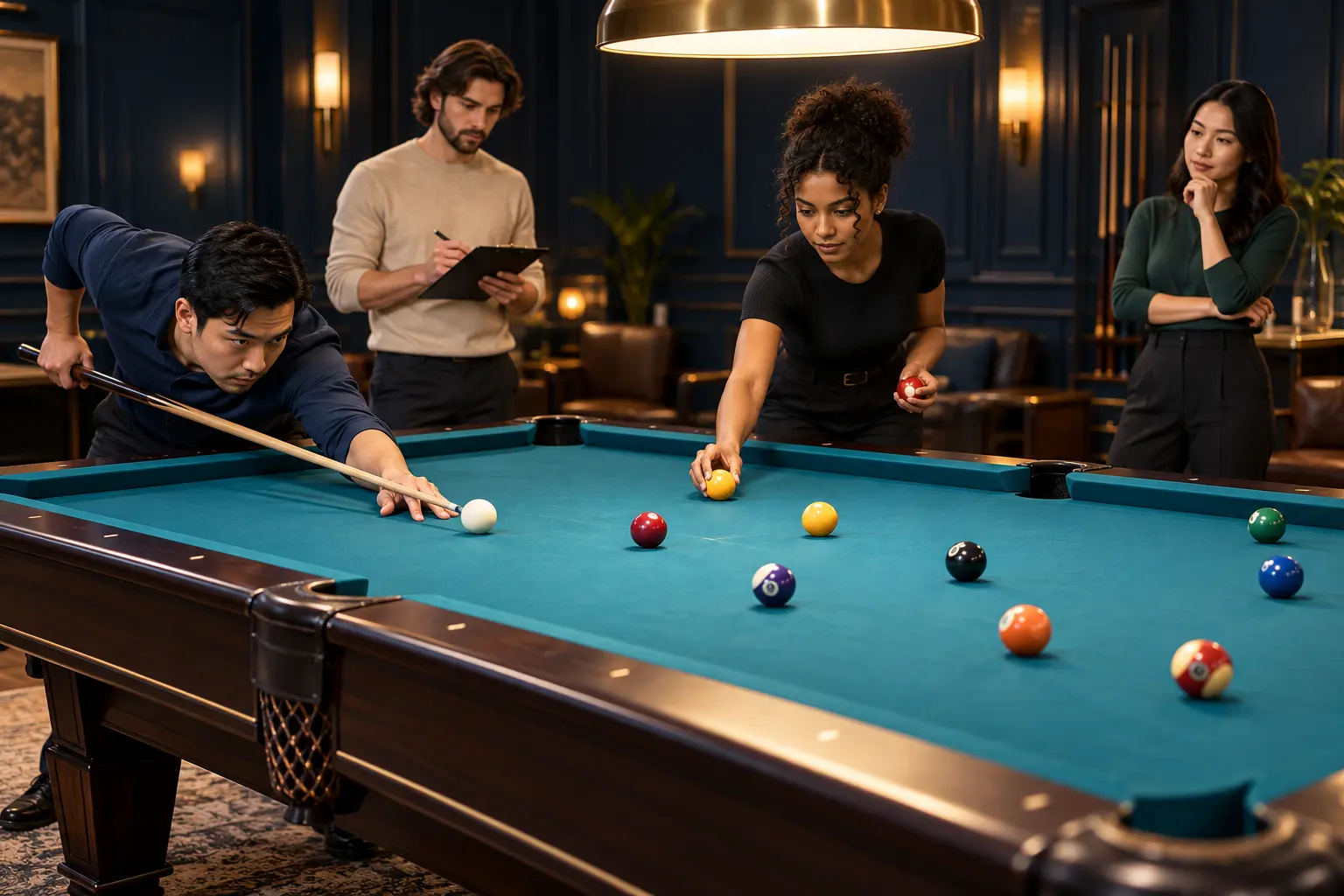
Create two or three jobs, with only one active shooter and ball layout per table. One pair shoots the selected position or speed task while a second pair records or resets only after all balls stop; another pair discusses a rule or safety decision away from the table. With multiple tables, each has its own clear shooting lane and one active stroke. Do not run simultaneous station shots on different parts of one table.
Rotate on a timer or after a fixed number of attempts. Short turns give every player repeated starts and reduce the temptation to let the strongest shooter take over the table.
Give observers a useful job
- Spot balls in the same positions for every attempt.
- Record the result without coaching during the stroke.
- Watch one agreed detail, such as cue ball finish or routine length.
- Ask the shooter what happened before offering a suggestion.
- Keep equipment and conversations outside the active shooting lane.
Match difficulty to the player
Players can share the same drill while using different distances, target zones or success goals. A newer player might receive a larger cue ball landing area while an experienced player must reach a smaller zone or begin from a harder angle.
Adjust the task, not the respect given to the result. APA league systems intentionally accommodate different skill levels, and a practice session should let each player work near the edge of current ability rather than copy one identical test.
Finish with pressure and choice
Turn the objective into a short team game. Award one point for the shot and another for cue ball position, require a safety after a miss, or let pairs choose which player takes each layout. Keep the scoring simple enough that it does not interrupt play.
Use the final game to test decisions, communication and routine under consequence. It should reveal what to practice next, not erase the value of earlier repetitions.
Close with evidence
End by asking what improved, what still felt uncertain and which station should return. Record a small team measure such as successful escapes out of attempts or average cue ball distance from the target.
Change one station at the next session while keeping one familiar benchmark. That combination makes practice feel fresh without losing the evidence needed to see progress.
Sources and further reading
References support the specific factual information above. The practical checklists are Ariakon editorial guidance.