
Bridge fundamentals · 3 min read
Position the Bridge Hand Without Twisting the Cue Line
A stable bridge can still point the cue away from the shot if the hand lands rotated and the shaft is forced sideways into the groove. The fix is not one prescribed hand shape. It is an order: select the line while standing, bring the cue and bridge forward together, plant a comfortable base, then confirm that the shaft slides without side pressure.
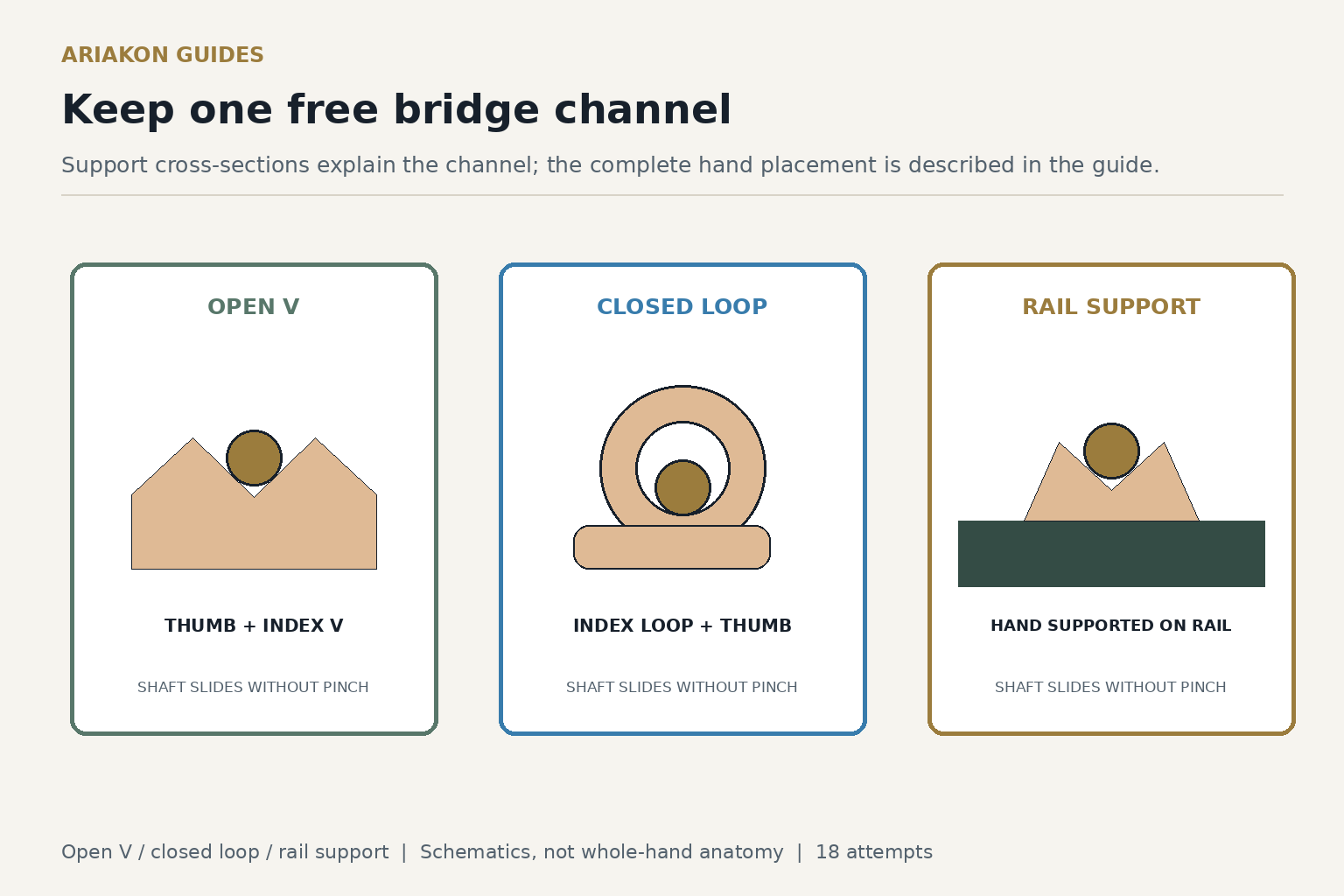
Build the hand around the line
Set a straight shot with the object ball one diamond from a corner and the cue ball two diamonds away. From behind the shot, select the center-ball line. Move the cue and bridge hand forward together, place the heel or base comfortably, spread the support fingers, and form the channel around the shaft. Do not plant the hand far to one side and pull the cue into place.
At address, make three slow practice strokes without touching the cue ball. The shaft should slide through the same channel without pushing the thumb, index finger or loop sideways. If it does, stand up and rebuild; twisting harder is not a correction.
Choose the simplest bridge type for the shot before testing hand placement.
Test bridge length separately so length does not become a hidden variable.
Use three bridge-placement stations
Shoot six attempts at each station for eighteen total. The rail station tests whether the player can keep the channel on line when the ordinary palm base is unavailable. It is not a contest to use one bridge everywhere.
| Station | Bridge condition | What stays fixed |
|---|---|---|
| A | Open bridge on cloth | Straight shot, two-diamond cue-ball distance |
| B | Closed bridge on cloth | Same ball centers and pocket speed |
| C | Rail bridge | Object ball and shot line; cue ball moves near rail |
Score placement before outcome
| Point | Visible requirement |
|---|---|
| 1 | Line chosen while standing |
| 1 | Bridge base lands without a late sideways drag |
| 1 | Three practice strokes stay in one shaft channel |
| 1 | Bridge remains planted through contact |
| 1 | Object ball reaches the called pocket |
| Maximum 90 | Eighteen attempts across three stations |
Separate twist from other causes
| Observation | One correction |
|---|---|
| Cue begins off line before practice strokes | Rebuild the approach and hand landing |
| Cue rubs one side of the channel | Relax and reshape the channel around the line |
| Bridge rotates only during delivery | Reduce hand pressure and delivery speed |
| Bridge is stable but cue still leaves line | Test grip and stroke mechanics separately |
| Only the rail station fails | Practice the rail base; do not change the cloth bridge |
Worked example and game transfer
A hypothetical player scores 29/30 with the open bridge, 25/30 closed and 19/30 on the rail. Rear video shows the rail hand landing left of the line and the cue being pulled right. The next action is six unscored rail placements with no ball strike, followed by one new six-shot rail set. The sound open bridge is preserved.
For transfer, play two racks and mark every shot that needs a rail, elevated or mechanical bridge. Apply the same line-first order and record whether the shaft channel remained free. Choose mechanical support when a comfortable planted hand cannot reach the shot; do not stretch until the bridge becomes unstable.