
Beginner pool · 5 min read
Pool Fundamentals for a Complete Beginner: Your First Session
A first pool session should answer a small set of practical questions: how to behave safely around the table, how to build a stable shot, how to strike the cue ball near center and how a simple game turn works. It should not compress advanced spin, systems and strategy into one hour. This plan gives a complete beginner a repeatable script and observable wins to carry into session two.
Start with four table-safety rules
| Rule | Visible behavior | Reason |
|---|---|---|
| Cue stays controlled | Carry tip down or close to body; no swinging | Protects people and fixtures |
| Nothing sits on cloth | Drinks, phones and chalk stay off playing surface | Protects cloth and balls |
| One shooter at a time | Others stand outside the cue and ball path | Creates a clear stroke and finish area |
| Normal-height shots only | No jumps, massé or hard breaks in session one | Keeps the task and equipment risk bounded |
Use one five-part shot script
| Step | Say silently | Observable check |
|---|---|---|
| 1. Plan | Ball, pocket, cue-ball start | Line chosen while standing |
| 2. Set | Feet stable; cue has room | No body part blocks cue |
| 3. Bridge | Hand still; channel supports cue | Cue slides without wobbling bridge |
| 4. Center | Tip near cue-ball center | No intentional sidespin |
| 5. Finish | Smooth forward stroke; finish comfortably, then rise safely when the cue is clear | Head and bridge remain quiet |
Advance each fundamental separately after the first-session script is repeatable.
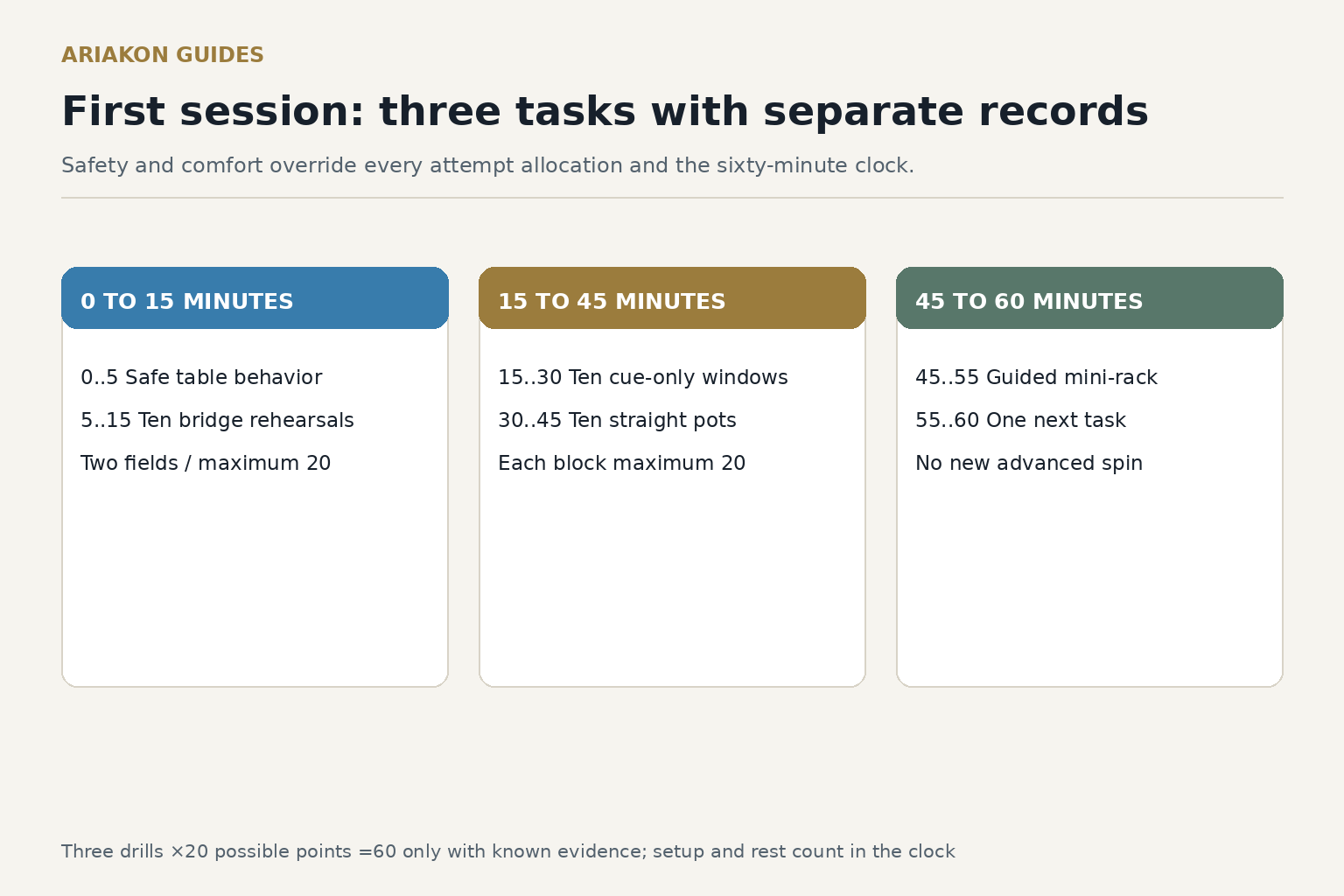
Follow a sixty-minute session map
| Minutes | Task | Attempts | Result to record |
|---|---|---|---|
| 0–5 | Safety, cue parts and table orientation | Walk-through | Four rules repeated |
| 5–15 | Bridge and straight cue slide | 10 | Cue stays in channel |
| 15–30 | Cue ball through a center gate | 10 | Gate passes |
| 30–45 | Straight object ball to pocket | 10 | Pocket and cue-ball finish |
| 45–55 | Three-ball guided rack | 1–3 | Legal choices named |
| 55–60 | Practice log | One row | Keep and next task |
Drill 1: slide the cue without a ball
Build an open bridge on the rail or table with the instructor's permission. Use a visual channel 0.5 ball diameter wider than the cue on each side, registered before rehearsal and with all physical aids removed; aim the cue through that imagined channel without contacting a ball. Make ten slow practice strokes and stop the cue before the far boundary.
Score 1 when the bridge stays still and 1 when the cue remains in the channel; maximum 20. A moving bridge sends the player back to hand stability. A stable bridge with a wandering cue selects a visible cue-path question; it does not prove grip pressure or one joint caused it.
Drill 2: send the cue ball through a gate
Coordinates are ball centers on an illustrative 100 by 50 inch bed: x=0..8 along length, y=0..4 across width, origin at the lower left cushion nose. One unit is 12.5 inches. For 2.25 inch equal balls, radius is 0.09 and diameter 0.18 units. Intact cushion center boundaries are x=0.09,7.91 and y=0.09,3.91; pockets interrupt the physical boundary at the four corners and (4,0),(4,4). Measure actual bed, balls and jaws before scaling. Remove every measuring aid before shooting; never mark a competition table.
Cue-only station C(2,1), intended upper cushion center contact R(2,3.91), away from side pocket x=4. At the outbound line y=2, call a cue-center window x=2±0.18. It is a virtual observation window, not two physical balls. Remove all reference aids. Use a familiar controlled no-intentional-sidespin delivery that reaches the cushion.
Ten attempts: one point for a known virtual-window pass and one for upper cushion contact with cue center x=2±0.18. Foul/unsafe action gives 0; unknown observations remain unscored independently. Maximum 20 if both fields are known on all ten. A window pass does not certify exact central tip contact.
Drill 3: pocket one straight ball
Use O(6,3), real upper right corner P(8,4), intended contact cue center G(5.839003,2.919502) and C(4.944576,2.472288). With u=(2,1)/sqrt(5), G=O minus 0.18u and C=G minus u. The centers are collinear and the equal balls are tangent at G.
Use 10 ordinary comfortable strikes. One point for a known legal pot and one additional point only if that pot also leaves the cue center within radius 0.36 of G. A known foul or miss scores 0. A known pot with hidden finish retains the pot point and has the bonus unknown. Maximum 20 only if all fields are known. A high contact request is not a guaranteed stop; no stop is compulsory in a first lesson.
Keep the three drill subtotals separate, each at most 20. A full known record has 60 possible points, but unobserved fields and unused allocations reduce their own denominator. Any safety concern stops the session; the clock limits include setup and rests, so ten is a ceiling rather than a requirement to rush.
Play a guided first rack
Use a three-ball mini rack rather than a full competitive match. The beginner names the object ball, pocket and one cue-ball preference before every shot. After a miss, the instructor asks what happened at the first observable step—plan, set, bridge, center or finish—without replacing the answer with a new system. The mini-rack is an original casual turn exercise: agree the legal first targets and end each turn at a miss or foul. It does not supply official eight-ball rules.
Record five turns with columns for called ball, legal contact, pocket result and script step to keep. End with one success the player can describe and one next action.
Walk through a complete first eight-ball rack after the mini rack and shot script are comfortable.
Sources and further reading
References support the specific factual information above. The practical checklists are Ariakon editorial guidance.