
Etiquette · 4 min read
Pool Etiquette for a Shared Home or Club Table
A shared table needs an agreed opening condition and an honest closing condition. This guide is about custody between home or club users: who may change equipment, when play stops, what is isolated and what the next group is told. It complements match etiquette without inventing a venue policy or a universal cleaning method.
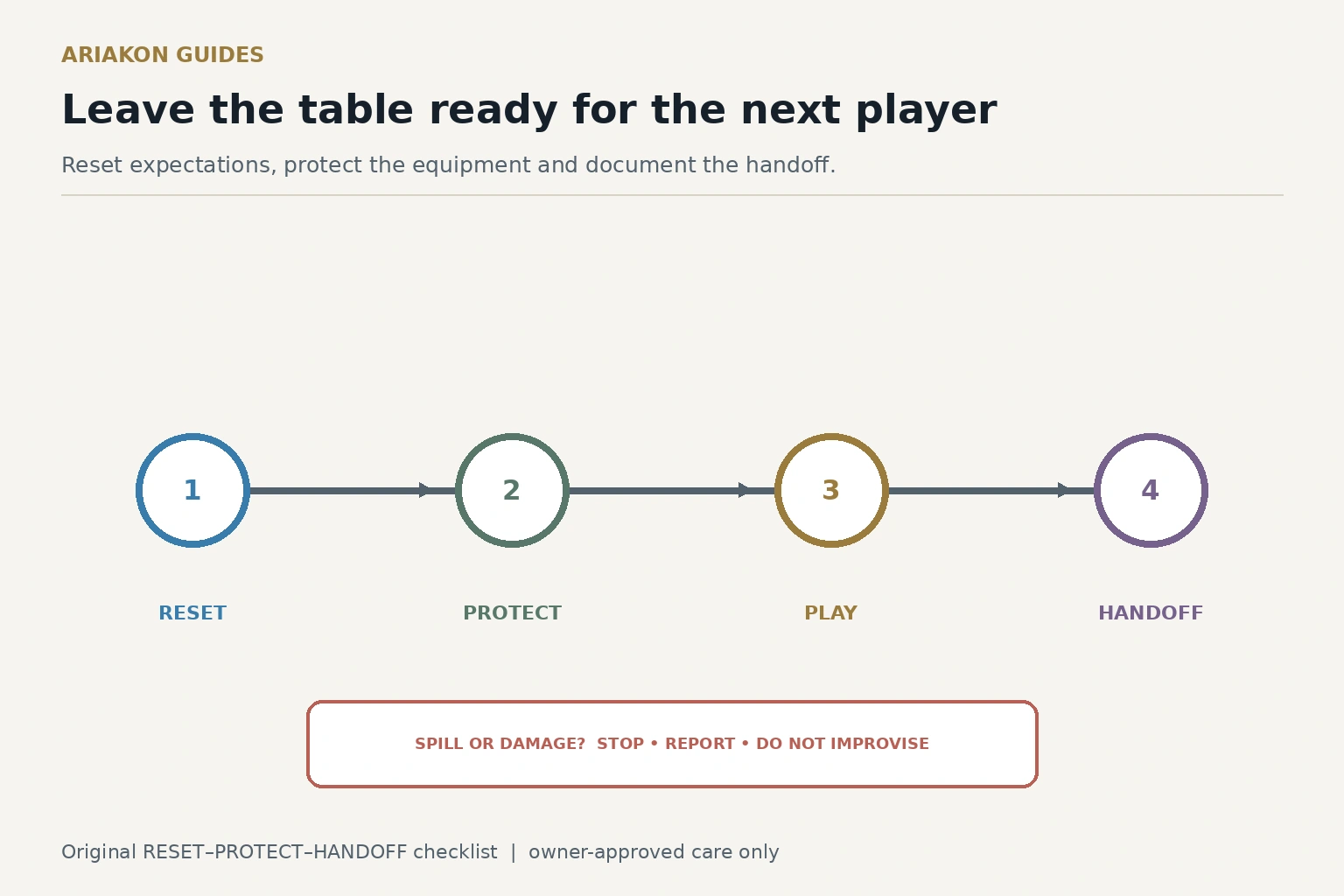
Write the agreement before the first rack
Record the booked start and release time, the chosen game and rules version, who answers a rules dispute, and the owner or attendant responsible for equipment. Agree on coaching, guests, children, food and drink placement, and the allowed care tasks. These are house choices to confirm, not claims about Ariakon membership or event rules.
A casual house agreement is not automatically a tournament rule. Current WPA rules address distracting conduct, improper equipment use and continuing after play is suspended; competition decisions belong to the designated official. A home group still needs an explicit authority rather than competing recollections.
Use the match-conduct guide for sightlines, pace and ordinary close calls.
Use the dispute response worksheet when a ruling, rather than property custody, is the issue.
Rehearse four stages with three confirmations each
Count each confirmation once: four stages×three=12. A total is a reminder, not an equipment safety certificate. A structural concern or missing authority is a hold even if eleven other boxes are marked. If an action was not permitted or no care was needed, record that fact rather than inventing a completed cleaning task.
Do not sit on the table, alter rails or lights, move balls during another player’s shot, or try a repair to avoid reporting damage. The owner decides who may inspect and what replacement is authorized. The next booking must not inherit an undocumented workaround.
| Stage | Three confirmations | Evidence |
|---|---|---|
| RESET | Times and rules agreed; authority identified; starting condition accepted | Session card and any pre-existing condition note |
| PROTECT | Off-table storage clear; drinks/food outside the playing area; only permitted supplies accessible | One walk-around before play |
| PLAY | Shooter space respected; changes require permission; spill/damage stops the affected use | Calm interruption and an incident record when needed |
| HANDOFF | Stop on time; accessories inventoried and only authorized care completed; next user receives condition and holds | Release time, accepted inventory and acknowledged status |
Use a six-field incident handoff instead of a cleaning guess
If there is a spill, prevent traffic through the affected area and notify the responsible role. Follow the actual table/cloth instructions and the owner’s authorized response; do not supply a universal liquid, brush or vacuum recipe. If a ball is chipped or marked, do not quietly mix a random spare into the set. A complete compatible replacement needs authorization.
Keep the record factual. “Visible chip; isolated; awaiting replacement” is useful. “It is harmless” or “this cleaner fixes all cloth” would be a diagnosis the observation does not support. Report even when the incident appears cosmetic.
| Field | Record |
|---|---|
| When and where | Time, table/area and the affected object |
| Observation | What is visible; photograph if appropriate and permitted |
| Immediate boundary | What use stopped and how the affected item was isolated |
| Notification | Responsible role, contact method and time |
| Instruction | Exact authorized action, or awaiting a response |
| Release | Who accepted the condition, unresolved holds and next check |
Operate the shared supply station for issue, return and restocking after a method is authorized.
Screen a replacement cue ball when compatibility rather than permission is the next question.
Work a ninety-minute booking without stealing the handoff time
Hypothetical booking: 14:00–15:30. The group reserves 15:20–15:30 for inventory, authorized care and handoff, leaving at most 80 minutes before closing tasks. If a six-minute incident pause occurs during that play window, at most 74 minutes remain for play; preparation delays reduce it further. The pause is not permission to extend the booking.
A damaged ball is isolated at 14:42. An authorized compatible replacement is supplied at 14:48, and play resumes without changing the 15:20 stop. At handoff, the group marks RESET 3/3, PROTECT 3/3, PLAY 3/3 and HANDOFF 2/3 because it has not told the next user where the isolated ball went. Total 11/12 means the handoff is incomplete, even though the playing set is complete.
The responsible role documents the held item and acknowledges the status with the next group; only then is that confirmation complete. This is a record-custody fix, not a new cleaning procedure or an invented room guarantee.
Review one failure and keep the house agreement current
After closing, record the one boundary that failed, the next action and its responsible role. Missing storage calls for storage clarification; unapproved coaching calls for a coaching agreement; an equipment defect calls for service. Do not replace a specific cause with a long list of unrelated rules.
Reconfirm the agreement when the owner, equipment, booking format or users change. Keep the original incident record with the accepted resolution. Good etiquette leaves the next user both usable space and truthful information.
Sources and further reading
References support the specific factual information above. The practical checklists are Ariakon editorial guidance.