
Competition guide · 2 min read
Pool Sportsmanship Mistakes That Create Avoidable Arguments
Many pool arguments grow because a small uncertainty is handled after another ball moves. Reduce that risk before the break, then use the same neutral response when a rules question, close hit, moved ball, distraction or concession occurs. Sportsmanship does not require surrendering a legitimate ruling; it requires handling it through the agreed authority.
Agree on authority before the break
Confirm the rule set, call-shot requirements, concession rule, time procedure, whether a referee can be summoned and how an unobserved close hit will be handled. In an organized event, the tournament director and event regulations control. In informal play, write the agreement or say it back before balls are broken.
Current WPA rules treat conduct such as distracting an opponent, marking the table, continuing after play is suspended, practicing during a match and intentionally delaying play as unsportsmanlike conduct. Penalties depend on the event and authority; a player should not invent or self-award one.
Use the shared-table etiquette guide for room flow and equipment respect.
Review bar-table etiquette for informal rotation and house-rule conversations.
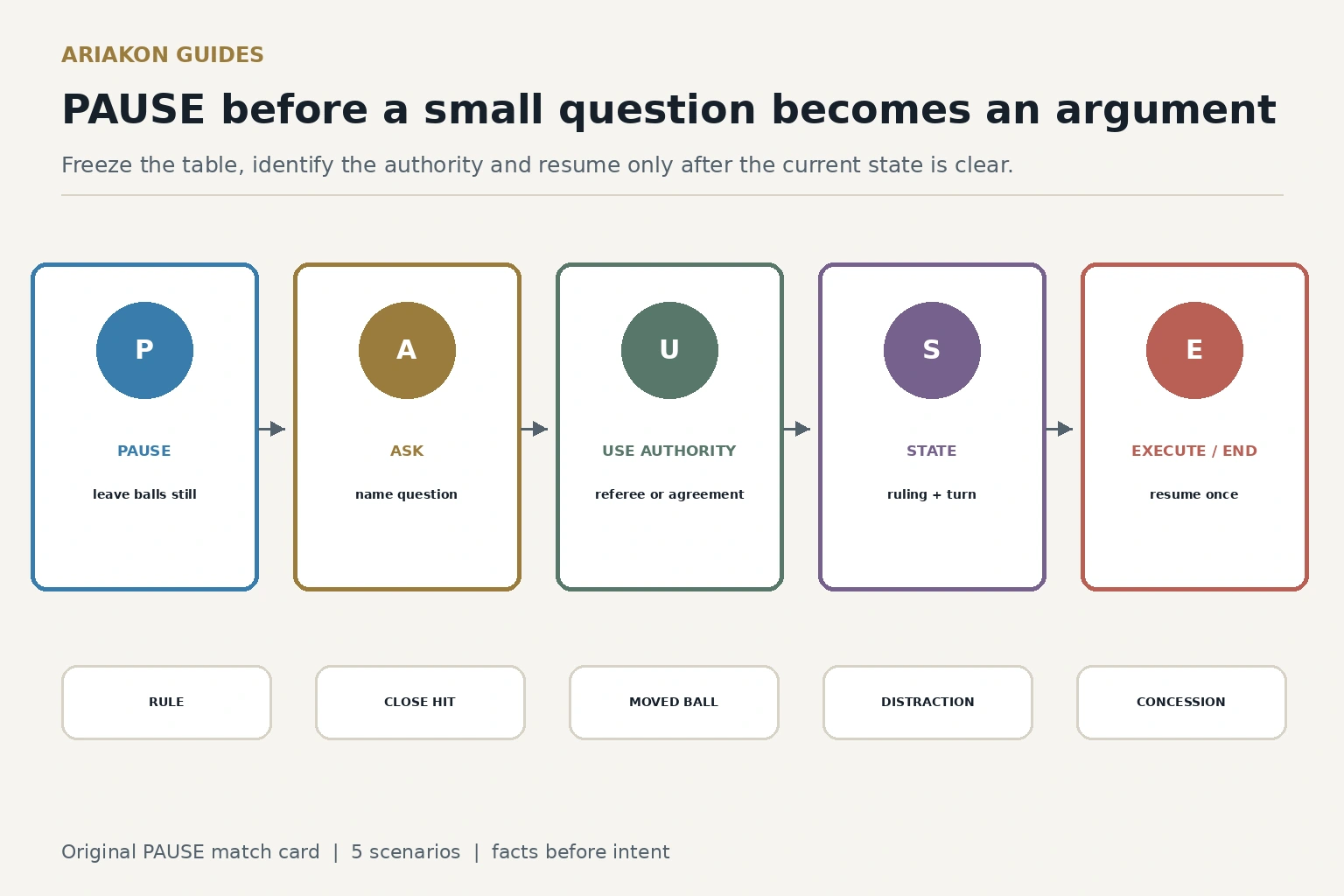
Use PAUSE during a dispute
| Step | Action |
|---|---|
| P — Pause | Stop shooting and leave balls and equipment where they are |
| A — Ask | State the question and the agreed rule or fact without assigning motive |
| U — Use authority | Call the referee, director or agreed neutral procedure |
| S — State outcome | Repeat the ruling, incoming player and ball positions |
| E — Execute or end | Resume once, or end and document if safe resolution is unavailable |
Prepare five avoidable-argument scenarios
| Scenario | Prevent | During play |
|---|---|---|
| Rule disagreement | Name the rule set | Pause before the next stroke; look up or request ruling |
| Close hit | Agree who calls a referee | Do not reconstruct after balls are moved |
| Moved ball or wrong turn | Confirm restoration/foul procedure | Freeze the layout and identify current facts |
| Distraction or delay | Set phone, talking and clock expectations | Request one neutral correction through authority |
| Concession | Confirm words/actions that count | Do not sweep balls until accepted or ruled |
Worked repair and post-session review
Example: a player believes the cue ball contacted the wrong ball first. Instead of picking up the cue ball, they say, ‘Pause—our question is first contact. The balls are still.’ The agreed referee rules; both players repeat who is shooting and resume. If no observer was called despite the pre-match agreement, record that process failure rather than claiming certainty from memory.
After the session, answer five yes/no questions: Was the rule set clear? Did play stop before another ball moved? Were facts separated from intent? Was the agreed authority used? Did both players know the resume state? Practice the first ‘no’ as a spoken scenario before the next match.
Sources and further reading
References support the specific factual information above. The practical checklists are Ariakon editorial guidance.