
Competition guide · 3 min read
Debrief a Double Elimination Pool Tournament After Two Losses
Two losses can end a double-elimination tournament, but they do not automatically tell the same story. Preserve each match, the event conditions and the bracket facts separately. Only then look for a repeated decision or execution cost worth training.
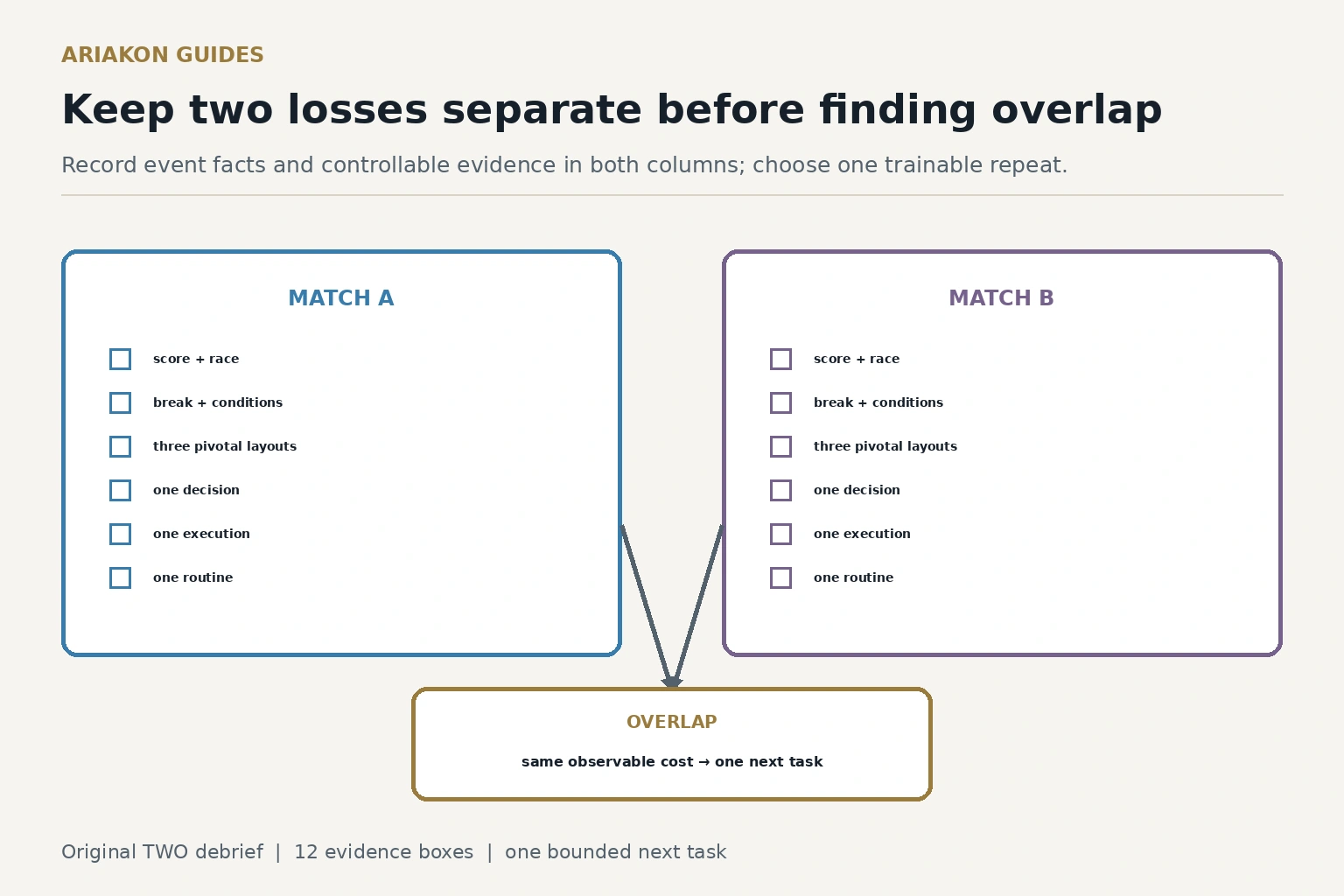
Record the event facts before interpretation
Double-elimination details are event facts, not universal rules. Confirm the organizer's bracket, race lengths, game rules, break procedure, time controls and advancement conditions. The current WPA Rules of Play can govern the game when adopted, but they do not replace a tournament's published format or desk instructions.
Make short notes only after the match, away from the table and without delaying the event. Record score and layouts before explaining why they happened. ‘Missed the 6 from two diamonds’ is evidence; ‘always collapses’ is not.
| Before play | After Match A | After Match B |
|---|---|---|
| Event rule set and discipline | Final score and race length | Final score and race length |
| Bracket/advancement procedure | Break format and first breaker | Break format and first breaker |
| Scorekeeping and referee process | Three pivotal layouts | Three pivotal layouts |
| Table, balls and warm-up conditions | One decision and one execution note | One decision and one execution note |
| Schedule and reporting requirement | Opponent actions as facts only | Opponent actions as facts only |
Use the single-loss review for a quick review of one match.
Prepare for a pool tournament before the next event day.
Use the TWO worksheet
Award one evidence point for each of the twelve populated boxes: three table facts and three controllable observations for each match. Do not search for overlap until both columns are complete. An overlap must be the same observable class, such as choosing a low-percentage offensive shot when a containing safety was available—not merely ‘lost position.’
Then label every candidate next task as decision, execution, routine or event preparation. Choose one that is trainable in a single session. A second issue may be parked, not blended into a vague plan to improve everything.
| Step | Match A | Match B |
|---|---|---|
| T — Table facts | Score, break, three layouts | Score, break, three layouts |
| W — What was controllable | One decision, one execution, one routine | One decision, one execution, one routine |
| O — Overlap | Mark only an evidence-backed repeat | Mark only an evidence-backed repeat |
Worked two-loss debrief
Example: Match A is a 4–6 loss with one dry break, one missed 6 and two failed containing safeties. Match B is a 2–5 loss with one scratch, two missed long pots and one aggressive bank chosen over a containing safety. Break results and long-pot misses differ. The supported overlap is the decision to attack when a broad containing safety existed.
The next session is six marked layouts with offense and one containing safety available. Before each attempt, name the score situation, compare the failure cost and commit to one option; score the decision separately from execution. Review after all six. The debrief does not prove a permanent weakness, explain the opponents' intentions or change the official result.
Sources and further reading
References support the specific factual information above. The practical checklists are Ariakon editorial guidance.