
Competition preparation · 3 min read
Prepare the Night Before a Pool Tournament
The night before a tournament is too late to rebuild a stroke and early enough to prevent a missing cue extension, wrong start time or rushed trip. The useful work is administrative and stabilizing: verify current event facts, inspect and pack, set the route and wake plan, choose a brief familiar warm-up and stop experimenting. This checklist ends with a written handoff to the morning.
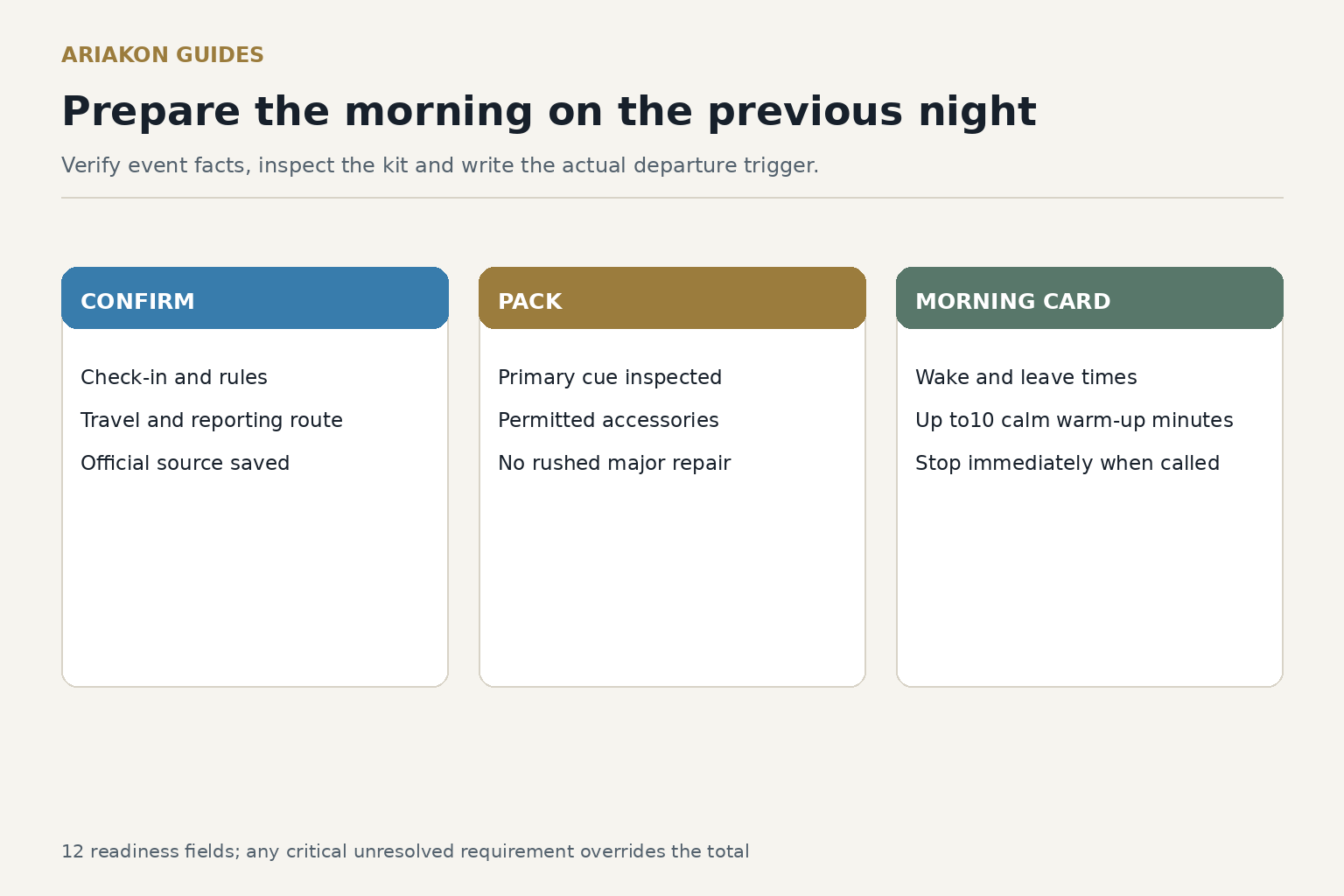
Freeze the event facts from the organizer
| Field | Record from current official source | Do not assume |
|---|---|---|
| Venue | Address, room and parking or entry note | Last event used the same room |
| Clock | Check-in, players meeting and first-match time | Posted start equals check-in |
| Format | Discipline, race or points, bracket and handicap | League-night rules apply |
| Rules | Organizer document and effective date | A familiar foul or break rule |
| Equipment | Table size, ball set, cue or jump limits if published | Every personal accessory is permitted |
| Contact | Director or venue number | Social comments are authoritative |
Use the broader important-match plan during the preceding training week rather than the final night.
Pack by function, then close the case
| Function | Inspect and pack | Stop or replace |
|---|---|---|
| Primary play | Butt, shaft, joint fit, tip and protectors | Loose joint, lifted tip or new damage |
| Rule-dependent | Break or jump cue only if permitted | Unknown event rule |
| Support | Chalk, glove, towel, extension and bridge head if used | Unfamiliar accessory added tonight |
| Administration | ID, membership proof, registration receipt and payment method | Screenshot without readable details |
| Comfort | Known clothing layers, water container and familiar food plan | Untried footwear or products |
Use a twelve-item readiness score
Score one point each for verified venue, check-in, format, rules, route, departure trigger, primary cue, tip condition, rule-dependent equipment, ID or registration, morning food or water plan and warm-up card. The maximum is 12. Resolve every zero that can prevent participation before leisure tasks.
A score is not tournament readiness by itself. Any red item—unknown venue, missed registration requirement, damaged primary tip or prohibited equipment—overrides the total.
Write the morning backward from check-in
| Time | Action | Buffer or evidence |
|---|---|---|
| 9:00 | Official check-in closes | Organizer page saved |
| 8:30 | Target arrival | Thirty-minute venue buffer |
| 7:55 | Leave home | Route estimate plus traffic margin |
| 7:35 | Final bag and ID check | Checklist photographed |
| 7:15 | Familiar breakfast and water | No new routine |
| 6:45 | Wake trigger | Alarm and backup set |
Choose a ten-minute warm-up card now
Plan up to ten calm minutes including resets and rests: up to three familiar straight stops, three cue-only pace checks and three routine cuts, with no required break. Use only permitted table time and finish immediately when called. The attempts are ceilings, not a timed performance requirement. The dated APA preparation article distinguishes event preparation from day-of warm-up; it does not guarantee this original dose or a specific result.
The warm-up passes when the player observes center contact, speed and table response. It is not a last-minute exam and should not introduce a new aiming system, cue, tip or stroke thought.
Close the technical work
After the pack and plan, write three match anchors on one card: a physical routine cue, a decision cue and a reset phrase. Put the card in the case and stop technical video review. If a genuine equipment issue appears, choose a known backup or qualified service rather than a rushed repair.
Preserve the player's normal sleep, meals, medication and hydration instructions. This guide does not prescribe a new health routine. Players with medical or dietary requirements should follow their existing clinician-guided plan.
Review the checklist after the event
| Question | Observable answer | Next action |
|---|---|---|
| Which fact prevented confusion? | Name the saved source | Keep that field |
| What was missing or unused? | Name the item | Add or remove once |
| Was the arrival buffer right? | Minutes early or late | Adjust route margin |
| Did warm-up reveal table response? | One useful observation | Keep or simplify card |
| What technical issue belongs in practice? | One shot family | Schedule later session |
Sources and further reading
References support the specific factual information above. The practical checklists are Ariakon editorial guidance.