
Practice diagnostics · 3 min read
Measure Four Sources of Pool Shot Consistency Separately
A run of misses can look like one consistency problem while coming from several different sources. This protocol separates pocket-entry control, straight cue delivery, speed repeatability and decision-routine use into four eight-shot stations. The result is a component profile and one next practice priority—not a personality label or a claim that one short session measures total ability.
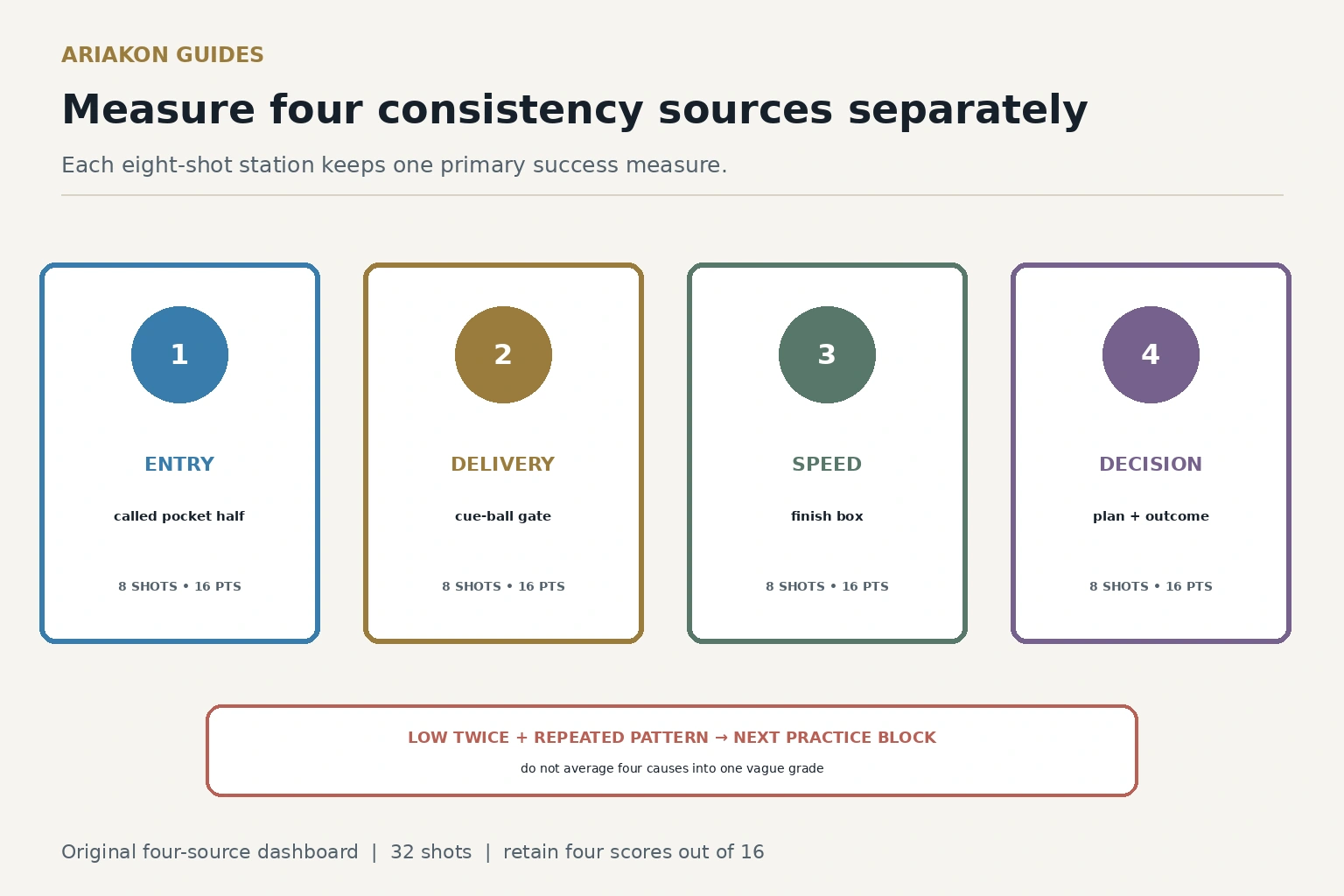
Register four stations with separate success measures
| Station | Setup | Primary measure |
|---|---|---|
| 1 — Entry | Medium cut to one corner at pocket speed | Object ball enters the called pocket half |
| 2 — Delivery | Straight stop shot with a cue-ball finish gate at the contact-center region | Cue ball finishes in the one-ball-wide registered corridor |
| 3 — Speed | One-rail cue-ball route to a one-diamond box | Finish distance from box center |
| 4 — Decision routine | Eight varied one-attempt layouts from prepared cards | Plan completed before stance and intended option attempted |
Use the A-D-S-D priorities checklist when you want all four priorities on one three-ball layout.
Build the broader ten-skill baseline when a full playing profile is needed.
Hold inputs stable within each station
Mark ball positions, pocket, speed band and camera or observation point. Use the same cue and table conditions. Take eight attempts at each station, with a two-minute reset between stations. Do not change technique halfway through a station; write the candidate change for later.
Repeatability is visible in the grouping, not only the number of makes. A tight group consistently outside a zone suggests a correctable bias. A scattered group suggests unstable input or a setup that is not registered precisely enough.
Score components instead of one total
Keep four scores out of sixteen and add a miss-pattern note. Do not average them into one consistency grade. A component profile gives the next test a defined task instead of treating every miss as the same consistency failure.
| Station | First point | Second point |
|---|---|---|
| Entry | Legal pocket | Called pocket half |
| Delivery | Object ball pocketed | Cue ball finishes in the registered corridor |
| Speed | Correct one-rail route | Cue ball finishes in box |
| Decision routine | Plan named before stance | Chosen outcome or containing result reached |
Choose a priority with a two-session rule
The four-point boundary is an original coaching rule for this worksheet, not a validated universal threshold. Retest under similar conditions before committing to a major change. Pain, visual difficulty or equipment damage belongs with an appropriate qualified professional or service provider.
| Pattern | Next block |
|---|---|
| One station is at least four points below every other station twice | Practice that component for two sessions |
| Two stations are tied low | Choose the one with the clearest repeated miss pattern |
| All scores vary by three or more points on retest | Improve setup registration and routine before a technical change |
| Practice improves but varied first attempts do not | Add transfer layouts rather than more blocked repetitions |
Worked example and transfer
A hypothetical player scores Entry 14/16, Delivery 13/16, Speed 8/16 and Decision routine 12/16. Six speed attempts finish beyond the target box. A second session produces 13, 14, 9 and 13, with the same long pattern. Speed becomes the next two-session priority; aim and delivery are maintained, not rebuilt.
After speed practice, the player repeats only Station 3 and then tries eight unfamiliar position shots once each. Better box scores without better varied-shot finishes mean the blocked task improved but transfer is incomplete. The correct next action is a varied speed block, not declaring the entire game consistent.
Sources and further reading
References support the specific factual information above. The practical checklists are Ariakon editorial guidance.