
Practice planning · 3 min read
Maintain a Pool Practice Log During a Planned Break
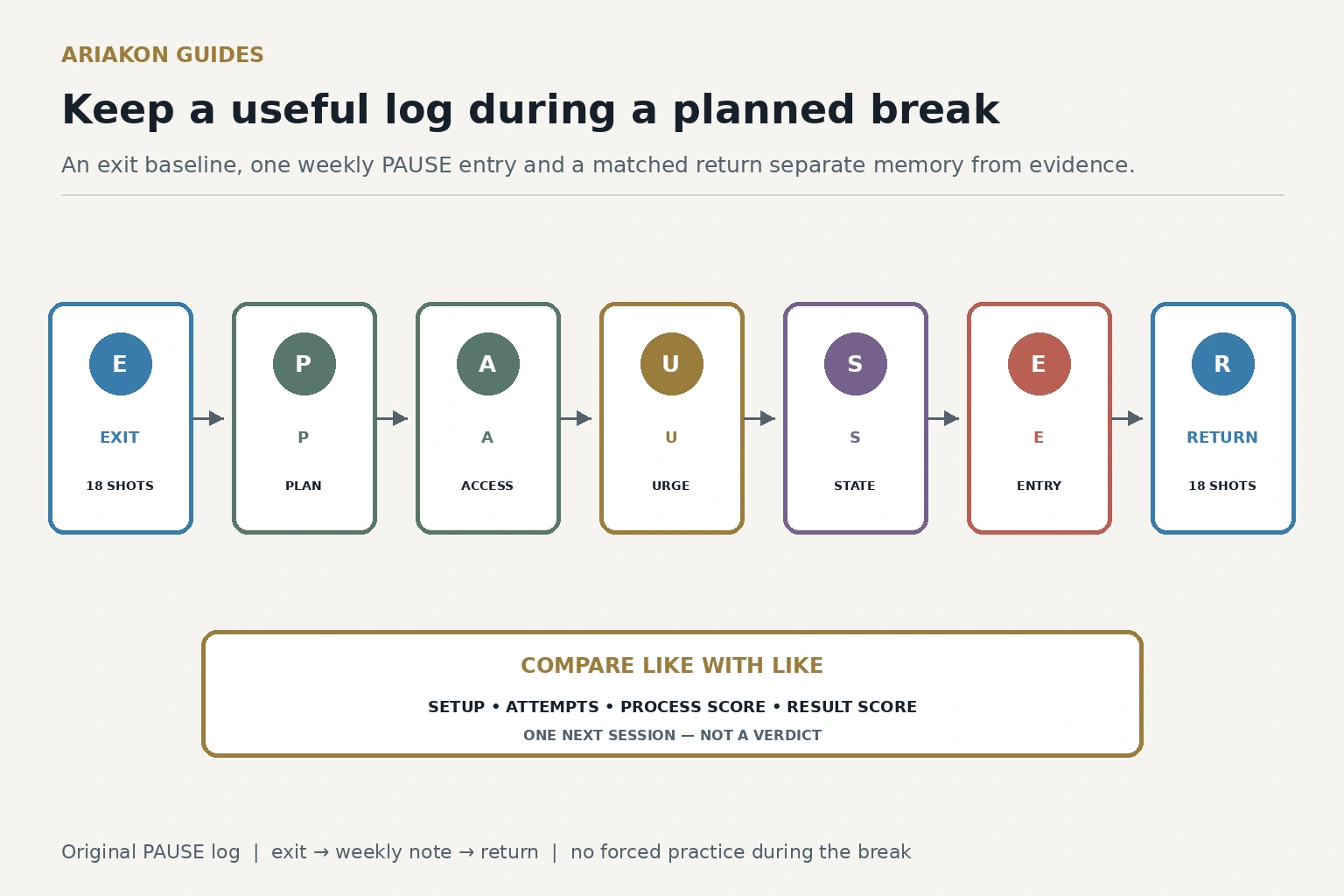
A planned break can protect time, recovery or motivation, but memory tends to blur what was stable before the pause. Use one exit baseline, short factual entries during the break and a matched return ladder. The planned-break guide covers whether and why to pause; this resource defines the log that makes the return diagnosable.
Open the log with a reason, boundary and stop rule
| Field | Record |
|---|---|
| Reason | Scheduling, travel, recovery, injury guidance or practice reset |
| Start and review date | Dates, not a promised comeback |
| Table access | None, limited or planned calibration only |
| Allowed off-table work | Named reading, diagram or routine rehearsal |
| Stop/escalation | Pain, illness or health concern follows qualified guidance |
Plan the break and return baseline for the broader pause, equipment storage and three-session ramp.
Rehearse a shot with a written script when a bounded off-table routine is part of the plan.
Record an eighteen-shot exit baseline
Record table, cloth condition, cue, ball marks and date. The thirty-six available component points are a reference, not a grade. If the break is for injury or medical reasons, skip the physical baseline unless appropriately qualified guidance permits it.
The cue-ball-only Speed station has a training condition against touching a cushion; it is not a claim that cushion contact is an official foul in ordinary pool. Keep the two result fields distinct.
| Station | Six attempts | Score |
|---|---|---|
| Contact | Straight stop shot: object ball one diamond from corner, cue ball two diamonds behind | Pocket + two-ball stop corridor, 12 max |
| Speed | Cue ball from head string to a one-diamond target zone without object ball | Zone + no cushion contact or unsafe speed, 12 max |
| Decision | Three-ball pattern reset twice; name route and next zone before stance | Plan + routine, 12 max |
Use one bounded entry per week away
Keep the entry under five minutes unless the plan explicitly includes an off-table study block. Zero table attempts is valid data. Do not fill blank weeks from memory later.
| Field | Allowed entry | Do not claim |
|---|---|---|
| P — Purpose | Does the original reason still apply? | The break is automatically improving skill |
| A — Access | Any table or cue access since last entry | Unlogged casual play is a baseline |
| U — Useful observation | One rule, route or routine idea | Reading equals execution |
| S — Storage | Cue and table remain safely stored | No visible problem means perfect condition |
| E — Entry next | Review date or first return station | A dramatic comeback target |
Return through three matched six-shot stages
Session 1 repeats the Contact station after a comfortable warm-up. Session 2 repeats Speed only if ordinary movement is safe and comfortable. Session 3 repeats the Decision station and then plays one short pattern set. Use the same equipment and marks when practical and record every changed condition.
Score the same two components at each station. Compare return totals to the exit baseline only after the complete station, never after the first miss or make. Stop before fatigue turns calibration into a conditioning test.
Worked return: diagnose conditions before ability
A hypothetical exit baseline is Contact 10/12, Speed 8/12 and Decision 9/12. After three weeks away, return scores are 9/12, 4/12 and 8/12. The speed station was run on a faster table, so the log marks that comparison as changed rather than declaring that touch disappeared.
The next action is a twelve-attempt speed-zone calibration on the current table. Contact and decision return to ordinary practice volume. No cue change, tip change or major stroke rebuild is justified by the one changed-condition result.
Transfer the log into one game task
Finish with one six-ball pattern that uses the weakest safe station. Record plan completion and result separately. The log's job is to choose the next task, not prove that the break helped or harmed performance.
| Evidence | Next action |
|---|---|
| All stations near the exit range | Resume normal plan gradually |
| One station falls under matched conditions | Give that station one focused block |
| Conditions changed | Calibrate before judging skill |
| Routine holds but outcomes vary | Keep process; collect another sample |
| Pain, illness or unsafe fatigue appears | Stop and follow qualified guidance |