
Practice planning · 3 min read
Rehearse a Pool Shot Away From the Table With a Written Script
Off-table imagery is useful when it rehearses a movement you already understand and creates a better physical test. It cannot calibrate cloth speed, cushion response or new technique. A written script prevents the rehearsal from drifting: it names the scene, first-person cues, real-time stroke and recovery, then it is checked against an exact table setup.
Choose one familiar, reproducible shot
Use a photo or diagram of a shot you have physically played before. Mark the cue-ball and object-ball centers with diamond coordinates, name the pocket and write the intended cue-ball finish zone. Avoid rehearsing a jump, masse, injury-sensitive movement or an unfamiliar correction without qualified instruction.
The broad off-table guide covers observation and planning. This exercise isolates a written, timed shot script and a later matched validation block.
Review honest off-table practice before treating imagery as evidence.
Build a repeatable pre-shot routine for the standing and set sequence used in the script.
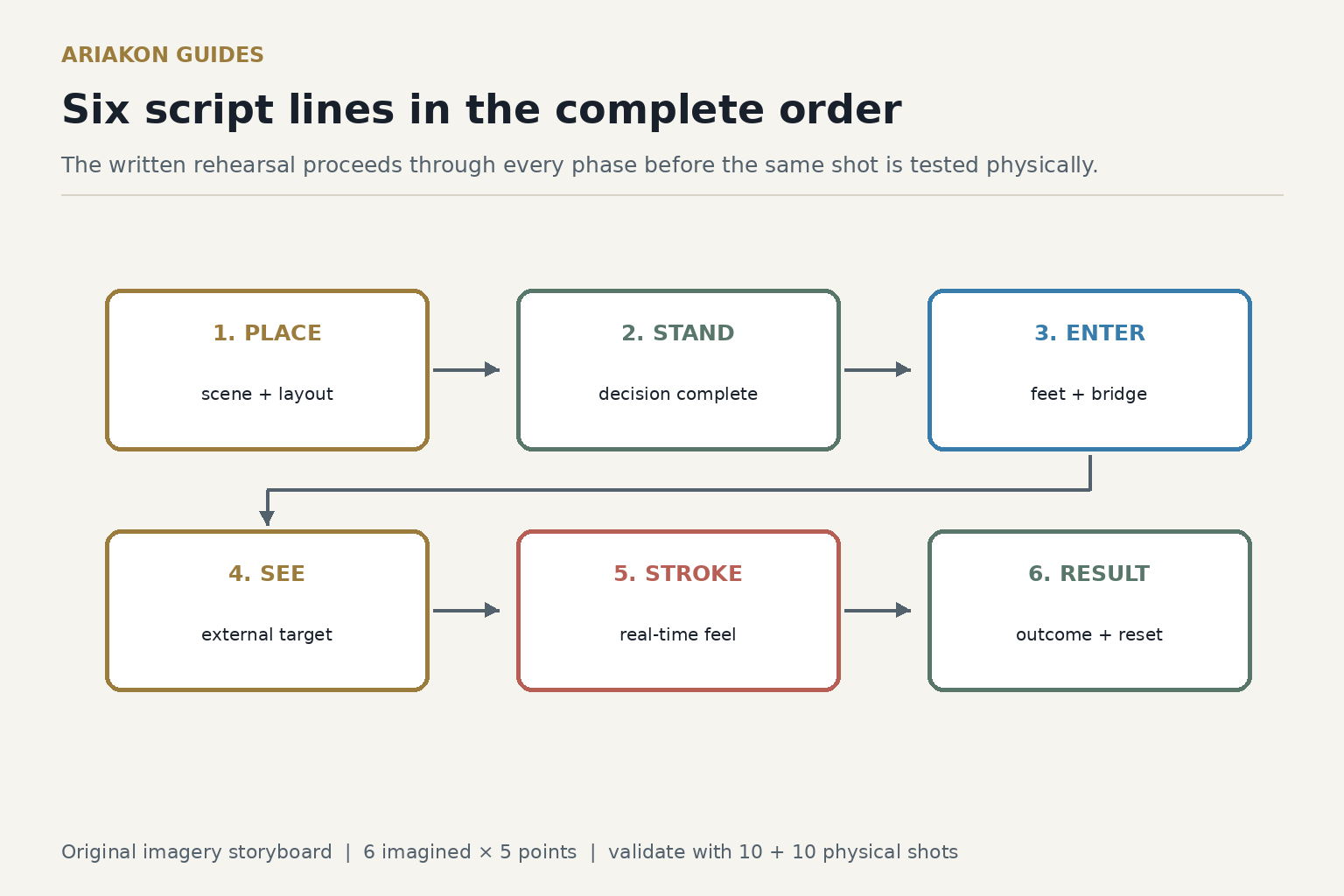
Write six lines in first-person present tense
The script records the task, environment, timing, perspective and sensory detail so that the imagined attempt can be compared with a physical one. Treat those as consistency prompts in this original worksheet; they do not establish that imagery improves this player’s pool performance.
| Line | Prompt | Example structure |
|---|---|---|
| 1 — Place | Where am I and what is fixed? | I see the object ball, called pocket and finish zone |
| 2 — Stand | What decision is complete? | I confirm the pocket line and one cue-ball task |
| 3 — Enter | How do feet and bridge arrive? | I step onto the line and settle without steering |
| 4 — See | What external target gets the final look? | I see the object-ball contact route |
| 5 — Stroke | What does real-time execution feel and sound like? | The cue accelerates once and the tip contact sounds clean |
| 6 — Result | What do I observe and how do I reset? | The ball reaches the pocket; I accept the leave and stand up |
Run six imagined repetitions
Read the script once, close your eyes only if comfortable and complete the sequence without physically swinging a cue in an unsafe space. Rest twenty seconds, score the repetition and change the script only between attempts. If pain, dizziness or distress appears, stop.
| Point | Observable self-report |
|---|---|
| 1 | Scene and ball locations stayed stable |
| 1 | Rehearsal used first-person perspective |
| 1 | Movement unfolded at believable real-time speed |
| 1 | At least one sound or touch cue was clear |
| 1 | Outcome and reset were completed without editing mid-stroke |
| Maximum 30 | Six repetitions; stop if attention becomes vague or forced |
Validate on the table instead of believing the image
Compare the two physical blocks by component, not by a promise of improvement. A difference of one or two makes in a short block may be ordinary variation. Keep the script only if it improves routine clarity without making delivery rigid, then retest on another day.
| Block | Attempts | Rule |
|---|---|---|
| Baseline | 10 | Shoot the registered layout before using the script |
| Rehearsal | 6 imagined | Use the written real-time sequence away from the table |
| Transfer | 10 | Reset the same layout and routine |
| Measure | 20 physical total | Record pocket, cue-ball zone and routine completion separately |
Worked rehearsal record
A hypothetical player scores 23/30 in imagery because the finish zone disappears on four repetitions and timing runs fast on three. The baseline is 7/10 pockets and 4/10 zones; transfer is 7/10 pockets and 6/10 zones. The honest conclusion is that position intention looked clearer in one small session, not that imagery caused a reliable gain.
The player rewrites line one to include the finish-zone edge and repeats the same comparison two days later. If physical delivery worsens or the script becomes internally focused during the stroke, the script is shortened rather than treated as mandatory.