
Stroke alignment · 3 min read
Keep the Cue on Line Through a Straight Pool Shot
A straight shot removes cut-angle judgment, but it does not remove alignment, center contact, cue elevation or delivery error. The goal is not to force the body into one pose. It is to choose a line while standing and keep the shaft inside the same visible corridor through the final stroke.
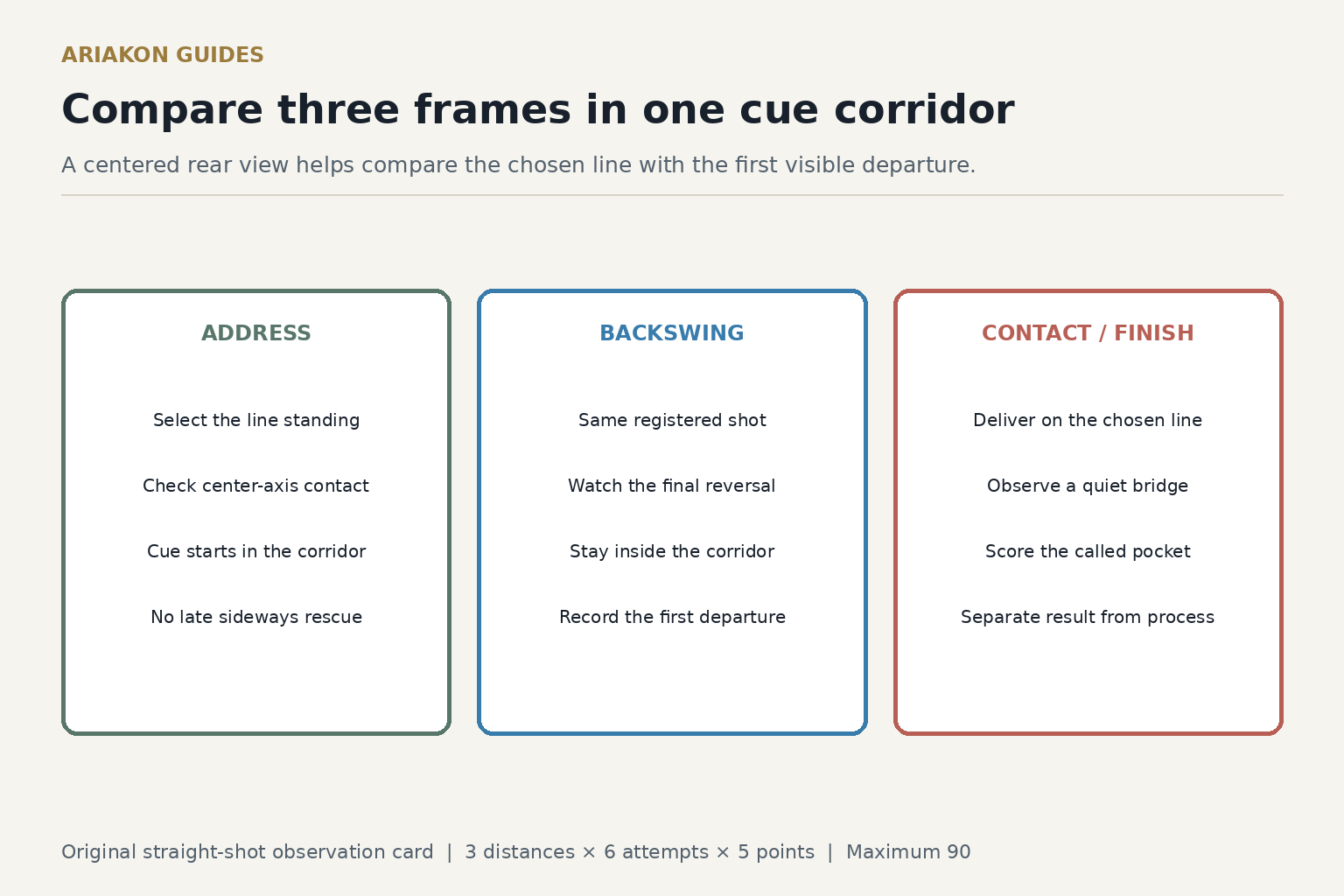
Create a straight reference without leaving hazards
Place the object ball one diamond from a corner pocket. Use a removable string or straightedge only while marking cue-ball centers one, two and three diamonds behind the object ball; remove it before shooting. Confirm the centers from behind the shot. Use vertical-axis contact and pocket speed.
Place a camera safely beyond the rear rail, centered on the shot line and outside every cue, player and ball path. Frame the cue from bridge to grip. Record six shots at each distance for eighteen total. Obtain permission before filming other people or a commercial room.
Build floor-up shot alignment before isolating the moving cue.
Use the stroke observation checklist when the first visible departure is still unknown.
Define the cue corridor from three frames
| Frame | Question |
|---|---|
| Address | Is the shaft centered on the selected cue-ball/object-ball line? |
| Final backswing | Does the shaft remain inside the same corridor? |
| Contact and finish | Does the cue return through the corridor without a sideways rescue? |
| After the shot | Did the bridge and head remain quiet long enough to observe the result? |
Score the eighteen-shot ladder
Score the video after the set rather than correcting every shot. Record miss side, cue-ball spin and corridor points separately. A made ball can still contain a line departure, and a miss can occur with a straight delivery if aim or center contact was wrong.
| Point | Observable requirement |
|---|---|
| 1 | Line selected while standing |
| 1 | Cue is inside the corridor at address |
| 1 | Final backswing remains inside the corridor |
| 1 | Delivery and finish return through the corridor |
| 1 | Object ball reaches the called pocket |
| Maximum 90 | Six shots each at one, two and three diamonds |
Diagnose the evidence in order
| Pattern | Next test |
|---|---|
| Cue starts outside corridor | Rebuild standing alignment and approach |
| Backswing leaves then returns | Reduce speed and observe grip/forearm path |
| Delivery leaves one side | Use a safe cue-path gate or rear video |
| Corridor passes but cue ball spins | Test vertical-center tip placement |
| Short passes, long fails | Keep mechanics and progress distance gradually |
Worked example and pattern transfer
A hypothetical player earns 30/30 at one diamond, 27/30 at two and 20/30 at three. Four long shots show the final backswing leaving left and the delivery finishing right. The correction is a slower three-diamond set with the same stance and target; the short-distance baseline is not rebuilt.
For transfer, play three racks and tag only shots that are nearly straight. Call the line and distance class while standing, then record whether the corridor held. Compare visual alignment, vertical-center contact, cue elevation and stroke direction as separate observations; a pocket result alone cannot identify which one changed.
Use a distance ladder to confirm a change after one cue-line correction is selected.