
Visual alignment · 5 min read
Diagnose Vertical Axis Perception Errors in Pool Alignment
A centered-looking address and an off-line camera picture can disagree for several reasons. This card records that disagreement before changing the head or delivery. It treats vertical-axis perception as a practical sight-picture question, not an eye condition, a named correction method or proof from one missed ball.
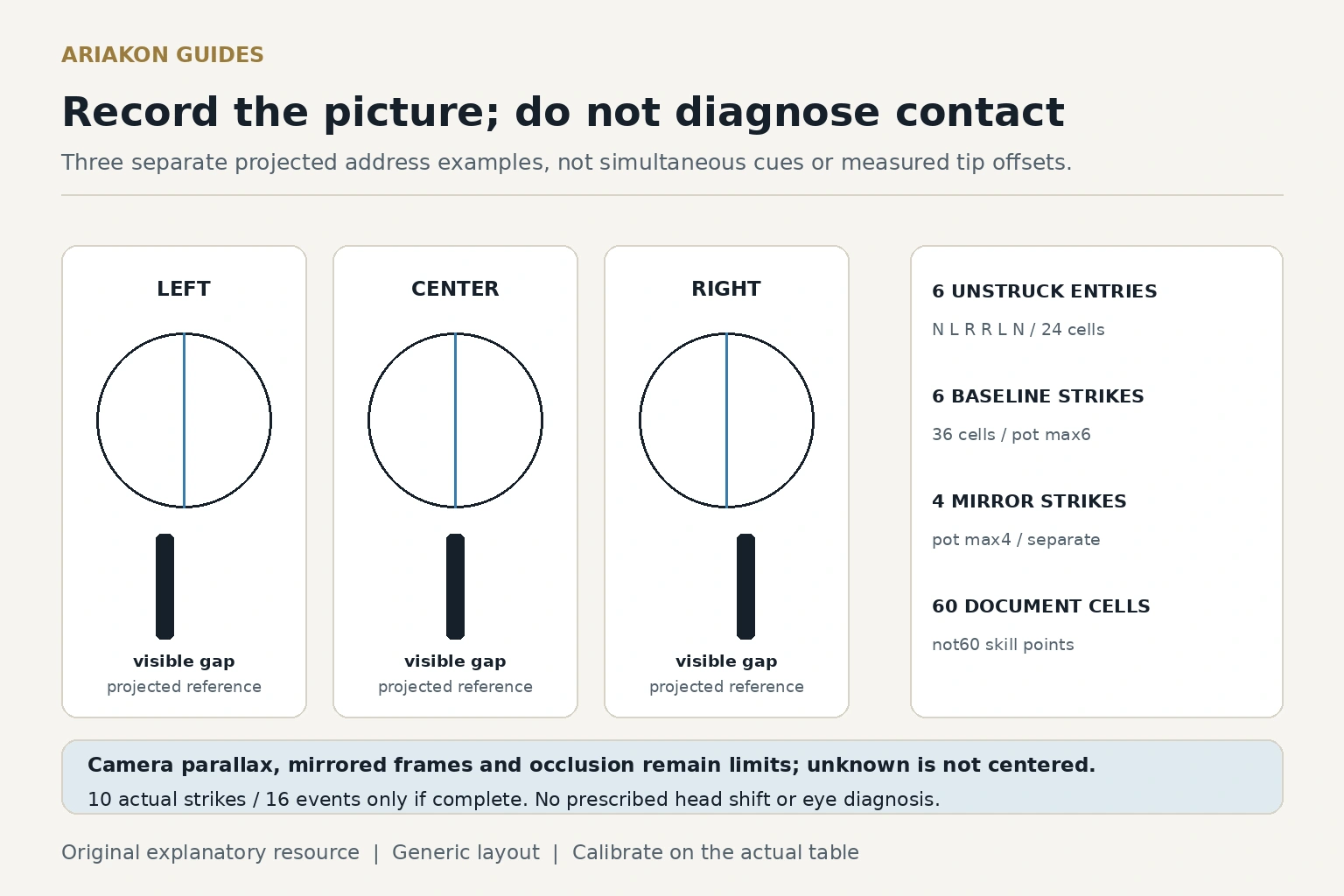
State what each observation can establish
Use a comfortable familiar stance and supported cue. A shifted picture can reflect camera skew, parallax, ball placement, entry or delivery as well as perception. A successful pot can coexist with a picture disagreement. Do not treat a resting chalk mark or sideways finish as direct contact evidence.
This is not a medical test. Stop rather than forcing a painful or uncomfortable position. Vision concerns belong with an eye-care professional; the worksheet supplies no diagnosis or treatment.
| Record | What it describes | What it cannot certify alone |
|---|---|---|
| Perceived picture | Shooter says left, centered, right or unknown at address | Physical initial contact or which head shift is correct |
| Registered camera picture | Projected cue/reference relationship in a fixed view | Exact three-dimensional tip offset or an eye diagnosis |
| Known shot result | Legal called pot, miss/foul and actual finish | The cause of a miss, exact impact spin or initial tip contact |
Preserve the chosen line during entry when the disagreement appears during lowering.
Keep contact-mark freshness and rotation separate before using residue as evidence.
Register a straight layout and a bounded view
Coordinates describe ball centers on an illustrative 100×50-inch bed: x=0..8 along the length, y=0..4 across it, origin at the lower-left cushion-nose corner. One unit is 12.5 inches; equal 2.25-inch balls have radius 0.09 and diameter 0.18 units. Intact-cushion center limits are 0.09..7.91 and 0.09..3.91. The four corners and (4,0),(4,4) are real pocket locations, not spots inside the bed. Measure actual balls, bed, mouths and jaws before scaling. Remove measuring aids before striking and never mark a competition table.
Use O(6, 3), real corner P(8, 4), first-contact cue center G(5.839003, 2.919502) and cue start C(4.944576, 2.472288). G=O−0.18u,C=G−u,u=(2,1)/√5; the intended centers are collinear. Use ordinary controlled delivery, practical low elevation and no intentional sidespin.
Place a stable camera behind the chosen approach outside the playing bed and stroke path; do not balance it on the cloth or cue. Verify the two fixed table reference points and the ball placement before and after the block. Keep lens, crop, height and position unchanged. Obtain permission to record. If the cue or ball silhouette is occluded, do not invent a centered entry.
Confirm that capture is not mirrored and map both reports to the same agreed table-side convention before comparing left/right. Otherwise mark the reports incompatible. A projected vertical through the ball-image center is a reference in that view. The cue and ball are at different depths/heights; cloth-plane calibration does not eliminate that parallax or certify microscopic contact. Prefer a qualified observer when placement cannot be registered safely. Remove physical measuring aids before shooting.
Hypothetical image calculation: ball-image center x=640, projected tip center x=628 and ball-image radius 80 pixels give (628−640)/80=−0.15 image radii. This is a leftward projected displacement in an unmirrored frame, not 0.15 physical ball radii of initial contact. Depth, resolution and occlusion remain separate limits.
Record six entries without striking, then six ordinary shots
N means normal approach; L/R are modest comfortable entry-side variations, not head positions or forced foot placements. If a variation is unsafe or unfamiliar, omit it and retain the actual category counts. Stop at address with a visible tip gap, state the perceived picture, capture the view, then withdraw. Do not slide the tip into the ball to make the camera look right.
For the six baseline strikes keep the normal approach, head candidate, camera and pace request fixed. Record left/center/right/unknown as image observations, not offset millimeters. A delivery description is visible straight-looking, visible change or unknown; ordinary phone footage does not resolve every contact interval.
Six unstruck rows × four fields gives 24 planned documentation cells; six baseline rows × six fields gives 36. Sixty cells are not sixty skill points or sixteen shots. Count known legal pots independently as 0/1, maximum 6, with unknown outcomes unscored.
| Block | Dose | Fields per event | Boundary |
|---|---|---|---|
| Unstruck entries | N,L,R,R,L,N; two per entry category | Entry, perceived picture, camera picture, view validity | No ball contact or pot |
| Baseline shots | 6 strikes from the same C/O/P | Entry, perceived picture, address picture, delivery visibility, pot, finish | Results separate from image interpretation |
Choose the first unresolved check, not a direction for the head
A hypothetical unstruck block reports perceived center on all six entries. The registered picture is left on four, centered on one and unknown on one. The disagreement count is 4 of 5 usable pictures, not four proven off-center contacts or an estimate of eye alignment.
Suppose the separate shot block pots 4 of 6. That outcome neither confirms nor erases the picture disagreement. Keep the six original rows; do not choose a permanent head position from those counts or infer the required direction of movement from a rear-view sign.
| Repeated record | First bounded next action | Do not infer |
|---|---|---|
| Perceived center; registered picture repeatedly one side | Recheck camera/layout, then ask an instructor to observe one comfortable candidate change | Move the head in a prescribed direction |
| Address picture stable; later cue picture changes | Inspect the visible delivery event in a separate clip | The exact tip-contact location from a finish |
| Disagreement follows only one entry category | Recheck the chosen line and supported entry | Eye dominance or an eye disorder |
| View unregistered, occluded or inconsistent | Repair the observation before changing technique | Unknown equals centered |
| Pictures stable but pots differ | Recheck actual aim, pocket and conditions | Perception caused every miss |
Retest one observation, then test the mirror separately
If the view was the problem, repair that view first and take a new six-entry plus six-strike record, keeping the body/routine candidate unchanged. If a registered disagreement remains, a qualified instructor can help test one comfortable candidate change; keep all other inputs and the original rows. Do not rename a proprietary eye-position exercise or claim a small before/after difference proves its cause.
For a separate four-strike transfer reflect x→8−x: O(2, 3), P(0, 4), G(2.160997, 2.919502), C(3.055424, 2.472288). Record perceived and camera pictures plus the known legal pot independently. Maximum 4 pot points; no baseline-image bonus.
Six unstruck entries, six baseline strikes and four transfer strikes are sixteen events but ten actual strikes only if complete. A retest is additional and separately dated. Unknowns reduce their own observed denominator, and administrative resets add preparations rather than score rows.
Calibrate a repeatable vision-center candidate separately after the evidence question is established.
Inspect lateral stop-shot drift as a separate task without treating this sight-picture card as a contact test.
Sources and further reading
References support the specific factual information above. The practical checklists are Ariakon editorial guidance.