
Fundamentals · 3 min read
Diagnose Misses on Straight Pool Shots
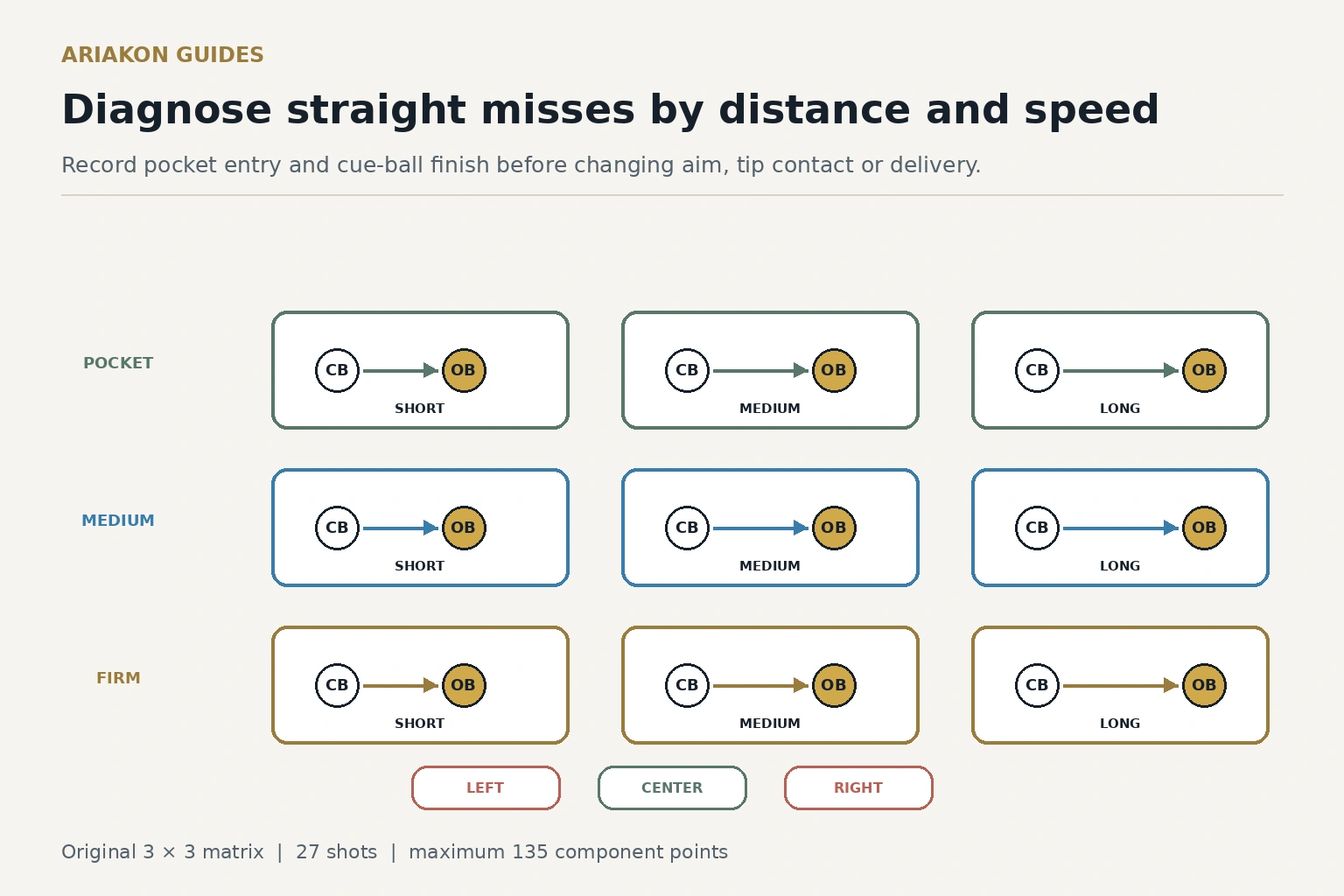
A straight shot removes cut-angle choice, which makes alignment and delivery errors easier to see. That does not mean every miss has the same cause. This diagnostic holds the object-ball path constant, changes only distance and speed by block, and records pocket entry plus cue-ball behavior before suggesting a correction.
Build one center-line reference
Mark ball centers only with removable aids the room permits. Use clean, undamaged balls and stop if equipment damage is visible. If the long station is not routinely makeable, shorten it; the goal is diagnosis, not punishment.
Test visual alignment, vertical-center contact, cue elevation and stroke direction as separate possible causes. The matrix records their observable consequences; it does not infer one cause from a single miss.
| Item | Setup | Reason |
|---|---|---|
| Object ball | One diamond from a corner pocket on its center line | Keeps the object-ball path visible |
| Short cue ball | One diamond behind the object ball | Low difficulty reference |
| Medium cue ball | Two diamonds behind | Adds delivery demand |
| Long cue ball | Three diamonds behind or the longest safe table fit | Magnifies small errors |
| Aim and spin | Center ball; object ball to pocket center | Reduces variables during diagnosis |
Establish complete shot alignment before interpreting the matrix.
Check cue travel through a straight shot if delivery evidence is inconsistent.
Shoot a twenty-seven-shot matrix
Award one point for the declared center-ball setup, one for no visible last-second steering, one for center-pocket entry, one for a legal make and one for the cue ball remaining inside a one-ball-width lateral lane after contact. Maximum score is 135. Record left and right misses even when the ball drops.
| Block | Speed description | Attempts at each distance |
|---|---|---|
| A | Pocket speed | 3 short + 3 medium + 3 long |
| B | Medium speed | 3 short + 3 medium + 3 long |
| C | Firm but controlled | 3 short + 3 medium + 3 long |
| Total | One routine and center-ball intention | 27 |
Read paired evidence
Squirt, swerve and throw can interact when the cue ball is struck off center. Because speed, elevation, cloth and ball condition matter, use repeated directional patterns instead of naming spin from one outcome.
| Pattern | First test | Do not conclude yet |
|---|---|---|
| Same miss side at all speeds and distances | Recheck standing sight line and vision center | That the pocket or table is wrong |
| Miss side changes with speed | Check cue elevation and unintended sidespin | That aim alone changed |
| Center entry but cue ball exits sideways | Inspect tip contact and cue delivery | That the make proves a centered hit |
| Only long shots scatter | Shorten distance and inspect routine stability | That a new aiming system is required |
| Same table-side drift from both ends | Check table roll and ball condition | That the stroke caused every result |
Worked diagnosis: long and firm misses
A hypothetical player scores 43/45 at short distance, 38/45 at medium and 26/45 at long. Seven of the nine long shots miss left or enter the left jaw, and six cue balls finish outside the right side of the lane. The firm long block is worst.
The player keeps the registered line, returns to medium distance and adds a deliberate center-tip check for nine shots. The score rises and lateral exits shrink. The next test is tip setup and delivery, not a global change to aim. A rear-view recording or qualified instructor can help if the pattern persists.
Retest one variable, then transfer
Change only one element—distance, speed, visual alignment, tip check or delivery cue—and repeat nine shots. Keep the change only if the same component improves on another day. Then transfer to a nearly straight cut while retaining the normal pre-shot routine.
Pain, vision concerns or persistent unexplained difficulty are outside a scorecard’s authority. Stop and seek an appropriate qualified professional rather than forcing more repetitions.