
Fundamentals · 3 min read
Choose Pool Foot Position Before Adjusting Head Height
Head height is only one part of a pool stance. If the feet move between attempts, a lower or higher view is being tested on a different base. Set the shot line while standing, place a comfortable front and rear foot relationship, confirm balance and cue clearance, then compare only two nearby head heights.
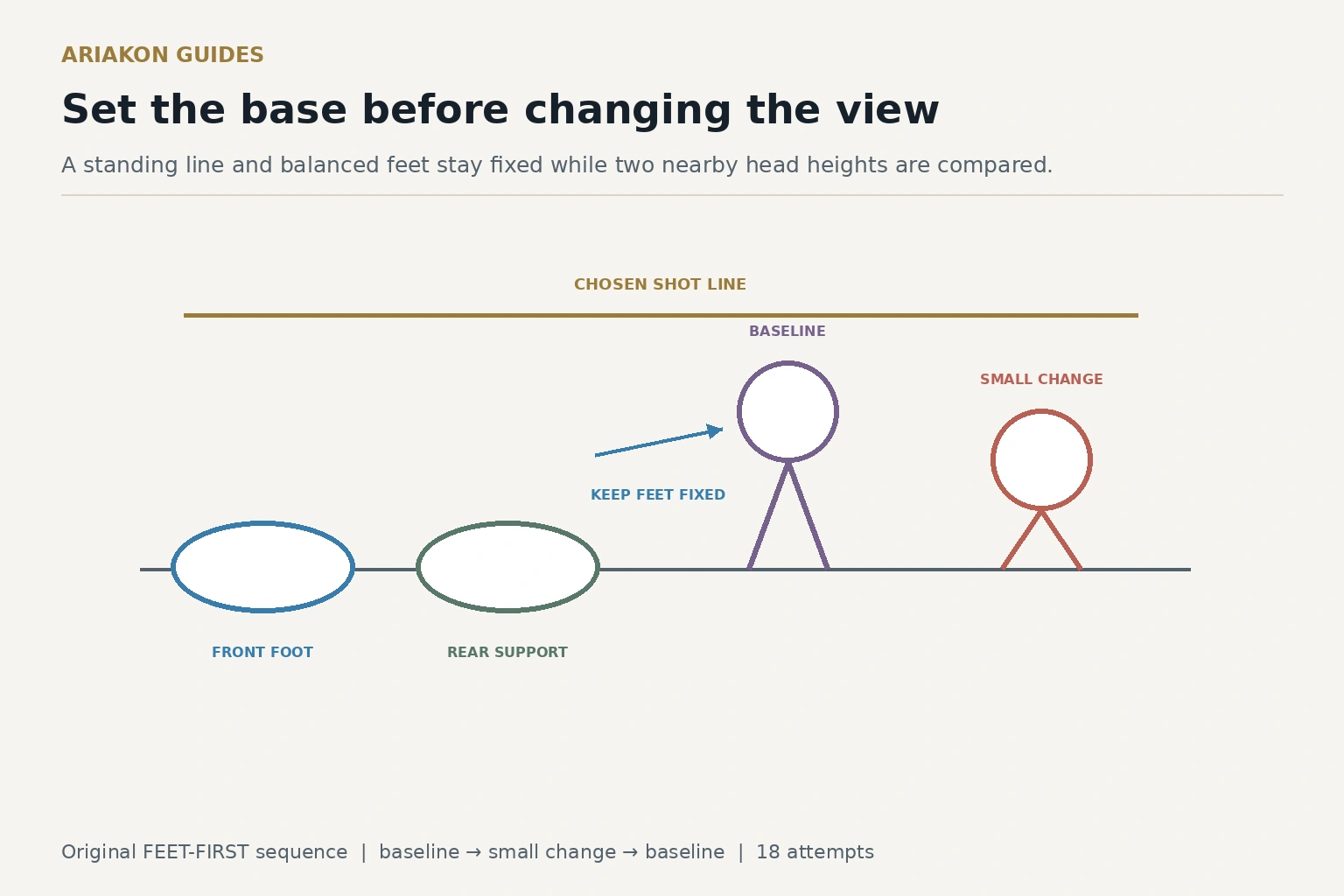
Follow FEET-FIRST in order
There is no single foot angle or head height for every body. The target is a repeatable, balanced position that preserves vision, cue clearance and a free delivery. Pain, numbness or dizziness is a stop point, not a scoring penalty.
Mark feet with removable floor references only where the venue permits. Do not tape or mark another person's floor without permission.
| Step | Observable check | Stop condition |
|---|---|---|
| F — Find line | Pocket, object-ball contact and cue line named while standing | No settled target |
| E — Enter | Front foot approaches the line without a late twist | Knee or hip pain |
| E — Establish rear support | Feet create a stable, comfortable base | Weight trapped or off balance |
| T — Test cue clearance | Grip, chest and chin allow a free stroke | Cue rubs or posture is forced |
| F — Fold | Hips and knees lower the body without reaching the head | Falling toward bridge hand |
| IRST — Inspect, repeat, settle, test | Eyes and cue return to the same line | Persistent visual or physical discomfort |
Choose a repeatable stance height for the broader comfort, clearance and vision tradeoffs.
Build pool-shot alignment from the floor up when the standing entry, not height, is unstable.
Run an 18-shot two-height comparison
Use a comfortable straight shot and center-ball speed. Change only head/torso height within a pain-free range; do not also move the bridge, foot marks or ball positions. Film only if the room permits and the camera can be placed safely outside play.
Worked example: baseline scores 22/24, lower height 17/24 and return 23/24. Four lower-height attempts show cue-to-chest contact. The next action is keeping the baseline, not forcing a lower view because it looked more traditional.
| Block | Condition | Score each attempt 0–4 |
|---|---|---|
| 1 | Natural baseline height | Balance, cue clearance, still head, declared result |
| 2 | One small comfortable height change | Same four points; feet remain fixed |
| 3 | Return to baseline | Same four points; checks for order or fatigue effects |
| Maximum | 72 process points | Pocket outcome is only the declared-result point |
Diagnose the first failed checkpoint
| Evidence | Next question | Next six attempts |
|---|---|---|
| Feet move before every descent | Was the standing line settled? | Re-enter without shooting |
| Stable feet, cue rubs body | Is there enough torso and grip clearance? | Return to the freer height |
| Balanced but misses one side | Does the cue start on the chosen line? | Use a wide safe cue gate |
| Pain or dizziness | Is the setup appropriate? | Stop; seek appropriate professional guidance |