
Learning resources · 3 min read
Choose a Beginner Pool Book You Can Turn Into Practice
A useful first pool book does more than explain the game. It gives you a small sequence of ideas you can verify on the table, shows setups clearly and distinguishes stable technique from rules that may change. Choose for the next skill you will practice, not for the thickest table of contents.
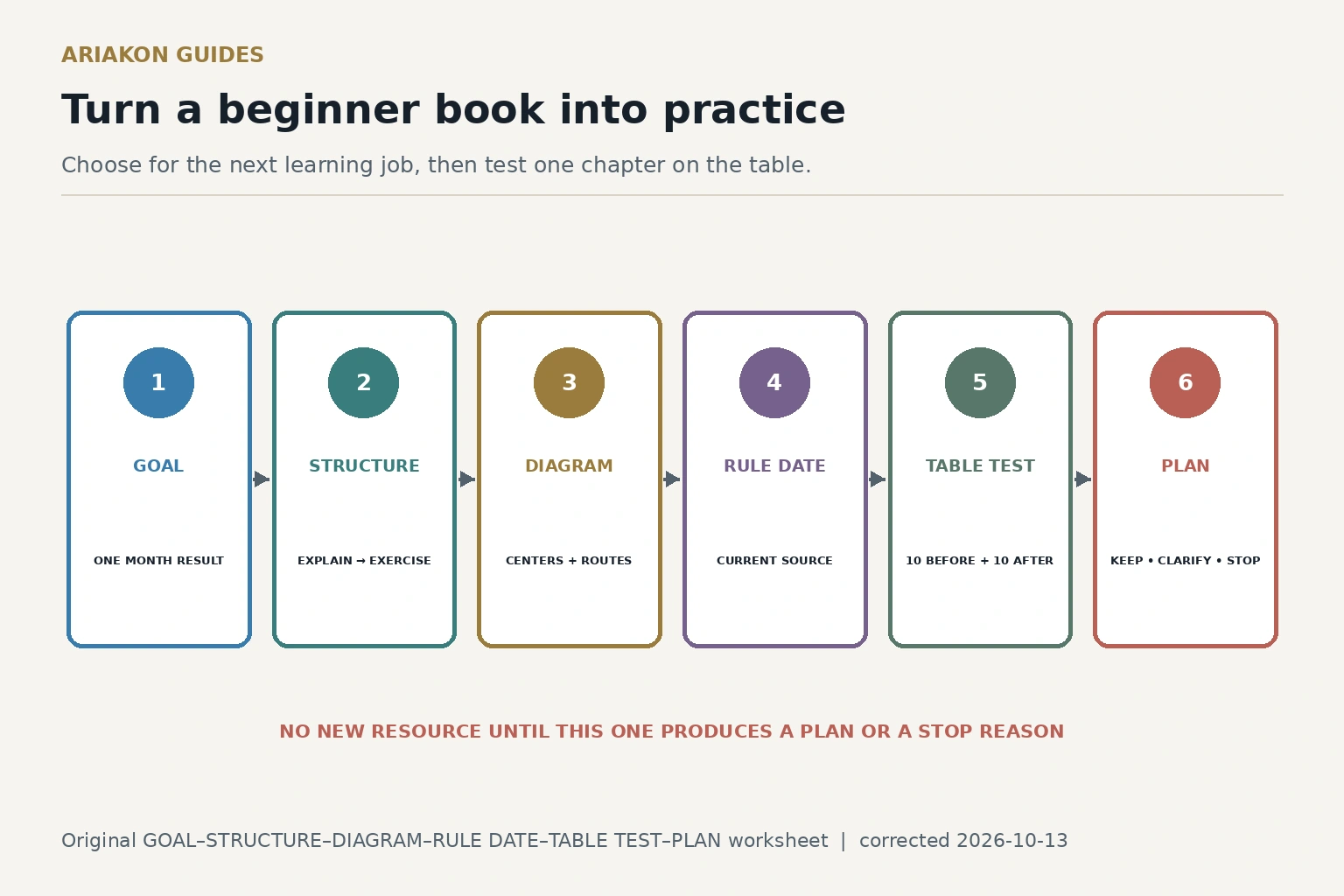
Choose one immediate learning job
A focused resource can be more useful than a broad reference when the next job is a repeatable stop shot or an accurate understanding of a game rule. Use the brief to judge the contents page rather than choosing by page count.
Do not treat an author biography, testimonial or bestseller label as evidence that the teaching sequence fits the reader's goal.
| Field | Write before browsing | Reject when |
|---|---|---|
| GOAL | One result for the next month | The book does not address it |
| LEVEL | First overview, fundamentals or next-step control | The first chapter assumes unexplained prior skill |
| TIME | Sessions per week and minutes per session | Exercises cannot fit the available table time |
| TABLE | Equipment and space actually available | Required setup cannot be rebuilt safely |
| EVIDENCE | What success will look like in ten attempts | The lesson offers no observable outcome |
Inspect structure, diagrams and rule dates
Technique and rules age differently. A basic stop-shot exercise may remain useful while break procedures, templates or foul rules change. Verify rule-dependent claims against the current event or league source before competition.
The World Pool Association publishes current rules and equipment documents. The event's own adopted rules still control the match.
| Check | Pass condition | Why it matters |
|---|---|---|
| STRUCTURE | Explanation leads to setup, attempts, score and next step | The chapter can become a session |
| DIAGRAM | Cue ball, object ball, pocket, centers and routes are unambiguous | The layout can be rebuilt |
| VOCABULARY | Terms are defined before the exercise relies on them | Private shorthand does not block learning |
| RULE DATE | Rule-dependent claims identify an organization and date | Competition rules can change or vary |
| PROGRESSION | Later work changes one difficulty at a time | The reader can diagnose a failure |
Use the practical pool training guide to place a useful chapter inside a weekly plan.
Run a ten-attempt chapter test
Worked example: the baseline produces 4/10 pockets with no consistent cue-ball finish. After the chapter, the retest produces 6/10 pockets and 5/10 called finishes. Record a promising local change, not proof that the book will improve every player.
If the diagram cannot be rebuilt, the scoring rule changes mid-exercise or the claimed result is not observable, mark the chapter clarify. Seek a clearer institutional resource or qualified instruction before practicing a guess.
| Block | Attempts | Record |
|---|---|---|
| Baseline | 10 from the exact marked setup before reading the instruction | Pocket result, cue-ball finish and miss side |
| Apply | Read one change and complete its stated practice | Only the changed variable and any unclear step |
| Retest | 10 from the same marks, pocket and called speed | Same three observations as baseline |
| Decision | Compare observation quality, not only makes | Keep, clarify or reject the chapter for this goal |
Build a small learning shelf
- One current rules source for the games being played.
- One fundamentals resource with reproducible setups.
- One cue-ball-control progression with measurable windows.
- A notebook for dates, baselines, questions and retests.
- Qualified visual instruction for movement a still page cannot show.
- No new resource until the current one produces a usable plan or a documented stop reason.
Sources and further reading
References support the specific factual information above. The practical checklists are Ariakon editorial guidance.