
Learning resources · 3 min read
Build Questions for a Pool Player Interview That Produce Useful Lessons
A useful player interview does not need to invent intimacy, expertise or endorsement. Ask questions that connect a specific situation to a decision, the evidence the player noticed, the adjustment made and the conditions where the lesson may not apply. Preserve the player's words accurately, separate fact from opinion and give the reader a safe way to test the idea.
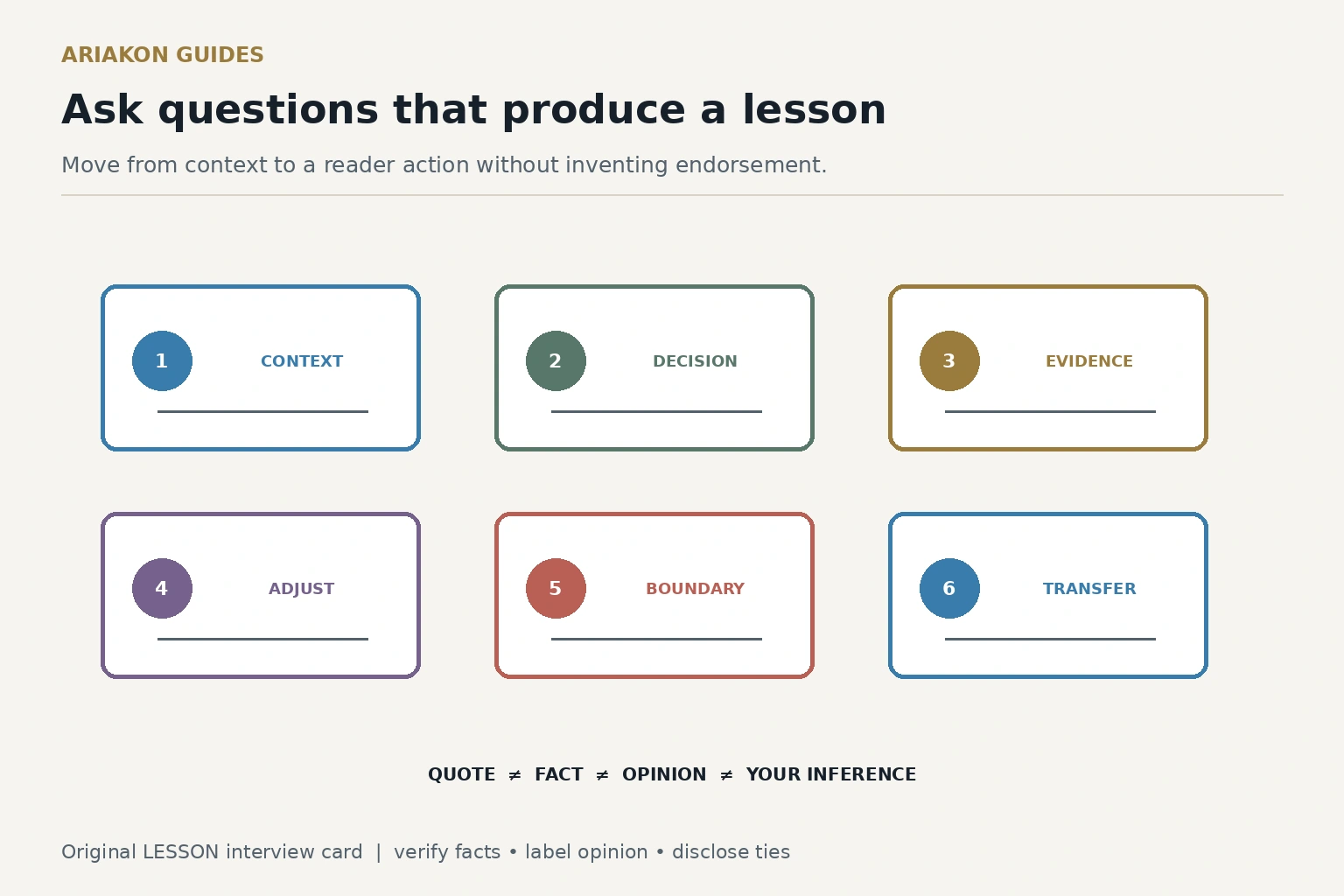
Build the six-part LESSON card
Send the subject and purpose before the conversation. Ask permission to record and explain whether the result is editorial, promotional or both. Do not imply a sponsorship, friendship or product relationship that does not exist.
Prefer one concrete episode over ten generic tips. Follow the answer with how did you know and what would change your choice. Those questions reveal decision criteria without demanding private information.
| Part | Question pattern | Useful output |
|---|---|---|
| Context | What exact game, score, table or practice condition are we discussing? | Bounded situation |
| Decision | What choice did you make, and what alternatives did you reject? | Observable judgment |
| Evidence | What did you see or measure before choosing? | Decision cue |
| Adjustment | What changed after the first attempt or failure? | Correction process |
| Boundary | When would you not use this method? | Limit and safety |
| Transfer | What can an intermediate player test this week? | Reader action |
Learn from professional pool matches for observing decisions before requesting an interview.
Study a practice method without inventing endorsement for testing a documented method after publication.
Label every answer before turning it into a lesson
Verify factual statements with current primary evidence and identify the source type clearly. A technical accuracy check can correct dates, wording and context without giving a subject control of the resulting article.
FTC guidance requires honest endorsements and disclosure of material connections in promotional contexts. A disclosure is not proof that a claim is true; product-performance claims still need appropriate support.
| Label | Example | Verification |
|---|---|---|
| Direct quote | The player's exact recorded words | Check transcript and context |
| Paraphrase | A faithful shortened meaning | Offer an accuracy check for technical wording |
| Factual claim | Event result, product specification or rule | Verify with current primary source |
| Opinion | The player's preference or interpretation | Attribute clearly |
| Your inference | A possible practice application | Label it as your analysis |
| Commercial connection | Payment, free product or sponsor relationship | Disclose clearly where readers will see it |
Turn one answer into a bounded practice test
The lesson is the decision process: identify trouble, protect access and reconsider when the condition changes. The reader tests that process in six marked layouts and records the first planning error. Nothing in the exercise claims that the interview subject endorses Ariakon or the reader's adaptation.
Before publication, link the full source when permitted, date the interview, correct factual errors and remove unsupported superlatives. The most useful closing question is what should a reader observe—not what equipment should everyone buy.
| Interview evidence | Reader translation | Boundary |
|---|---|---|
| Player says they identify the trouble ball before selecting an opening shot | Mark one trouble ball in six eight-ball layouts | Do not copy the player's full pattern by reputation |
| Player names cluster access as the deciding cue | Record whether an access ball exists | Rules and table conditions still control |
| Player changes plan when no access ball remains | Compare one attack and one safety option | The player's choice is not a guarantee |
| Six-layout review | Count complete plans and first decision errors | Report personal results only |
Sources and further reading
References support the specific factual information above. The practical checklists are Ariakon editorial guidance.