
Fundamentals · 4 min read
Center Ball Pool Shots: Detect Accidental Sidespin
Accidental sidespin can create cue-ball deflection, curve and contact-induced changes that masquerade as an aiming problem. But a missed shot alone does not prove sidespin: alignment, object-ball contact, throw, table level and delivery can produce similar evidence. Use multiple repeatable observations, record direction and change one variable at a time.
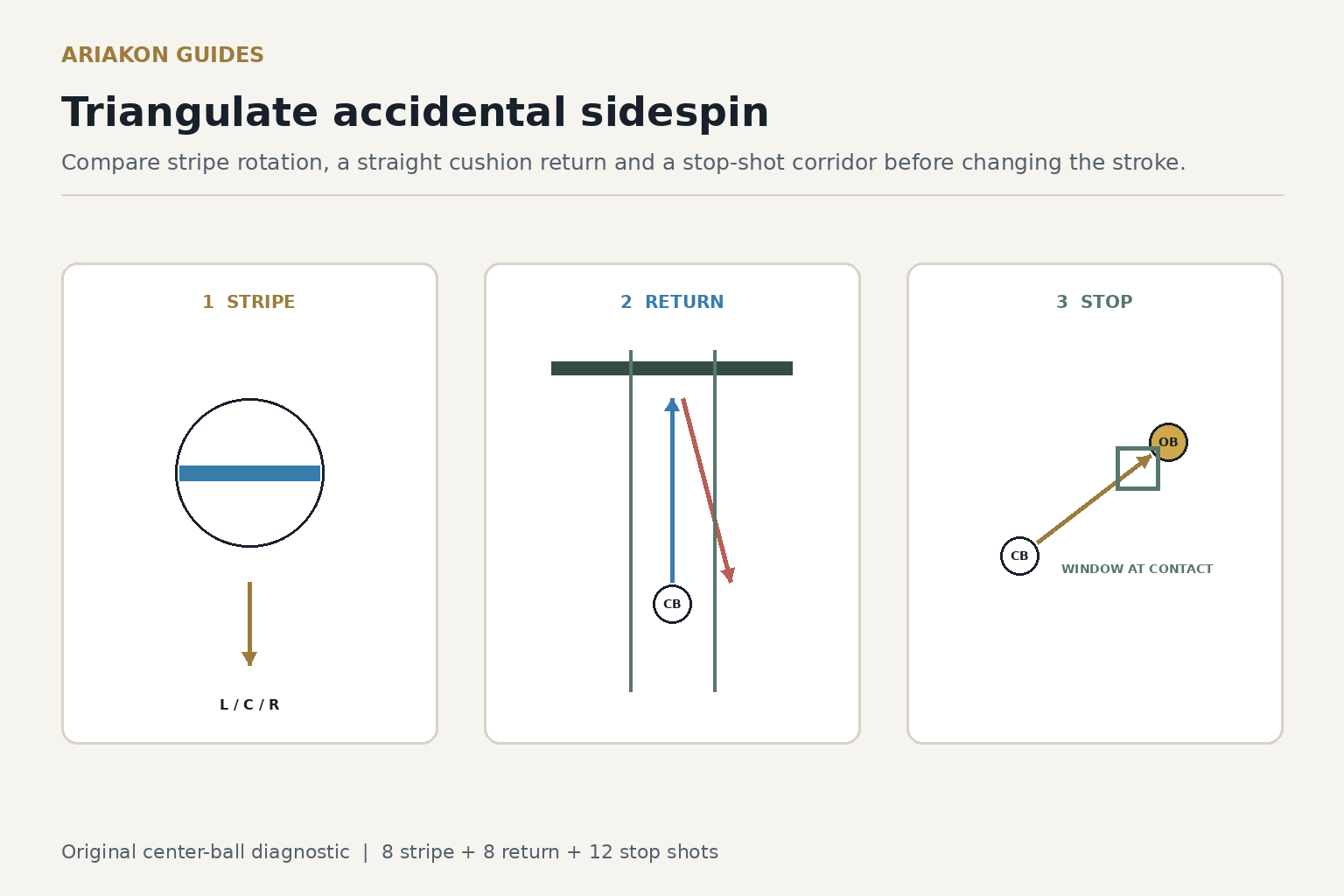
Define center ball as a vertical line
For this drill, center ball means contact on the cue ball's vertical centerline. Contact may be above or below geometric center for roll, stop or draw, but it stays on that vertical axis. A tip that arrives left or right introduces sidespin even when the player began by aiming at the middle.
Stand behind the cue ball and use its visual symmetry, markings or a striped practice ball to identify the vertical line. Set the bridge and cue so the shaft points through that reference before warm-up strokes begin. Do not swoop the back hand during delivery to correct the line.
For any straight stop-shot score in this guide, center the finish window on the cue-ball center at object-ball contact: one ball diameter behind the object-ball center on the incoming line. The cue-ball starting position is not the stop destination. Keep the window size fixed before the block.
Find and strike the center of the cue ball for the visual and alignment foundation.
Build pool shot alignment from the floor up if every test drifts in the same direction.
Test 1: read stripe rotation
Place a striped ball as the cue ball with its stripe vertical and facing your viewing direction. From the head spot, roll it gently down the table on the centerline with high-center contact. Film from behind if safe, with the camera outside the cue and ball path. Watch whether the stripe rotates end over end or visibly precesses sideways.
Shoot eight attempts and mark L, C or R for left wobble, clean-looking vertical rotation or right wobble. The stripe is a practical visual reference, not a calibrated spin meter. Dirt, a misoriented stripe and camera angle can mislead, so reset the stripe before each attempt.
Test 2: use the straight cushion return
Send the cue ball from the head spot straight to the center diamond of the foot cushion and let it return. Use a medium, comfortable rolling speed. Mark a one-ball-wide corridor around the centerline. Shoot eight attempts and record whether the returning center crosses the head string inside the corridor.
A consistent angled return may reflect sidespin, an off-center cushion hit, cushion response or table level. Reverse the direction and compare another table lane before assigning the cause. This is a diagnostic screen, not a measurement of cushion accuracy.
Test 3: compare a straight stop shot
Place an object ball one diamond from a corner and the cue ball one diamond straight behind it. Shoot twelve stop shots at one speed. Record pocket, cue-ball finish left/center/right of a one-ball-wide window and visible stripe direction. Replace both centers exactly after every attempt.
Score one point for pocket, one for stopping in the window and one for a clean-looking center-axis stripe. Maximum thirty-six. A pocketed ball with a sideways cue-ball finish is especially useful evidence because it separates pocket result from cue-ball behavior.
| Test | Attempts | Primary observation | Do not conclude from one result |
|---|---|---|---|
| Stripe roll | 8 | L / C / R rotation | Exact spin amount |
| Cushion return | 8 | Left / corridor / right | That the cushion is wrong |
| Stop shot | 12 | Pocket + finish + stripe | That every miss is sidespin |
Worked example: triangulate before changing equipment
The stripe test shows right wobble on six of eight attempts. The return test finishes left of the shooter on five of eight attempts, consistent with the cue ball leaving the tip with unintended right sidespin and changing at the cushion. The stop-shot set pockets ten of twelve, but seven cue balls finish left of the window and show the same rotation direction.
Because three observations repeat one direction, the next action is a filmed eight-shot delivery block with a wider target and attention to tip placement—not a new shaft. If rotation direction alternates while the cue passes through a physical gate, recheck sighting, ball cleanliness, camera view and table path before making a claim.
| Pattern | Next check |
|---|---|
| Same spin direction in all tests | Tip placement, back-hand movement and alignment |
| Stripe clean; rebound drifts | Cushion contact, lane and table level |
| Stripe alternates left/right | Delivery repeatability and visual center reference |
| Cue ball straight; object ball misses | Aim, cut contact and throw |
| Only firm shots drift | Grip pressure, cue elevation and steering under speed |