
Practice planning · 3 min read
Can Pool Video Games Help Your Practice? Separate Planning From Execution
A pool video game can make pattern options visible and let you rehearse choices without table access. It cannot establish how your cue, cloth, stroke or contact will behave. Treat the screen as a planning notebook: name a decision, predict a route and then verify that exact idea in a short physical session.
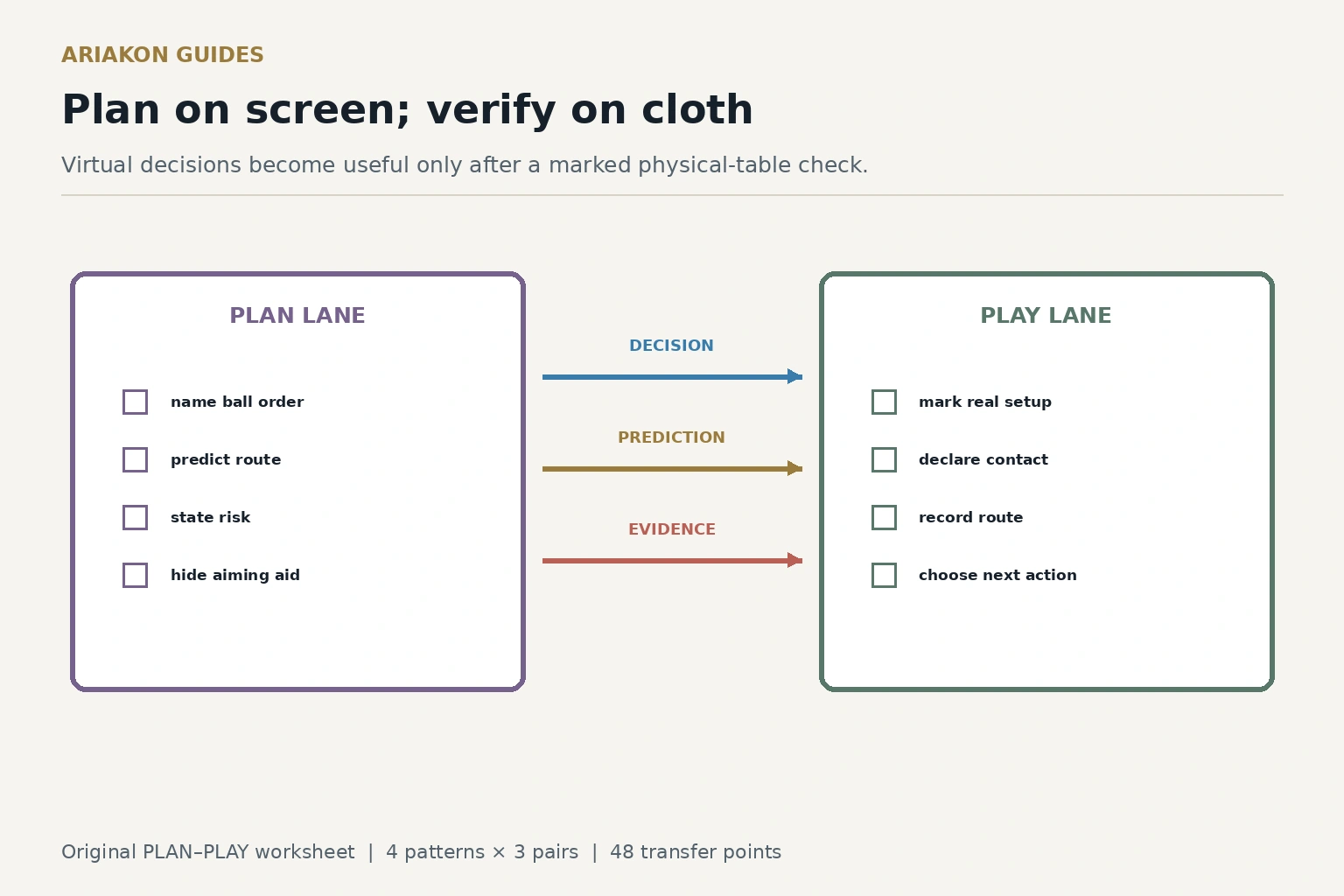
Separate decisions from executions
Treat any virtual-to-table transfer as a question to measure in your own session. A software route can suggest a plan, but its physics do not establish your delivered contact, speed or cushion result. The paired worksheet below records the difference instead of promising a research-backed billiards benefit.
Use a title and date for the exact game or simulator because its rules and physics may change. Ariakon does not endorse a game, and the worksheet does not rate a product.
| Screen can help rehearse | Physical table must verify | Do not claim |
|---|---|---|
| Ball order and alternative patterns | Whether the chosen route is executable at your level | That game physics equal the table |
| Safety versus offense choices | Object-ball contact and cue-ball speed | That a controller rehearses a cue stroke |
| Rail-count and target-zone vocabulary | Rail response on the actual cloth and cushions | That drawn lines guarantee a route |
| Score, inning and error review | Standing routine, contact and finish | That a higher game rating is pool improvement |
Practice pool away from the table for imagery, observation and note-taking methods beyond simulations.
Plan three-ball patterns when the virtual decision needs a small table test.
Run twelve PLAN–PLAY pairs
Choose four ordinary three-ball patterns. Make one virtual decision, hide any aiming aid, sketch the route and play three physical attempts from marked positions. If the software cannot reproduce a legal rule or table condition, label that field unknown instead of correcting the game by assumption.
Worked example: the player earns 12 plan, 11 predict, 12 place and 7 play points. All five failed physical attempts finish long. The next action is a six-shot speed-zone test on the table; it is not more controller repetitions.
| Point | Observable evidence |
|---|---|
| 1 — Plan | Name the ball order, cue-ball zone and main risk before playing |
| 1 — Predict | Sketch the intended route without copying an on-screen aim line |
| 1 — Place | Recreate only a simple, safely measurable table layout |
| 1 — Play | Contact and route match the predeclared plan and cue ball reaches the called zone; record every miss |
| Maximum | 48 transfer points; virtual and physical outcomes remain separate columns |
Close the loop with one next action
Stop after writing one six-attempt table task. The simulation remains useful only when it improves the next question and the physical result is recorded honestly.
| Mismatch | Next action | Keep separate |
|---|---|---|
| Wrong ball order | Re-plan two routes and state the risk | Stroke mechanics |
| Route direction differs | Verify contact and tangent-line expectation | Game rendering |
| Distance differs | Calibrate one physical speed zone | Virtual power meter |
| Delivery breaks down | Use a simple center-ball drill | Pattern complexity |