
Banks and kicks · 4 min read
Map Four Cross-Side Banks With a Miss-Continuation Record
A hook chart needs a bank route before it needs labels. This original four-station card reaches a real side pocket by one intact cushion, then records only the continuation that an actual miss produces. The four station numbers and notebook hooks belong to this independent calibration card, not a fixed conversion-number banking system.
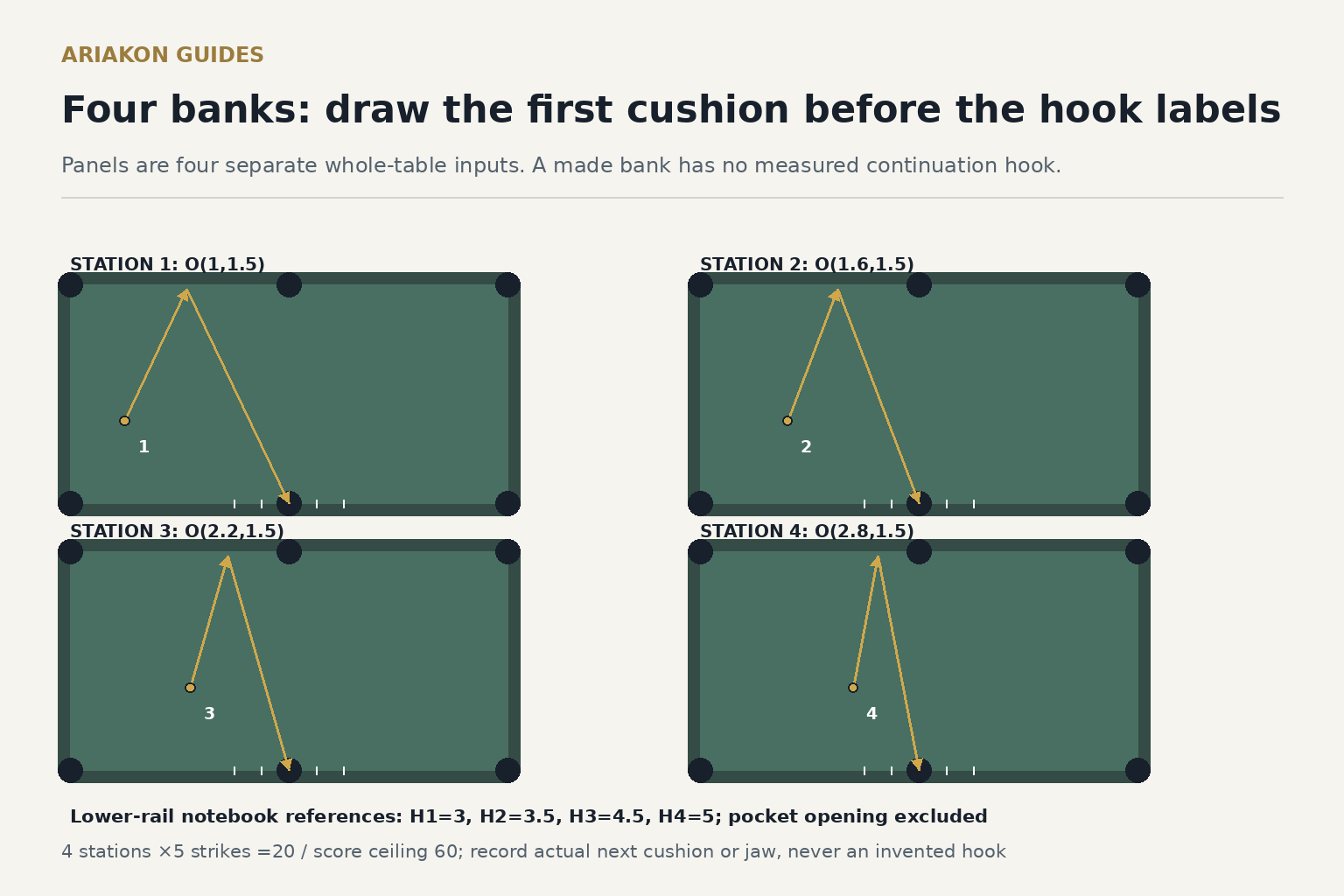
Call the side pocket and define the center reflection
Coordinates are ball centers on an illustrative 100 by 50 inch bed: x=0..8 along length, y=0..4 across width, origin at the lower left cushion nose. One unit is 12.5 inches. For 2.25 inch equal balls, radius is 0.09 and diameter 0.18 units. Intact cushion center boundaries are x=0.09,7.91 and y=0.09,3.91; pockets interrupt the physical boundary at the four corners and (4,0),(4,4). Measure actual bed, balls and jaws before scaling. Remove every measuring aid before shooting; never mark a competition table.
Use real lower side pocket P(4,0), upper reflecting center boundary y=3.91, and virtual pocket V(4,7.82). Four separate object starts are O1(1,1.5),O2(1.6,1.5),O3(2.2,1.5),O4(2.8,1.5). Only one station is placed at a time. No black pocket is drawn inside the bed.
For each O compute R_x=O_x+(4−O_x)(3.91−1.5)/(7.82−1.5). First center contacts R1..R4 are approximately(2.143987,3.91),(2.515190,3.91),(2.886392,3.91),(3.257595,3.91). Their physical nose points have the same x and y=4, on intact cushion. Let u=(R−O)/|R−O|; cue first-contact center is G=O−0.18u and cue start C=G−0.75u. Cue/object approach is straight at first contact.
The drawn O→R→P lines are ideal equal-angle references. Speed, object rotation and cushion response can move the real bank. Use a modest repeated no-intentional-sidespin input; never claim a center tip request removes object spin.
Record hooks as actual continuation observations
A made bank ends in P and has no second-rail hook. A missed bank may hit a jaw, stop, fall in another pocket, or reach the lower intact cushion beside the pocket. Record the actual first postbank lower-cushion nose coordinate x only when seen; do not invent a continuation through a pocket or jaw.
Hooks H1=3,H2=3.5,H3=4.5,H4=5 are notebook references along the lower physical nose, not expected outcomes or aim points. The side-pocket opening around x=4 is excluded. Record beyond-H, between-H, jaw, no lower contact or unknown rather than forcing every miss into one of four labels. A ball contacting another cushion first is a different route.
Take twenty distinct station attempts
Take station order 1,2,3,4 five times: five actual strikes per station,20 overall if completed. Reset exact centers after every strike. Keep contact request, pace and equipment fixed in the baseline. Do not add spin to rescue a station midcard.
Use ordinary legal ball contact and a called bank pocket. Score 0 known foul/wrong required cushion;1 correct first cushion but pocket missed without jaw contact;2 correct cushion then known jaw contact without pot;3 legal called bank pot. Required events that are hidden leave the nested score unknown, with independent known events retained. Each complete known station has 15 possible points; the baseline ceiling is 60.
Keep pocket and hook evidence in different columns
| Field | Record |
|---|---|
| Station and version | O,C,G,R and the actual input label |
| First cushion | Observed nose coordinate or unknown |
| Pocket result | Legal pot, jaw, wide miss or unknown |
| Continuation | Actual next cushion/contact coordinate, stopped, jaw or unknown |
| Cue result | Actual legal finish and any scratch |
| Score | 0..3 with applicable known denominator |
Use a correction only after a stable repeated pattern
A station is a candidate after three known legal bank pots of five, all first-cushion observations known and no unsafe action. If misses show a stable signed pattern, test one modest aim or pace change in a new five-attempt record. More speed is a hypothesis to test, not a universal short-bank repair.
Do not compute a median hook from made banks or jawed attempts that never reach the measured cushion. Report the number of usable continuation observations beside that median. A station with no measured hooks has no hook estimate, even if it potted all five.
Transfer the calibrated family cautiously
Take four separately recorded nearby game-like banks with the same legal pocket and 0..3 score, maximum 12. Choose from the actual cue location and inspect scratch risk. A table change invalidates exact numeric corrections; repeat the needed station. This twenty-strike map compares table response across four starts, while the general kick/bank guide separates moving-ball families.
Sources and further reading
References support the specific factual information above. The practical checklists are Ariakon editorial guidance.