
Practice planning · 3 min read
Build Pool Skill Progressions With Graduation Criteria
A progression is more than making a drill harder after one good attempt. Each level needs a defined skill, fixed denominator, passing result, repeat rule and fallback. Graduation criteria protect the player from endless retries, moving targets and highlight-based promotion. The numbers below are an original planning example, not a universal rating scale.
Write the skill contract before the first shot
| Field | Required definition |
|---|---|
| Skill | One observable task, such as a straight stop shot |
| Setup | Exact ball centers, pocket, contact and speed |
| Denominator | A fixed number of counted attempts |
| Pass | Outcome and process points required |
| Repeat | Number of separate passing sessions |
| Retention | Delayed retest without unlimited warm-up |
| Transfer | One changed condition that preserves the skill |
| Fallback | Level and correction used after a failed retest |
Turn practice time into a defined skill before creating levels.
Choose the next drill from observed innings when the target skill is still unclear.
Build four levels by changing one condition
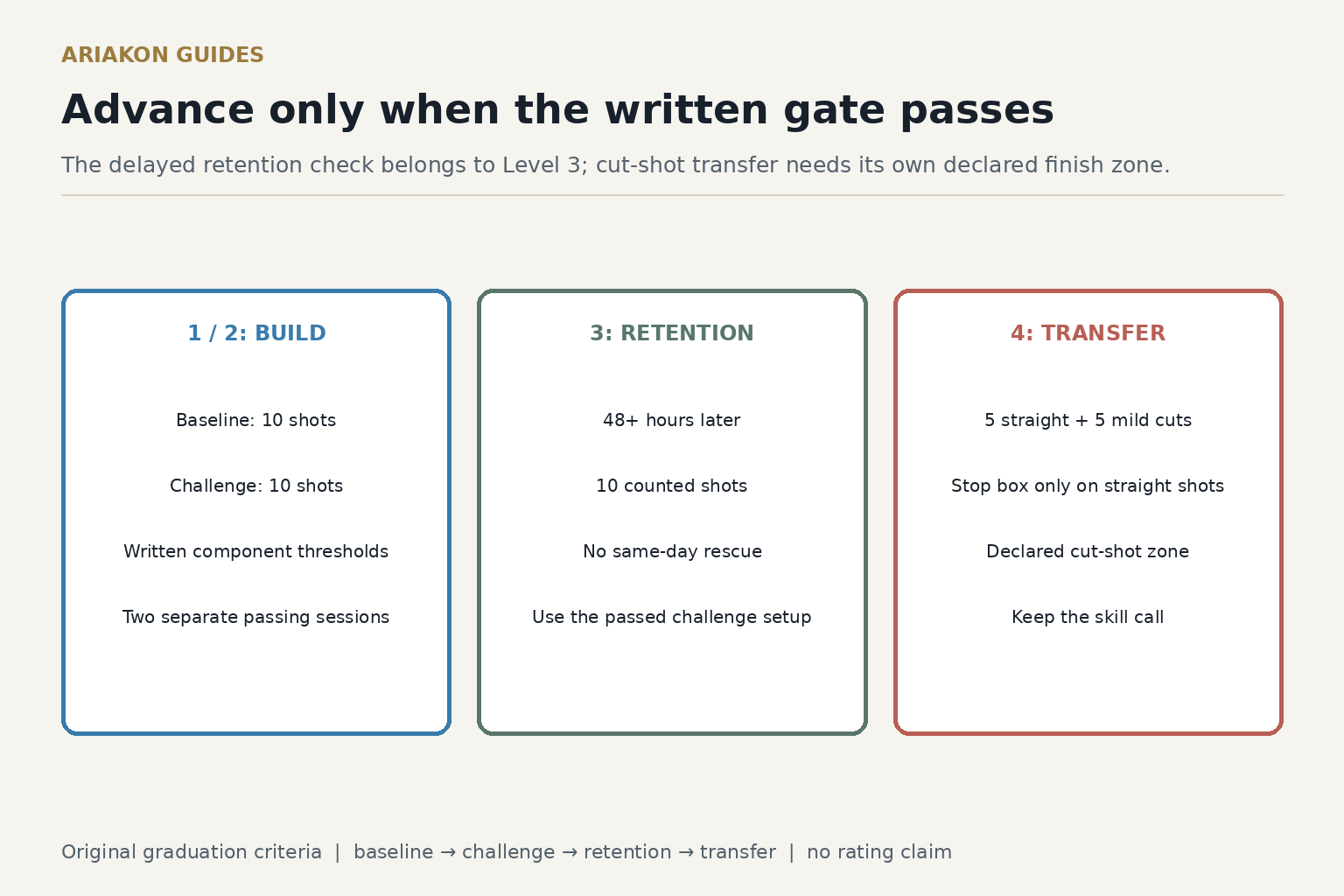
Use a straight stop shot as a worked design. At every level, mark the object ball one diamond from a corner and keep vertical-axis contact. Level 1 uses a one-diamond cue-ball distance and a one-ball stop box. Level 2 moves the cue ball to two diamonds. Level 3 repeats the passed level after at least forty-eight hours. At Level 4, alternate five straight stop shots with five mild cuts; before scoring, select and record a broad natural-route finish zone for each cut. A correct outcome means a pocket plus the stop box on a straight shot, or a pocket plus the declared cut-shot zone. Stop-box scoring never applies to a cut.
Change only the listed condition. Do not tighten the box, add speed and increase distance simultaneously. If the skill is not a stop shot, keep the same baseline-challenge-retention-transfer structure and replace the observable result.
| Level | Ten-shot pass | Promotion rule |
|---|---|---|
| 1. Baseline | 8 pockets, 7 stop-box finishes, 8 stable deliveries | Pass in two sessions |
| 2. Challenge | 7 pockets, 7 stop-box finishes, 8 stable deliveries | Pass in two sessions |
| 3. Retention | Repeat Level 2 after 48+ hours | One ten-shot set; no same-day rescue |
| 4. Transfer | Alternate 5 straight and 5 mild cuts; 7 correct outcomes | Keep skill call and process score |
Use counted sets and stop rules
Warm up with no more than five unscored attempts, then begin the declared ten-shot set. Every attempt counts unless the setup was objectively wrong. Stop after the denominator; do not add balls until the threshold is reached. Record pockets, cue-ball outcome and process as separate columns.
A failed set determines the next action, not the player's worth. If process passes but outcome fails, inspect speed and contact. If process fails, repeat the current level with one correction. If both pass twice, schedule retention instead of continuing until fatigue creates a worse result.
Make regression part of the design
| Evidence | Fallback |
|---|---|
| Miss pass by one outcome point | Repeat the same level next session |
| Miss process threshold | Return to prior passed level with one checkpoint |
| Retention fails | Two current-level sessions before another delayed retest |
| Transfer fails but baseline holds | Reduce variation; do not erase the baseline pass |
| Setup cannot be reproduced | Repair marks and definition before scoring again |
Worked example and program transfer
A hypothetical player passes Level 1 twice, passes Level 2 twice and then scores six pockets, five stop-box finishes and eight stable deliveries on retention. Process held, but outcome did not. The design calls for two Level 2 sessions focused on speed/contact before another delayed retest; it does not allow five extra shots to manufacture a pass.
To transfer the framework, write one progression each for pocketing, cue-ball speed and safety. Run only one scored progression per session and keep the other skills in ordinary play. Review criteria after four weeks, but never move a threshold after seeing today's score. External exams can provide broader assessment context; the local criteria remain transparent practice rules rather than credentials.