
Aiming · 3 min read
Build a Pool Aiming Reference You Can Verify at the Table
An aiming idea becomes useful only when you can rebuild the shot and check what it predicts. This guide does not crown a named aiming system. It helps you create one personal reference card for straight, medium and thin cuts, mirror it left and right, and record pocket entry so fortunate makes do not hide a biased line.
Choose one visual reference for the whole card
Pick the reference you can describe in one sentence and do not switch it mid-card. Center-ball, moderate-speed trials reduce variables but do not eliminate cut-induced throw, cloth effects or visual error.
The broad shot-alignment guide places body and cue on a chosen line. This card tests whether one aiming picture predicts three cuts after alignment is established.
| Reference | What is visualized | What must stay honest |
|---|---|---|
| Ghost-ball center | Cue-ball center at impact | The imaginary ball is not a physical target |
| Object-ball contact | Contact location on the object ball | Cue-ball center still must arrive on the correct line |
| Fractional overlap | Visible ball overlap from the shooting view | The fraction is a repeatable picture, not exact physics |
| Contact-to-pocket line | Object-ball path plus chosen cue-ball line | Throw and spin can change the result |
Build alignment from the floor up before testing the aiming picture.
Compare aiming methods with coded trials only after one reference card is stable.
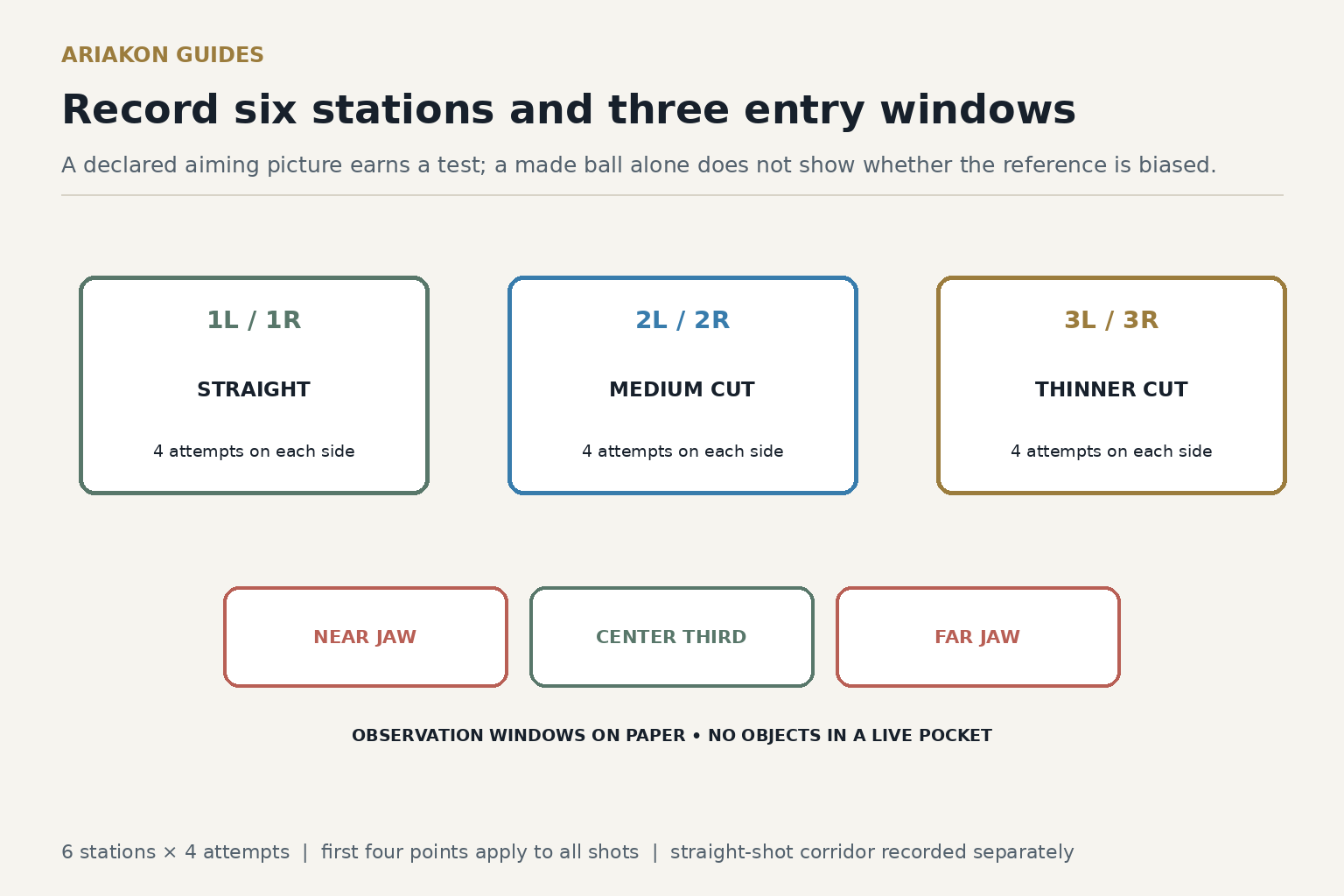
Register three stations and mirror them
Table dimensions and diamond spacing differ, so the card records centers rather than claiming universal cut angles. If a station is beyond your current reliable range, move the cue ball closer while preserving the left/right mirror.
| Station | Object-ball path | Cue-ball placement |
|---|---|---|
| 1L / 1R | Straight to left or right corner | One diamond away on the pocket line |
| 2L / 2R | Medium cut to left or right corner | Move cue ball one diamond sideways from straight |
| 3L / 3R | Thin but comfortable cut | Move another half diamond sideways |
| All | Object ball one diamond from pocket | Mark exact centers and retain one speed |
Score twenty-four shots by entry window
Shoot four attempts at each of the six stations. Draw three pocket-entry windows on the card: near jaw, center third and far jaw. Never mark the table or pocket. Record the observed entry, miss side and cue-ball lateral path.
Award one point for using the declared reference, one for no last-second steering, one for the object ball entering the center third, one for a legal make and one for the cue ball remaining inside a one-ball-width post-impact corridor on straight shots only. The first four points apply to all twenty-four shots; the corridor point is diagnostic at straight stations.
Turn a pattern into one bounded adjustment
| Observed pattern | Do not assume | Next test |
|---|---|---|
| Both left and right cuts miss thick | That every cut needs more aim | Check ghost-ball or contact picture at medium stations |
| Left misses thick, right misses thin | That the aiming geometry changes by side | Check vision center and walk-in symmetry |
| Center entry but cue ball drifts on straight shots | That aim is the only problem | Run a tip-contact and delivery test |
| Thin cuts vary widely | That one make validates the picture | Shorten distance and repeat four attempts |
| Entry changes with speed | That the original line is stable | Test throw and table conditions separately |
Worked card and retest
A hypothetical player makes 22/24, but sixteen balls enter through the near-jaw window and both thin right cuts miss thick. That is a biased reference despite the high make count. The player shifts only the thin-cut visual picture, leaves footwork and speed unchanged and repeats stations 3L and 3R.
The second block centers six of eight entries with seven makes. The player saves the drawing, date, table and speed as a reference—not as proof the picture will transfer to sidespin, long distance or another table.