
Practice planning · 4 min read
Build a Fifty-Point Pool Skills Checklist Without Repeating Generic Tips
A checklist becomes generic when every line says 'improve aim' or 'practice position.' This one gives ten observable five-point tasks, a fifty-point total and a drill-selection map. Use the score to plan practice; it does not certify playing ability, establish a handicap or forecast match results.
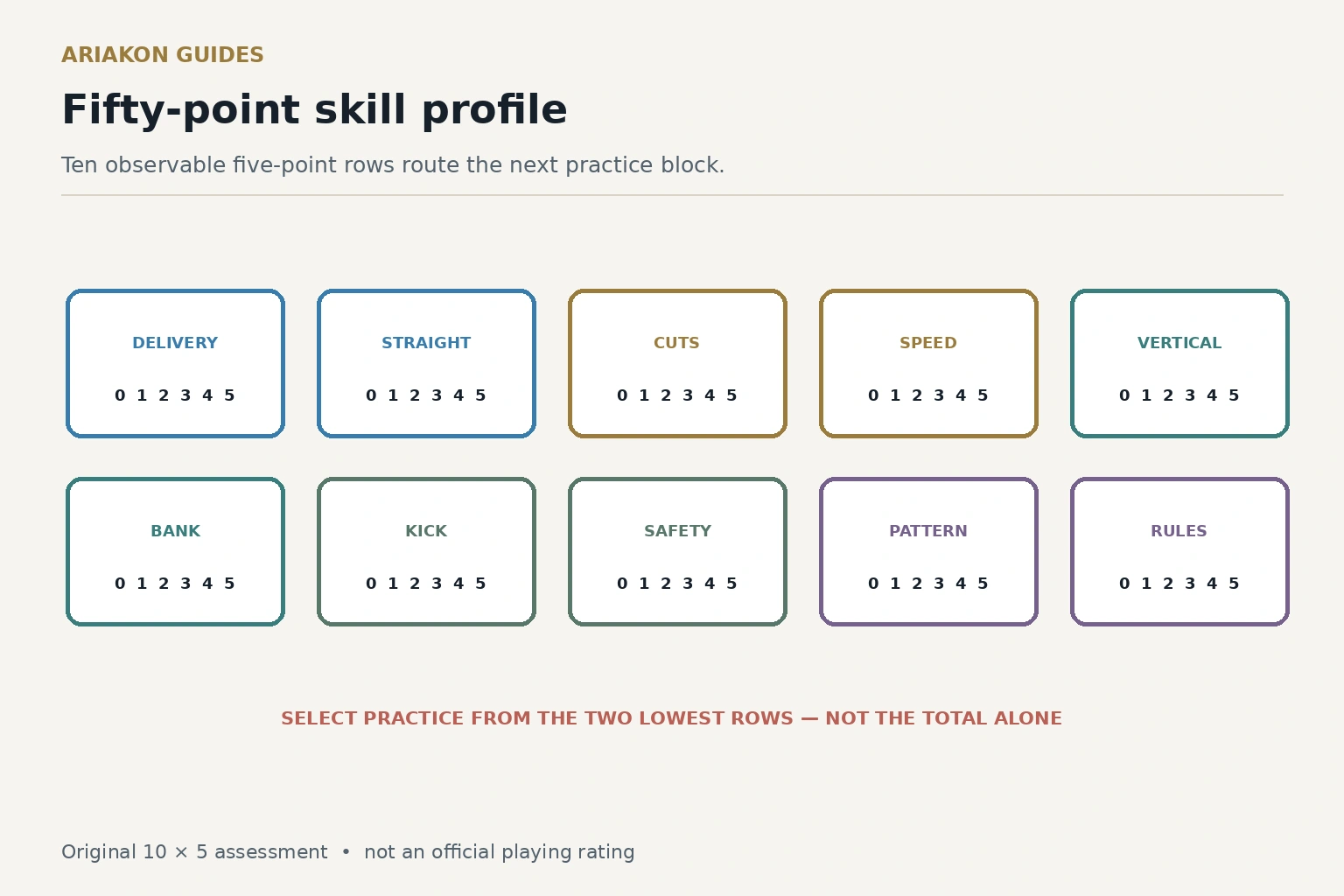
Use ten scored tasks instead of fifty slogans
Award one point for each successful attempt or satisfied criterion. Do not award partial points after a miss, and do not alter a listed setup after seeing a result; where the row prescribes different distances or cuts, freeze those five stations before starting. Record the table, date and equipment so later scores are comparable.
The ten equally weighted rows keep pocketing, cue-ball control and decisions visible as separate observations. This fifty-point worksheet has its own task definitions and no conversion to an external examination, diploma or playing rating.
| Area | Five-point task | Deeper resource |
|---|---|---|
| Delivery | Five center-ball strokes through a one-ball-wide gate | Cueing and pocketing workbook |
| Straight pocketing | Five straight shots from increasing one- to five-diamond distances | Cueing and pocketing workbook |
| Cut pocketing | Five marked cuts: 15°, 30°, 45°, 45° mirror and 30° mirror | Cueing and pocketing workbook |
| Rolling speed | Five called one- through five-diamond finish windows | Speed and spin workbook |
| Stun/follow/draw | One called stop, two follow windows and two draw windows | Speed and spin workbook |
| Bank | Five identical called cross-side banks | Banks, kicks and safety workbook |
| Kick | Five one-rail kicks with called full or half-ball contact | Banks, kicks and safety workbook |
| Safety | Five attempts to send object ball to a called rail and fully hide cue ball | Banks, kicks and safety workbook |
| Pattern choice | Five three-ball layouts with route and exit written before shooting | Patterns and match decisions workbook |
| Rules and review | For five layouts: name game/rules, then classify the outcome without rewriting the choice | Patterns and match decisions workbook |
Open the cueing and pocketing workbook for delivery, straight and cut progressions.
Open the cue-ball speed and spin workbook for rolling, stun, follow and draw targets.
Open the defensive workbook for bank, kick, contact-side and hide scoring.
Open the match-decision workbook for prospective route and review scores.
Read the profile before the total
Two players can both score 32/50 and need opposite plans. A player with weak delivery and strong decisions should not copy the schedule of a player with strong pocketing and weak kick/safety scores.
The total is useful for tracking the same assessment over time, but the row profile chooses the next drill. Never translate it into an official ranking or compare scores taken on materially different tables as if conditions were identical.
| Score in an area | Meaning for this setup | Action |
|---|---|---|
| 0–1 | The task is not yet a stable baseline | Shorten route or enlarge target; repeat the same five attempts |
| 2 | Some success, but failure dominates | Use twelve blocked repetitions in the linked workbook |
| 3 | Working skill with meaningful misses | Keep layout and add immediate outcome notes |
| 4 | Strong current result | Retest on another day before increasing difficulty |
| 5 | All five passed once | Confirm in a second session; one perfect row is not mastery |
| Total only | Can hide a zero behind unrelated strengths | Always select work from the two lowest rows |
Select a two-week plan from the lowest rows
Worked example: the player scores 4, 4, 3, 3, 2, 3, 1, 2, 4 and 4 for 30/50. Her total is less actionable than the profile: kick, safety and vertical cue-ball control are lowest. She schedules defensive contact first, short draw second and keeps her existing pattern work at maintenance volume.
If pain, vision change or a damaged table affects the test, stop and record the interruption instead of scoring through it. The checklist measures the session that occurred; it does not diagnose health or equipment.
| Step | Instruction | Example |
|---|---|---|
| 1 — Rank | Sort ten row scores from lowest to highest | Kick 1, safety 2, draw 2 are lowest |
| 2 — Group | Choose at most two linked workbooks | Defensive workbook + speed/spin workbook |
| 3 — Dose | Three sessions each week: 24 attempts on primary, 12 on secondary | Kick contact first; short draw second |
| 4 — Retest | Repeat only the selected checklist rows after one week | Do not wait for a full fifty-point test |
| 5 — Transfer | Add one mixed layout using the improved skill | Kick escape followed by a safety choice |
| 6 — Full check | Repeat all ten rows after two weeks | Compare rows under the same conditions |
Sources and further reading
References support the specific factual information above. The practical checklists are Ariakon editorial guidance.