
Bank pool · 4 min read
Bank Pool Fundamentals: Called Banks, Scoring and Basic Routes
Bank pool is a scoring game built around called bank shots, not simply a collection of cushion drills. A made object ball may fail to score if the wrong pocket or cushion path was used, another object ball interfered, or the local rules require a different call. Agree on the rules first, then practice three basic routes with separate geometry and scoring records.
Freeze the rules card before the first rack
Current World Pool Association rules define a short-rack form with nine balls and a winning score of five, and a full-rack form with fifteen balls and a winning score of eight. A valid bank requires the called object ball, its one or more cushions in order and the called pocket. The cue ball must contact that ball before another ball or rail; the called ball may not contact another object ball, the cue ball a second time or an uncalled rail, and the shot must contain no foul.
Each valid bank scores one point. Additional pocketed balls do not count and are spotted after the turn. Standard fouls cost one point, may create an owed-ball marker and pass play. Confirm the event document because administrative procedures can still vary, but do not replace the governing bank-pool rules with a familiar call-shot convention from another game.
| Item | Write before play | Why it matters |
|---|---|---|
| Rack | Nine-ball banks or full-rack banks | Short rack plays to five; full rack plays to eight |
| Call | Object ball, cushions in order and pocket | An uncalled route is not a valid bank |
| First contact | Called object ball before any rail or other ball | Rail-first and wrong-ball-first attempts fail |
| Clean path | No other object ball, second cue-ball contact or uncalled rail | Incidental pocket-jaw contacts are treated by the governing rule |
| Foul penalty | One point, inning end and required spotting | A player without a scored ball can owe one |
| Extra balls | Spot after the turn | Only the valid called bank scores |
Build a one-rail bank baseline for speed and table calibration before scoring a rack.
Calibrate bank speed before adding spin when the cushion response changes.
Learn three route names
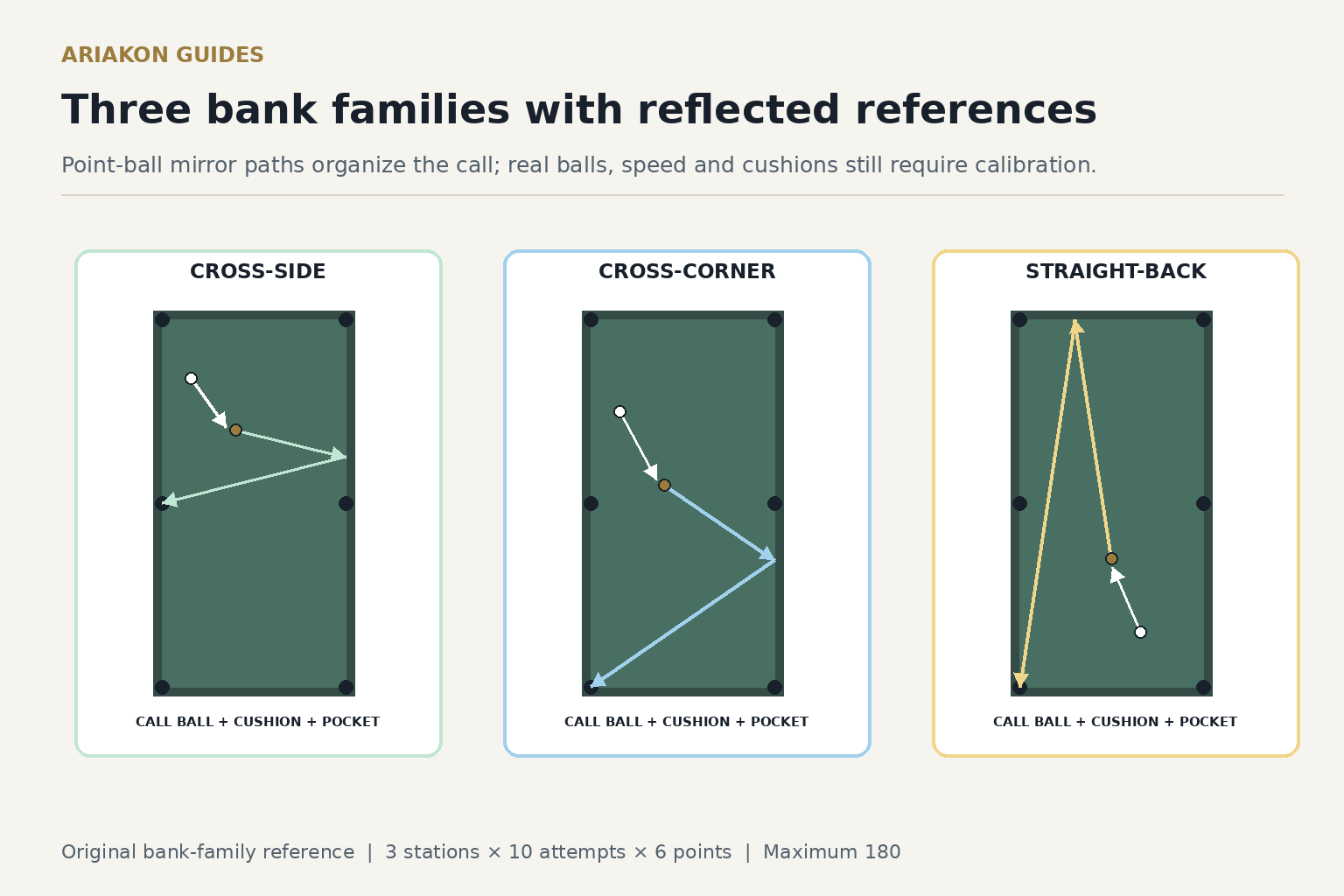
Names communicate the intended path, but they are not aiming systems. Place the object ball on a diamond intersection, mark the cue-ball start and use center ball first. Call the route aloud before lowering into the shot.
| Route | Object-ball path | Practice pocket |
|---|---|---|
| Cross-side | One long cushion into a side pocket | Opposite side |
| Cross-corner | One long cushion into a corner pocket | Diagonal corner |
| Straight-back | One end cushion into a corner pocket | Corner behind the shooter or opposite end by call |
| Two-rail | Two named cushions into the called pocket | Call the complete path |
Run a thirty-shot legal-bank circuit
Adjust a starting point by one ball width if the table's spots or pocket geometry make the written placement impossible, then retain the adjusted layout for all ten attempts. Do not add sidespin to rescue a miss during the first circuit; record short or long relative to the called pocket.
| Station | Setup | Attempts |
|---|---|---|
| A — cross-side | Object ball one diamond from a long rail; cue ball two diamonds away | 10 |
| B — cross-corner | Object ball near table center; cue ball creates a comfortable cut | 10 |
| C — straight-back | Object ball one diamond above foot spot; cue ball one diamond to either side | 10 |
| All | Mark exact ball centers and keep one medium speed for the first block | 30 |
Score legality before pocketing
A pocketed ball earns the pocketing point only if the preceding legality points are also true. This prevents a lucky route from being recorded as a repeatable bank-pool score.
| Point | Requirement |
|---|---|
| 1 | Ball, pocket and cushion path called before the stance |
| 1 | Cue ball contacts the intended object ball first under the agreed rules |
| 1 | Object ball reaches the intended cushion path |
| 1 | Called ball contacts no other ball, the cue ball a second time or an uncalled cushion; no foul |
| 1 | Called ball reaches the called pocket |
| 1 | Result is recorded as point, spot, miss or penalty |
| Maximum 180 | Thirty attempts across three stations |
Worked rack and next practice decision
A hypothetical player pockets six of ten cross-side attempts, four cross-corners and five straight-backs. Two cross-corner makes used a second cushion that was not called, so they are recorded as spotted balls rather than points under the chosen rules. The legal results are 6, 2 and 5—not fifteen makes.
The next block repeats cross-corner at the same speed, moving the aim by a quarter-ball reference only after three misses show the same long pattern. Once the baseline stabilizes, play a short practice rack to the agreed count and maintain a points-owed line for fouls.
Sources and further reading
References support the specific factual information above. The practical checklists are Ariakon editorial guidance.