
Decision skills · 3 min read
Avoid Unforced Pool Errors With a Before Shot Checklist
An unforced error is not every miss. Here it means an avoidable omission that was visible before the stroke: the wrong legal target, an ignored scratch line, no next-ball zone, an unacceptable miss or an undecided plan. The CLEAR checklist catches those omissions while standing. It does not guarantee execution or diagnose why a well-chosen shot missed.
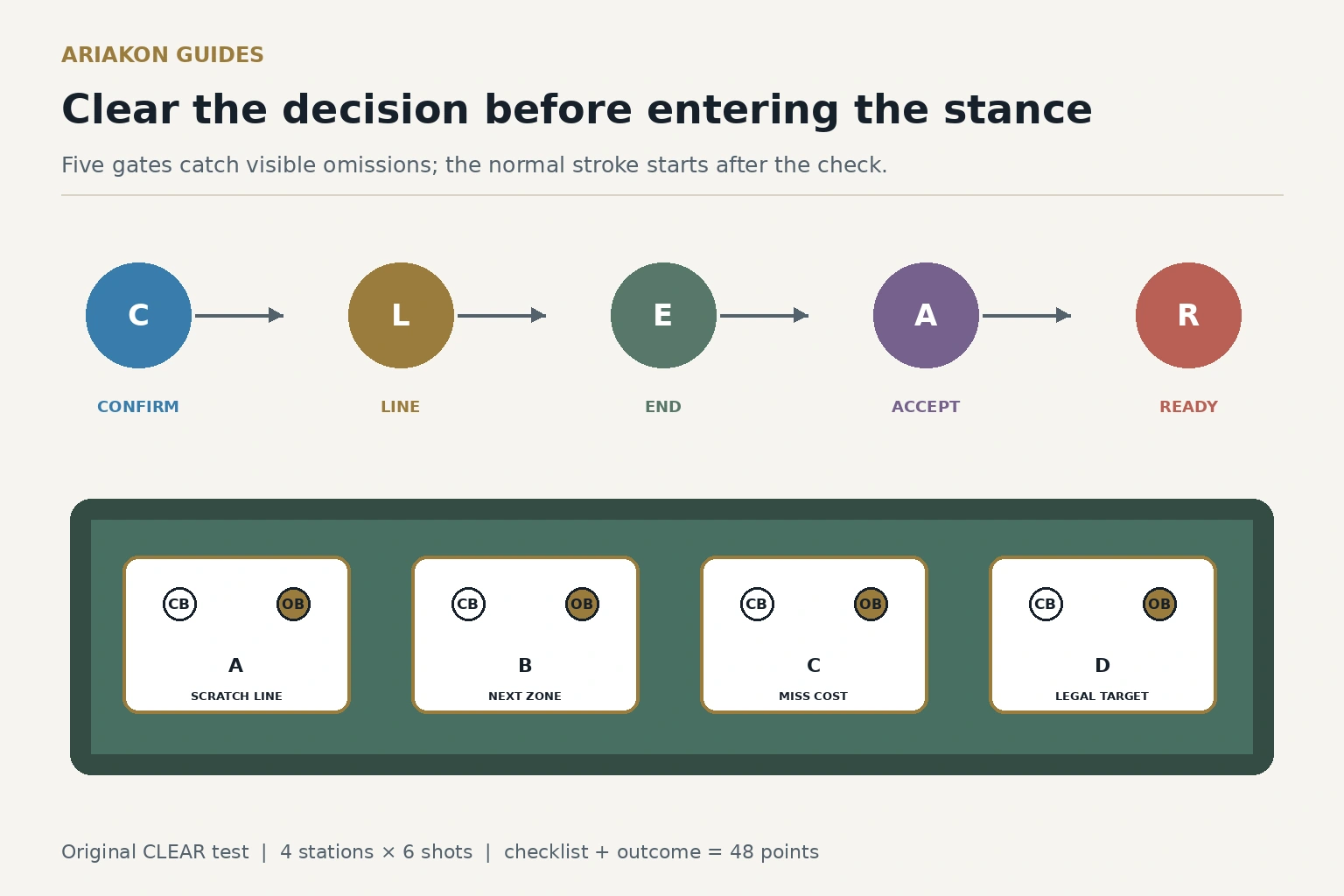
Use five CLEAR gates before lowering
| Gate | Standing question | Pass evidence |
|---|---|---|
| C — Confirm | What target, pocket or safety is legal now? | Active rules and called intention agree |
| L — Line | Where can the cue ball scratch, kiss or cross danger? | One path traced past contact |
| E — End position | What broad cue-ball zone supports the next decision? | Zone or containing finish named |
| A — Accept the miss | What does the opponent receive if this fails? | Offense, safety or two-way choice survives the comparison |
| R — Ready | Are speed and tip contact decided? | One plan stated before stance |
Compare full shot percentages when offense and safety deserve a deeper analysis.
Use the nine-ball decision check when lowest-ball and rack-order rules are the specific risk.
Keep the checklist outside the stroke
CLEAR is complete before the stance. Once the shot passes, use the normal pre-shot routine and one familiar execution cue at most. If the view from down reveals a changed fact, stand up and run only the affected gate again.
Do not turn CLEAR into five swing thoughts. The checklist selects the shot; it does not direct the cue through contact. A missed but fully checked shot is an execution result, not automatically an unforced decision error.
Run four six-shot stations
Before each attempt, say or write the five answers. Reset the first three stations exactly; vary the fourth through six prewritten cards. Do not rescue a weak answer by changing the layout after lowering.
| Station | Layout | Primary omission exposed |
|---|---|---|
| A | Straight stop shot with a nearby side-pocket scratch lane | Line |
| B | Medium cut with two possible next-ball zones | End position |
| C | Makeable shot with a costly open-table miss and a broad safety | Accept the miss |
| D | Game-specific layout with a legal-target or call requirement | Confirm and Ready |
Score omissions separately from outcomes
Track which gate failed even when the ball was pocketed. A fortunate make after skipping the scratch check is still a checklist failure. Conversely, a miss after a complete sound plan can earn the checklist point and direct the next session toward execution rather than decision overload.
| Point | Award when |
|---|---|
| Checklist point | All five gates are completed before stance |
| Outcome point | The called object-ball, cue-ball or safety result is reached |
Worked example and match transfer
A hypothetical player scores 21/24 checklist points but only 15/24 outcomes. All three checklist misses occur at Station C because the player notices the easy pocket and never compares the sellout. The next practice block keeps normal shot-making work but rehearses the A gate with one offense-versus-safety sentence.
In a match, the player uses CLEAR only until the shot choice is made. On routine open shots it takes a few seconds; on a real risk decision it can justify standing longer. The whole-match checklist handles equipment, conditions and interruptions. CLEAR begins when one table decision is ready to be selected.
Sources and further reading
References support the specific factual information above. The practical checklists are Ariakon editorial guidance.